

“Shortly after his first birthday, Paul Gaugin was bundled aboard a ship called The Albert, to sail some 12,000 miles from the French port of Le Havre to Peru.”
The Peru link above is not insignificant. This book was sparked and is informed by the discovery of Gaugin’s private diaries Avant et Apres in 2020, now safely ensconced in the Courthauld Institute in London. These are not diaries in the sense of Tuesday, had tea with the vicar. These are 200 pages of handwritten scrawl in the last couple of years of his life. They are a testament. The gospel according to Paul. That men might live by different values. Their first-hand dynamic fills these pages with as much colour about his life and thoughts as his paintings. Interpreted by a skilled biographer in Sue Pridaux, the result is revelatory and valedictory.
One thing about Gaugin that most people agree on is that he was the Man. Degas bought his paintings. Matisse followed his style. He was there the night Van Gogh cut his ear off. He had visions beyond his canvases. The diaries were an attempt to put down in ink rather than oils.
A lot of what we presume to know about Gaugin comes airily from a fiction in Somerset Maugham’s A Moon and Sixpence, written in 1919, sixteen years after his death, and two films one in 1942 and the next in 1959. Re-reading the Maugham story, it is strikingly Colonel Blimp, an after dinner conversation, pass the brandy, old boy. You know that chap, the stockbroker who gave it all up and ran off to the south seas to paint dusky maidens. Probably gave them all the clap.
The myth might stick but Maugham does not even give Gaugin his real name but passes him off as one Roger Strickland. He opens with the notion: “I confess” as well he might, “I never for a moment discerned that there was in him anything out of the ordinary.” You are on your own on that one, Somerset.
Prideaux pretty much blows all those cobwebs out of the corners of our cultural consciousness. For a start, Gaugin did not give up a career in the stock exchange, rather the stock exchange gave up on him when it crashed and left him penniless.
Rather than the wasted absinthe drinking philanderer, Prideaux paints a visionary of the south seas seeking a religious message of an untouched Eden, of a purer primitive existence unsullied by the decadence of colonial Europe.
The Peru of the opening lines is salient, an influence Gauguin never fully relinquished. He was, or saw himself as, the little savage from overseas even when locked up in a French lycee. He never felt comfortable at home in the Republic, or even in his adopted Brittany where he was revered at the time by fellow artists and even now is part of the area’s iconolatry.
Prideaux’s other great asset here is that she knows her art. She wrote a biography of Munch. Her godmother sat for Munch. She has also written biographies of Strindberg and another on Nietzsche. I have not read those but I doubt they will have the same passion as we have here. As we progress through the book Prideaux falls in love with her re-construction, and not really in any dry academic way. She becomes the muse, for us, a century later. And it is easy enough to explain because we have the art.
Through her lens we see Gaugin as the artist starving himself in his garret, working without a patron or sponsor. Yes, he had Van Gogh’s brother Theo as his agent for a time, and yes other artists, as was the way, might buy up his works, Degas in particular was a collector. Rather than the image of a stockbroker the indelible picture here is of Gaugin as the seaman and sailor, six years in the merchant navy, learning the rough arts of the sea and eventually making the grand journey south to Polynesia more than once, each trip taking two months and more and being nearly 10,000 miles apart.
And slowly this life unfolds, at first through diligent straitlaced research. His family were friends of the south American revolutionary Bolivar, his grandmother was a noted Communist and feminist Flora Tristan. His mother Aline was also of a person of danger as far the republic was concerned in France, but here immediately Prideaux steps in with a little personal aside pointing out that after two children in quick succession “her hands had been more than full of babies” rather than political chicanery. When the boy Gaugin returns to his grandfather’s house in Orleans outside Paris he finds a ‘gloomy and glaucous” welcome.
After his mother’s death he is taken in by the art collector Gustave Arosa who had his own collection of paintings by Delacroix, Millet and Corot. Impressed, the young man started collecting works by Manet, Cezanne and Monet and apprenticed himself to Camille Pissarro, he was on the way….the start, arguably of the modern in art.
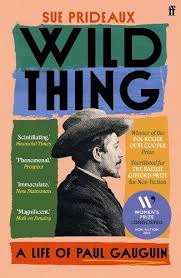
In this Faber edition, his paintings are carefully positioned to match the narrative. Their colours, those backgrounds, political place holders, religious riddles… combine to wonderful effect. The papeback edition has a slightly different take on the cover image, which is interesting in itself, all hat and respectable pointed beard:

 101 Great Reads