
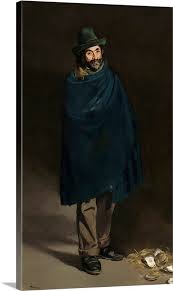
Andreas Ammer might have benefited from reading my own Oyster a Gastronomic history before embarking on his operatic ode to the world’s oldest and most iconic shellfish. He does, I admit, show a masterly, gynaecological, Germanic interest in the sex changes of the mollusc before he launches into an empirical conjecture as to whether the oyster – in a natural history sense – is more important than us humans – an argument that might have more verve if we stopped polluting their shoreline habitat.
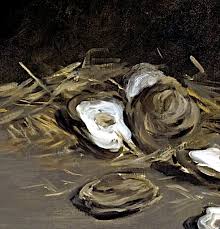
But, but… there is a wonderful portrait by Manet at the front of the book – above – Beggar with Oysters, which in a way says more than any words. Here ostensibly is a man on the cusp, and at his feet are a pile of newly shucked oysters lying on straw, the oyster gleaming seductively up against the dark clothes, at that moment where it has just been opened, exposed as is, we presume, the man. But, but… on closer inspection this man is maybe not so much a beggar – his hat is felt, his beard trimmed, his cloak velveteen, the shoes are used but serviceable, his hands are inside the cloak, not supplicating, so maybe not so much a beggar, but maybe a gentleman on the cusp, confronting his mortality as is the oyster. Both maybe discarded on the floor, as if thrown away. The shadow also shows that this is a studio portrait, so the message is deliberate. But, but… a little research reveals it is in fact one of three portraits by Manet held at the Art Institute of Chicago, the others being Beggar with a Duffle Coat – where the hands are revealed and indeed supplicating but no oysters here – and another the Ragpicker, where again there is a rubble of detritus by the feet, including, just, the shell of an oyster.
In the Beggar with Oysters the man’s clothes are painted in the kind of sumptuous dark textures that Manet might have used for a society portrait of someone’s wife, quite feminine on inspection, but, but…on the Ragpicker the white shirt and blue trousers have all the vivacity and loudness of a Joaquin Sorolla painting, who was a bit younger than Manet but might also have known about the Spanish connection. For, for… Chicago says they were inspired by a series of paintings by Diego Velasquez from 1638 representing story tellers as humble beggars in Greece…
I don’t hold with Ammer’s views on gastronomy and the oyster, but I am with him on the genius of Edouard Manet and the oysters unspoken but frequent role in art.




 101 Great Reads