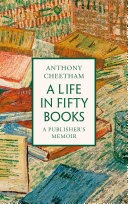
A Life in Fifty Books by Anthony Cheetham (Head of Zeus)

I am not inclined usually to fall for this kind of congratulatory memoir. But this is Anthony Cheetham, publisher extraordinaire.

He has brought many books to market down the years from Frank Herbet’s Dune to Michael Connelly’s Bosch detective series. He has popularised history with Antonia Fraser and latterly much science and science fiction.

There is a photograph of his library in a converted barn in Oxfordshire. It looks like a set for a Stephen Spielberg film called The Dictionary.

Themes, as he says, are: “History is a looking glass to make sense of the past. The Sciences define our understanding of the cosmos and formulate projects for the future. Fiction is the playlist of what it means to be human. Philosophy is the spirit of the wisdom that binds them all.” And they are all here.

We start with Homer and then Tolkien and even Donald Trump, who did not write or even read the Art of the Deal but Anthony is also a deal maker. The recommendations are trite and sweet – not to compete, perhaps, with the authors but room enough to say thank you to everyone who has helped along the way.

Sadly quite a few of the books are out of print or no longer easily available, even on Abe books. I really want to read Aime Tschiffely’s Southern Cross to Pole Star, first published in 1982. And quite a few others.  I reviewed one of his favourites here:

For a publisher I might point out someone was struggling with their InDesign techniques on the layouts, and £25 for 200 slim pages is pushing the boat out a bit far.

But it is hard to argue with someone who was instrumental in bringing the likes of Kingsley Amis, Ben Okri, Ian Rankin to print, who revived the reputations of Thomas Mann, Joan Collins and even Christopher Wood, aka Timothy Lea for Confessions of a Window Cleaner. And others, for example the novelisation of the film Alien by Alan Dean Foster.

Across 75 years, one can only wish there were more individuals like him with the vision to champion great writing through a corporate world. Chapeau.

Posted in 101greatreads, Biography | Tagged , , , , , , , | Leave a comment

The Fraud by Zadie Smith

The trigger for this exhilarating romp through literary Victoriana was a sale at the auction house of Sotheby’s. A first edition of Charles Dickens’ Christmas Carol sold for a record sum. The inscription was to a Mrs Touchet. Meet Eliza.

Mrs Touchet herself is less than impressed by Mr Dickens, smarting at his usual jibe of touché, Mrs Touchet, a joke no one else laughs at. Her affections are for rival author, less well known today although you can find him for 99p on Amazon as Harrison William Ainsworth.

Perhaps the set up, the number of pages, 454, suggests a soporific Victorian melodrama, but that is one part of the conceit, the joke. Mrs Touchet does not do the melodramatic.

We are in London from 1830 onwards. You can almost taste the flavor of the old city. Gentlemen ride on Willesden Green, Kensal Rise is home to this literary salon.

Zadie Smith beams her heroine into this fusty salon of port sloshing tyros. She is the Mrs Touchet, aka Eliza, aka the Targe, depending on her company.

“She thought of herself as having several faces on show at different times to different people…”

She has modern sensibilities. She is housekeeper, muse, amour, dominant, flirt, but mostly a woman of little means in a society where men have all the means.

The shape shifting of fortunes cloud the background like the weather. Every short chapter-ette is change. It is news. The story shuffles slyly, leaping from one decade to another and back, from private to public, from scandalous to sedate.

The Fake of the title applies to more than just the main court case. Eliza is something of a social detective picking over the dilemmas of the time. The humour is Dickensian:

“They found Crossley and his sizeable belly in a quiet corner, wedged between the wall and table, already encircled by half a dozen dishes.”

We have the creaking, litigious, greedy machinations of old money, of inheritance, the passing of power. Slavery has just been disenfranchised itself, a few Africans arrive in London, there is civil war in America, the cotton mills of Manchester are grinding to a halt in protest. The empire is decaying.

And so is the house – the library floor has collapsed under the weight of books, Eliza is

abandoned by her husband, she pleads with cousin Ainsworth to take her in, he has married well but her father is now bankrupt. The good natured Ainsworth is furiously writing the next novel to keep them all afloat.

And then we have the Claimant of the title, the fraud although many of the people are frauds in their own ways, but The Tichbourne case is the cause of the moment – the heir to the estate thought lost at sea reappears to claim his inheritance. But is he real or a charlatan? A noble lord or a butcher from Wapping?  The Old Bailey is convened to decide, which becomes a riotous vaudeville.

Eliza bears witness, sharing her intimate thoughts, she confides, she whispers, she chides…

The second wives are voracious, hungry to spend the fortunes of empire:

“In mercantile matters – as in all others – the two women proved ill-matched. Eliza had a sharp eye for shoddy craftsmanship, political sympathy for the working man… Sarah had no sense of housekeeping in particular, not of money in general.”

Like some Greek chorus, the public voices intrude on Eliza’s private thoughts – the suffragettes, the mob and then even the handsome Andrew Bogle, the Claimant’s African man, descended likewise from tribal elders, disenfranchised likewise, to slavery in Jamaica, and now to speak for his master, their fates bound together, Jamaica itself abandoned while the lawyers decided who can run the farm, who owns the crop, who wields the whip, who inherits. No slavery, just dissolution.

Posted in 101greatreads, fiction | Tagged , , , , , , | Leave a comment

Death in Pont Aven by Jean-Luc Bannalec

THE light first drew artists to the north west of France. Most famously it was Gauguin and his portraits of girls in clogs and costumes, one of many.  Pont Aven, a sleepy one church town on a creek was where they would meet up. The town gave its name to a school of painting. They also named the nearby beach Tahiti in Gauguin’s honour.

This most westerly part of France was largely overlooked before the new railway brought the painters. It was a long way from anywhere, somewhere north of Bordeaux, west of Normandy. They drank cider, not wine. It was its own country until a few centuries back, known only in tales from sailors of the terrors of the bay of Biscay. This was Asterix and Obelix country.

But the vistas, especially the sunsets of open sky and sea, painted by artists from Robert Wylie (who died here) to Van Gogh to Monet brought tourists. And then readers of the first of what has become a series and TV starring Commissaire Georges Dupin. This first book sold seven million copies.

Dupin, newly arrived from Paris where he has been demoted to this unexplored, ragged landscape with huge forests, finger-like creeks, the blue city at Concarneau,  huge tidal swells, magic islands, prehistoric memorials of menhirs and dolmens, and legends. To the Romans Finistere was literally the end of the world, to locals in their own dialect “Penn ar Bed ” – the Beginning of Everything.

Just how impenetrable some of this culture might be is plain in the place names that smack of a language beyond even Gaelic – Quimper, Douarnenez, Kerfany.

Jean-Luc Bannalec is an adopted son of Brittany, a German publisher turned author writing under a pseudonym that he took from a village outside of Pont Aven. His real name is Jorg Bong. What sets him and his alter ego Dupin apart from other detectives-set-in-foreign-places is his understanding of the area. He has even written a guidebook, and a cookbook. And now nearly a dozen novels, each set in a different part of the region. Pont Aven was where it all started.

Inspector Dupin is still regarded as a foreigner by the locals. He is in search of the soul of the region. A naïf even.  His inspectoral team do their best to bring him up to speed because this not a region that is really very comfortable with the idea of being a part of France at all.

It is somewhere of  “enchanting landscape…traces of mysterious eras…untouched and unspoiled.”

At each turn there is another glance at the landscape – ”a stunning long dazzlingly white beach…”the entrance to the harbor with the little lighthouse and the buoys bobbing sleepily in the groundswell….””you could hear the sound of falling water all over Pont Aven.”

Dupin has an ally to initiate him in this new land, his secretary the formidable Nolwenn, a native Breton, still suspicious of anything French. She instructs him in all things Breton: We grow more artichokes than anywhere in the world, we have the second biggest tidal range of anywhere, we have the most varied traditional costumes of anywhere – 1266 in all – and we have 770 saints etc.

And we have a murder.

A reputed hotelier has been stabbed in his front room. Aged 91. And not just any hotel but the Central, the first stop for all the painters arriving by train…. The hotel was founded by the victim’s grandmother Marie Jeanne in 1879, much of which, if not all, is true.

Like all great detectives Dupin has his foibles. He needs his shot of coffee to think. He does not like going on boats. He writes his notes diligently in a red Clairefontaine notebook. He needs to go for long walks around the great coastal vistas, to think, to deduce. He likes his food. He likes his old blue Citroen DX.

The clues come slowly: the son, the wife, the brother. “The drama was still playing even if they could not see it”.  There is concern from the mayor worried about the tourist season (shades of Jaws), and higher up,

Bannalec weaves all this together with good humour like he might have been sitting on the dockside waiting for a ferry. There are unashamed nods you might conject to the interrogation techniques of Columbo, the pensive thinking of Morse, the inspiration of Sherlock Holmes, the whodunit sagas of Agatha Christie, even the pastures of Thomas Hardy, but Bannalec does the genre with elan. He is a good storyteller, his plotting is clever, his characters have bite, the vistas bristle, the changing weather mirrors the mood of the investigation.

And much of this is real enough. Even the Amiral café is a real cafe and has a menu now dedicated to Dupin (and one to Maigret who also had an investigation here the Yellow Dog). The painters and the caffe Central are also part of the local folklore. As is Flaubert who has a rock named after him around the bay where he liked to sit.

The wrongdoing is so much needlework pulling together patchworks of suspicion, of local politics, of rural intrigues. It is a proper novel. Crime in its proper setting. In the community. Georges to the rescue. Brittany to the fore.

Posted in 101greatreads, fiction | Tagged , , , , , , , | Leave a comment

Regenesis by George Monbiot (Allen Lane)

“It’s a wonderful place for an orchard, but a terrible place for growing fruit.”

LIKE all good horror stories we start out slowly, the John Carpenter cruise around the suburban neighbourhood, albeit in this case we are digging in George’s back garden or what he calls his orchard. The title does not do this book justice. It might have been The Shit We Are In.

Monbiot’s arguments are elegant and polite and beautifully constructed, but just to ram home his message, let us write it out in tablod neon: The Global Food Machine, fed by the Global Agriculture Machine fed by the Global Drugs Machine fed by the Global Banking Machine supported by The Global Property Owners Club Ltd is destroying the planet.…Agriculture is not about farmers anymore, but it is about anonymous global corporative interest. It is capitalism gone bonkers.

You only need to read the labels on the supermarket packaging to see the influence of a small number of ingredients – principally soy and corn – to find the evidence. Worse than that, as Monbiot illustrates, is that we now grow more food to feed to the cattle, pigs and even chickens than we do to feed ourselves. All so the industry can support the likes of Kentucky Fried Chicken and other Global Food Brands. And these chickens are leaving a dirtier footprint on the planet than we do.

In this context government is impotent. Politicians and civil servants misunderstand what is going on, and as Monbiot illustrates again with stunning examples, where governments have tried to intervene it has usually been disastrous.

What this book lays on the line is if you want mass cheap fast food, this is what you get…erosion and destruction of the soil we depend on, a one way ticket to Armageddon, something that has already arrived for many species, like the brown trout, the barbell, the Wye salmon. All those pretty sheep grazing on the Welsh hills, have unfortunately also turned the pasture into a dead zone, paid for by the EC grants.

The brilliant Diane Purkiss – whose English Food I reviewed last – categorized ’s historic misunderstandings of how the food chain works (or does not) but here here we have the other side of the same coin, the up to date inventory of destruction. Do I believe Monbiot? Yes I do because I have written about it for 40 years.

His great achievement here – and this is a book with very nearly 100 pages of notes and references to back it up – is to harness all these Big Thoughts and put forward what is a Global Argument – the importance of diversity, the importance of weaning ourselves off an agriculture that is meat dependent, that is grant dependent, that is grubbing up not just the UK countryside but the Amazon, the rain forest, chunks of Argentina, more forest in Poland etc etc. These guys are out of control. Big agriculture is very bad news for everybody. We need to go back to local and small holdings. Before it is too late. But maybe it already is too late…

The truth, as he accurately diagnoses, is:

“Long distance trade and mass production favour transnational corporations and accelerate the homogenization of the Global Standard farm.”

The answer for Monboit lies in the soil.

Posted in Biography | Leave a comment

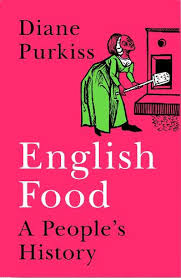
English Food by Diane Purkiss (William Collins)

“If historians and readers think they know exactly when food culture in England was stable and not subject to the fickle whims of fashion, they tend to finger breakfast as the changeless moment.”

FROM the opening paragraph, above, Diane Purkiss lets on that she is about to blow up a lot of the myths that surround our food culture and the role it has played in our politics and lifestyles. Followers of Elizabeth David and Jane Grigson be warned.

A remarkable book, scholarly, entertaining fascinating, an update really of Dorothy Hartley’s magnificent Food in England first published in 1954. Purkiss is extraordinarily well read, articulate, entertaining, thorough. Drawing from a towering mass of read research, she sets out a startling, informative portrait of what we ate in England (not Britain) or at least what was written down. The sub title is the People’s History, even if most of her witnesses are very literate, upper people. Breakfast she redefines, almost in abstract, as toast, a class declension of the poor servant sweeping out the grate, making the fire, holding fork to the flames and passing up her toast for buttering or even occasionally jamming by her betters. Another poor woman does not butter her fresh bread because the fresh bread is too soft, but toasts it a few days later when she can afford to light a fire at all.

In the introduction Purkiss compares dinner at an Oxford college, the feast for the men of partridges and sprouts, to the “gravy soup” endured by the young Virginia Woolf for the women at a Cambridge college. From here she goes under the skirts of convention to strip bare the many presumptions that surround what we eat and why, covering most aspects from fish to milk to cake and back again. Lunch gets a proper, awesome dissection of its own. She explains why houses in Whitby were built with whale bone rafters and who makes/made the money from whaling. And there are instructions for fly fishing – the favoured sport of clergy – to include a rod cut from hazel or willow between Michaelmas and Candlemas. The thread would be white horse hair from a stallion or a gelding because mares tend to mess theirs up. Hooks were needles rendered in a flame.  She writes beautifully herself. This is a rogue carter bringing so called Epping sausages:

“Sent to London daily by wagon – a broad wheeled wagon, with a russet-coloured awning, a pair of farm horses in the shafts, and for a teamster a pippin-faced countryman, in a snowy smock-frock, and with turnpike tickets stuck in the band of his battered old beaver hat…”

Or here, concluding an argument about bread with this pithy thought:

“The need for bread also marked the people’s first attempts to speak politically, to protest about the price paid for grain, the price of their aching bellies, and some of them died for their words.”

Her approach is not specifically culinary but a broader political thinking on nutrition and impacts. Modern fast rising breads, eg the sliced loaf, she points out allow the gluten to stay in the bread in a way that would not have happened in the more traditional slower and longer fermentation. Intolerance is today’s disease where baker’s asthma was a condition from working in feudal unlit, unventilated basements. Working conditions may have improved, but ‘progress’ comes with its own backlash.

Mandatory reading for anyone involved – however peripherally because she throws her net wide to include farmhands as well as chefs et al – in what we now refer to euphemistically as the food chain, as if it were a piece of jewellery or a ball and chain, but which includes all of us, as consumers, and eaters. And I would add politicians and policy makers, although that is a big beast of a ship to turn around.

In the end she concudes, as did Napoleon, that the English were shopkeepers who turned into voracious traders. Brilliant.

Posted in Biography | Tagged | Leave a comment

The Black Echo by Michael Connelly (Orion)

“The boy couldn’t see in the dark, but he didn’t need to.”

How to write a best seller? Michael Connelly has sold 80 million copies of his books. This is how he began…

Bosch wakes from a Vietnam nightmare. The pager rings. There is a body down the pipe. First smoke of the day. First  Aspirins of the day. Uniforms are disturbing a crime scene. Sorry about that, says the sergeant. Already the jargon is flying – the ME, the SID, the hype, the spike, the DB = dead body. Bosch hitches up his Smith and Wesson 9mm, covers for his partner, moonlighting as an estate agent. Fill in some background, some LA scenery, sky blue, wisps of white, nothing over the top just a few social mentions of the drought and wondering who the damn was built for, a few smells of crops being sprayed.

He is a tough guy. Wiry say the newspapers. The ex-tunnel rat is going down a pipe again to find the body. Something is not right. This is page 11. Pathology arrive…

There are currently 25 Harry Bosch books. Plus another 12 including the Lincoln Lawyer and Mickey Haller. This was Michael Connelly’s first. Written in 1992. There are other reviews here and here and and here and here!

The style is more script than novel, a camera chases the action, thoughts are engrained, cliches burnished, dialogue combative.

Bosch is trying to get through to the station. He admonishes:

Somebody could die in the time it took to answer this phone. “Get me the duty sergeant.”

It is a small detail but already it tells us, on page 4, if we are being fictional detectives here, that Bosch has little truck with bureaucracy, with the uniforms and does not mind saying so. He has a higher calling. Death. Or rather the aftermath. Vietnam, LA what is the difference? This is the south and he is wearing a gun. The duty sergeant is not so much sheriff, but an old Gunsmoke Chester clinking the keys to the jail.

But also another perspective is already nailed – he is on call, he sleeps in a chair fully dressed, insomniac, stiff, going grey, 40 something, forgot to buy toothpaste. And that is one of Connelly’s great skills – he can ram in the details fast and loose so before you skip a chapter you feel informed. We know we are in LA. We know there are things going on. Things we can relate to. Or not. The dead man has a broken finger. Harry notices these things. He is the pivot around which everything revolves.

Do we care about the victim? Hardly, maybe only retrospectively. Harry is the now. We care that Harry gets it sorted, whatever. Murder, fine. Ordering a take-out, fine.

Harry has a back story. He has a mother too, she also has a backstory. Harry is not trying to date Hollywood starlets, he is down the pipe looking for a discarded half can of Coke that might have been used as a stove to cook some heroin. The whole Uncle-Sam-gets-the-job-done is loaded up in Harry’s pistol.

I have not, as yet, passed page 20…

The literary nuts and bolts are:

  • a journey around Los Angeles
  • a sequential set of clues
  • scenes drawn in dialogue
  • back story characterisation

Bosch was thrown out of RH – robbery and homicide – for being too tough.

We don’t get any pause in the unrolling of events, no storytelling, until page 68, when Bosch gets home and has a beer. Connelly allows himself a little extra colour, relaxing the text along with his hero with a little description:

“The setting sun burned the sky pink and orange in the same bright hues as the surfers’ bathing suits.”

And we get to know our man a bit more. By page 72 we find out why this book is called Black Echo. Connelly shies away from obvious titles. This is no Strange Death of H Meadows. Or Good Cop Down.

The plot then takes a mighty swerve. Woaw! And we have this wonderful piece of description about deputy chief Irvin Irving’s teeth, a portrait that might stand against any example of fine American writing.

We have moved into a different plane now, it is army v police enforcement. I still have not reached page 100…356 to go…

Apart from Thelia King, also known as King or preferably Elvis, in computer records, a few distant mothers and a blonde jogger, we have not encountered any women so far. Enter la femme on page 132. What can she make of this outsider, this rough diamond, this unreconstructed southern male? Is there a heart of gold or just the unreformed unreformable? Part three – woman v man. Quite how this going to break down has its own frisson, although we gather she can take care of herself…but now the balance is more about them than the deceased.

“Harry”, she says, “That’s speculation on top of speculation.”

“That’s what cops do,” he replies.

By page 199 we are offered a moral construct, the prison within the prison system, but this one  exclusively for the veterans. We get our man back. Even should they fall and get sent to goal, there is a prison farm for ex-vets to rehabilitate and straighten them out.

By this point, and maybe it is because over the years I have become, we have become as readers and watchers of TV detective crimos, hardwired. Person A is not going to survive. Harry will, he has other capers to assign. The villain is person B. It is a crossword puzzle. The key is in the box. It is a crime scene Sudoko. We are getting there. It can only be… and then we get a third swerve in the plot. We move from micro to macro. Woaw!!

Connelly has a habit, I won’t call it a device, of sometimes handing the camera over to another character for a few paragraphs or even pages, so you get to see inside their lives, their heads too. And then every now and then out pops a piece of A1 description:

“Porter could still wear a size 34 belt, but above it a tremendous gut bloomed outward like an awning…His face was gaunt and as pallid as a flour tortilla, behind a drinker’s nose that was large, misshapen and painfully red.”

When he wants. He can. Write.

We know now this becomes a series of Bosch books but at heart this original is a novel about the Vietnam veteran making his way back into society through police work.

Overshadowing everyone is the city itself. Los Angeles earns more character traits than its inhabitants, like it is a breathing mass, Wiltshire, Olympic, Robertson, Doheny might be round the corner.

And what Connelly is also masterly at is the action sequences, in one case he actually says it was like watching a slow motion movie reel. Or here:

“He was gripping the steering wheel at the ten and two o’clock positions, urging the car on as if he held the reins of a galloping horse.”

It is all very specific, mundane even, relentless and believable. We are in the front seat with him. We are drinking coffee with him. We are interviewing the suspect with him. We are in his head. Searchlights on. Brain ticking. Gun to hand. We are his silent partner in all things, except when he has to go to the wash room, which he does, rather occasionally. And as a former crime reporter for the LA Times, he knows his patch.

It may have spawned a series, but it is a grand novel in its own right, even if the ending is a little too forced, just a tad hammy, but Harry will drive you there in style, I might have taken a different fork in the road plotwise, but Harry’s driving.

Posted in 101greatreads, fiction | Tagged , , , , | Leave a comment

The honjin murders by Seishi Yokomizo (Pushkin)

“Before recording the strange history that follows, I felt I ought to take a look at the house where such a gruesome murder was committed.”

THERE is a masterly, writerly opening to this classic Japanese crimo. Yokomizo introduces himself as the crime writer who stumbles over a real life murder. It is a locked-room-murder theme, he tells us straightaway, styled after the author of that rather clunky phrase John Dickson Carr and followed also by other crime writers of the genre Gaston Leroux, Maurice LeBlanc, S.S. Van Dine and Roger Scarlett who have told similar Cluedo-esque tales. But none them, he tells us, can quite have imagined what happened at this honjin, an old tavern exclusively reserved for royalty and aristocracy. Later there is an interesting discovery of a library of detective books which also reference other writers of the pre-war genre.

So we proceed to the wedding from hell with a certain Japanese scrupulous focus on the gory but also a scrupulous forensic unpacking of the detective work; almost an algorithm of minutiae of process. This locked-room has secrets. These people have ancestry. This valley is full of gossip.

“There’s a suspicious smell in the air and it is getting right up my nose,” declares the uncle

Enter the unlikely looking detective Kosuke Kindaicho (whom this blog has met in a later incarnation here). Yokomizo acknowledges he has based him on his favorite British author AA Milne’s Anthony Gillingham in the popular Red House Mystery, a 1922 book (written more than decade before the locked-room epithet was coined and Milne’s only mystery story). This honjin has also been painted red.

Kosuke is the master of logic and reason, a Sherlock Holmes in a splash pattern dyed hakama with a stammer. And almost as eccentic. There are more than a few Holmes accents here including Kosuke’s drug use plus his magical powers of deduction.

Suspicions swirl. Each chapter has its own thesis as the evidence is slowly unravelled. The conclusion is complicated, but with nods to both Sherlock and to Agatha Christie. The cover photo above is from the Japanese version, both a clue and a red herring in itself.

Posted in 101greatreads, fiction | Tagged , | Leave a comment

Death on Gokumon Island by Seishi Yokomizo (Pushkin)

“Seventeen miles south of Kasaoka…is a tiny island, measuring barely five miles in circumference, its name is Gokumon-to, meaning Hell’s Gate Island.”

GIVEN what Hollywood has done to terms like Hell’s Gate, I am not sure the English translation applies here, more Gokumon might be the island of adversarial spirits and ancestors, a closed island that has survived the trauma of war but has its own sub culture, if you like by omission from the rest of Japan and the 20th century. I enjoyed this leisurely, rural Japanese crimo, for the wrong reasons, or at least not the reasons why it was first penned. This you might say is Japanese noir, 1945.  Seishi Yokomizo captures the clash of old and new as the war subsides, the moody countryside, the weather and the people on this small island where pirates still roam offshore and the macho fishermen are not quite as brave as they seem. Maybe the fanciful plot is secondary or even tertiary like one of those classic oil portraits where the face is fairly blank and all the interest is around it, in the clothes, the room and the view out of the window. Even the violence is totemic. Everyone on the island is nervous, not least of strangers. We meet the pretty, batty sisters, the priests, the divided family, the doctor, the jolly policeman, the gossipy barber, the tidemaster et al…and later we will even discover their ancestors. The dialogue is a bit manga so we get a lot of “Oh, but that is impossible!” but it works as scaffolding to hang all these various threads of the grand puzzle together.

Kosuke, an investigator, is back from the war, with a letter and mission, to the island where his best friend’s family are notables. He is prone to long silences while he is thinking, and scratching his head of thick hair. Each time bad things are coming his heart beats faster and when confronted by a victim he shudders and sweats. In crime scene analogy he is more Endeavour than Morse, more heartbroiled than hardboiled.

Yokomizo teases out through the conversations a bigger portrait of a passing society, customs are unpredictable, norms are at odds even probably to Tokyo readers confronted with this far outpost where past bonds, the temple and shamanic traditions still hold sway. The ending is suitably involved, colourfully imagined and elaborate. Yokomizo wrote more than 70 stories and died in 1981. This work just creeps in to the 21st century definition of this blog thanks to Louise Heal Kawai’s new and welcome translation. If you have read Guillaume Musso’s Secret Lives, then I will just say that his final denouement, is the starting point here…

Posted in 101greatreads, fiction | Tagged , , | Leave a comment

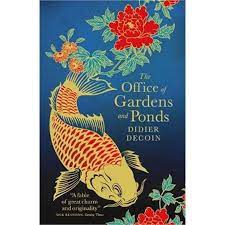
The Office of Gardens and Ponds by Didier Decoin (Maclehose Press)

“Following a long confinement and strict observance of the eating restrictions associated with bereavement….”

A STRANGE lash up of old Japanese folklore with Gallic machismo teeters on the edge of being a fine read full of intriguing descriptions and sparkling interactions and then bumps along on an Edgar Rice Burroughs style adventure yarn. It would be interesting to compare this with Burroughs and Tarzan and views on other heritable elites.  The mundane title might equally. and more literally. have been the Journey of Carp Fisherman’s Widow.

Decoin has published more than 20 books in France, and spent many years researching all this background. Miyuki is wrapped in as as many adjectives as layers of kimonos. She is almost a naïve, encountering strange personalities:

“…an elderly woman with a bloated face, a snub nose, and a large wide mouth, moist like a toad’s, whose body seemed to float within a smock squeezed into red trousers…”

The images of courtly Japan feel, even smell, which is a theme, as close as perhaps we can get to the 12th century or thereabouts.  

The relationships also beg attention, even the unrequited ones; people we meet on the way at the monastery, and at the court itself could have been spun out some more, if Miyuki were not so passive, although she did win Decoin a bad sex award for:

“Katsuro’s penis had tasted of raw fish, of warm young bamboo shoots, and of fresh almonds…”

She is on a journey to the office of gardens of the title, a young widow in wild, middle ages Japan, weighed down by the carp she is delivering. The sexual imagery is pretty overt.  You can guess it will a reach a climax at the imperial palace, with a contest, of course, evolved here from the ceremony of kodo, being the way of fragrance.

The final pages return us to the elegance of a deeper story, a surprisingly touching end that dispels some of the doubts that probably have built up on the way.

Posted in 101greatreads, fiction | Tagged , , | 1 Comment

Cooking by Jeremy Lee (Fourth Estate)

“The simple truth I’ve learned from a lifetime of cooking is that good food is honed from fine ingredients”.

THAT opening sentence may not sound so radical, so revolutionary but it is a statement of courage and intent, the kernel of an idea that even in our fast food infected times, stands out as a prime virtue and validation of both the pleasure in cooking but also its why and its wherefores.

We all love Jeremy. Or those of us who follow such things. He is the most exuberant of cooks. So here we have the exuberant cookbook, boy from Scotland comes down to London and finds his way through the kitchens that have helped define modern British cooking – Bibendum, Blueprint Café, Quo Vadis.

Radio 4 marked the publication with a heartwarming valediction, one I could have written 40 years or so ago, did write 40 or so years ago. It takes a while for the BBC to catch up. Sadly it was prompted also by the death of one Jeremy’s compadres and mentors Alastair Little. I coined the term modern British cooking in 1985, after lunch at Little’s with Jeremy Round. Lee was in the kitchen.

A cadre of intelligent, book-reading chaps took over the stoves, eschewing stocks and sauces for simple olive oil. The old cooking was about suppressing the ingredients, disguising them, it was a tomato sauce so who cares what kind of tomato, but Little, Simon Hopkinson, Roley Leigh, Mark Hix, and a solitary female in Sally Clarke and later Ruth Rodgers championed the ingredients themselves, like Alice Waters in San Francisco who called it her light bulb moment, and to an extent Michel Guerard in France whose sauce vierge managed to straddle two eras. It was an intellectual change, a breaking out of the disciplined hierarchy of cuisine laid down by Escoffier. A return to the market. A need to discover the true value of a tomato. To say, enough, it is a tomato. And also an emancipation by which a single chef could take back control of the cuisine from the brigades.

Lee writes:

“It was a new kind of cooking best summed up by dishes such as a whole grilled seabass or sardines dressed only with superb olive oil and lemon.”

There are some lovely old bits of language revived here. An ashet being an old Scottish term for a large serving dish, a charger for a larger platter on to which you might put a salmagundi being an assembly of many – not just meat and two veg but more than a dozen vegetable and salad leaves or so – different ingredients, topped with a single showpiece like a roast chicken or a whole fish. Cecils are small meats balls. Sippets are smaller variations on croutons, an old southern Italian device for turning breadcrumbs into things of significance by mixing them with parsley and garlic, black olives, sherry to such a point that one recipe detailed here is simply spaghetti with lemon and fennel flowers..and breadcrumbs.

Salads, as the grower Frances Smith says on Radio 4, were grown to stretch the market, open up new avenues, to make a point that lettuce dos not mean one thing, one lettuce, but many varieties, each with their own characteristics. That diversity is important.  And the job of the kitchen is to understand that and show it off. One hand me down of this approach, pioneered by Smith, is actually rocket, once rare and obscure, now ubiquitous, available to all. Hurrah.

These days when the recipe book weighs more than the chicken you are cooking, there is the question of where or how to read such a tome – because for all the fandango of photos and lovely illustrations, this is is at heart a reading book full of intelligent culinary diversions. I used to read these kind of books in the public library where you had a table and space to write notes.

Even for old stagers like myself there are tips I may follow like the caramelised apples in the rummage of the salmagundi, like blanching the lemons for 30 minutes before slicing the skins thinly, but mostly I will turn to it for the things I don’t usually cook like the pies, the tarts, the pastry.

This was written in lockdown, a sort of pared down restaurant book designed for home use although some of the elements you may find hard to uncover outside of Soho, and some of the processes you might need to be in lockdown again to have the time.

Lee credits a lot of his enthusiasm to his mother and father, and any aspiring young cook reading this might well be jealous of such parents. That they could approach food in this manner in the ‘50s and ‘60s just north of Dundee is a statement in itself.  It could be done, even if, as he laments, many of the Dundee bakers of his childhood have disappeared.  In that sense this book is important because it sets out a stall. It connects the kitchen with the producers and countryside, in a way that is second nature in France and Italy but here even now is too often spuriously confused. This is a book that may change your mind more even than your cooking. The best reason to cook at all, as Lee points out, is that you want to eat what you want. And you will probably want to eat quite a lot of this…

Posted in 101greatreads, Non fiction | Tagged , , | Leave a comment