The life-changing magic of tidying by Marie Kondo (Vermillion)

tidying

“When I tell people that my job is teaching others how to tidy, I am usually met with looks of amazement.”

I DO NOT recall if I ever actually wrote the notorious essay A Day In The Life of a Sixpence at school but it remains in my consciousness: A writer should be able to write about anything, we were taught. So, write a book about…tidying. A whole book?

Marie has an advantage here. People actually pay her to show them how to tidy their homes. There is a three month waiting list for her services, or was when this was written but by now it will be considerably longer. She has mined a slim, shiny passage into the human condition to the point it seems completely essential to know.

One mark of good writing is sticking to message and Marie does not waver. She is resolute. “Do not tidy one day at a time”, she instructs. Do it as one big project and then never worry about it again. And knowing your subject.

She speaks of her tasks (or your tasks if you instruct her) in the most beautifully enthused fashion. Tidying is not a chore, it is a mission. You must put your days of “potato ball socks” behind you.

I confess to a certain concern looking around my study at just what would happen if Marie came through the door. The same fear her little sister felt when Marie turned her attention to her room.

Fortunately her clients are mostly in Tokyo where she assures me the average woman may own as many as  160 tops (I am safe on that one). One client took her to stand under a secluded waterfall to meditate. “There is,” she assures us, “a significant similarity between meditating under a waterfall and tidying”.  This tome is all chutzpah, charm and yes charisma, Miss mindful. And in a way it has got a serious point. The secret, her secret, is to stack vertically, not horizontally. Before that you will have to have encountered the taboo of loungewear, learned how to fold and show respect to those socks and to organise troublesome papers. Quite.

Posted in 101greatreads, Non fiction | Tagged , , , | Leave a comment

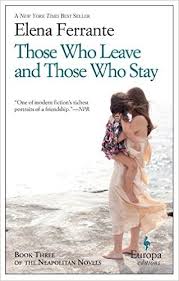
Those Who Leave and Those Who Stay by Elena Ferrante (Europa)

ThoseWhoLeave

“I saw Lila for the last time five years ago, in the winter of 2005”.

FERRANTE starts the third book of her Neapolitan quartet with a burst of energy, bubbling to get on with things. She leaps forward, gathering her cast, her flock even, around her and is quickly revealing more of herself. The opening is the familiar device, an introductory come-on from further ahead in time, but then we are quickly back in a present tense with where we left off…her fledgling career as a writer has already begun to create ripples…

Separated from her great pal, she is more introvert, swept up in a tumult of revolutionary politics and early feminism, causes both that beckon from the desperation of her childhood. Our main engagement is in how others react to her fiction (which we have not read and can only guess second hand) and storms brewing (which are equally not articulated in any detail as yet), confronting her new Italy (“a confusion of space and time, of distant moods”) unfurling like a flag in front of her, pleading with her to believe what others believe, even to step up and grasp the emblem, to be what they want.

Beneath this runs an earnest girlish humanity: “I recalled the powerful emotion I had felt when I held the child in my arms and, since he didn’t calm down, I couldn’t restrain myself. I got up, and, following the trail of his wailing, reached a door through which light filtered. I knocked.  Silvia answered rudely.”

Each chapterette has its own sting in the tail, like this one: “You acted the lady, bitch, and look what you have become.” Or a come on: “His clumsy gait, his flat feet, the tangle of his hair moved me.” It is more than enough to make the tea cups in Downton Abbey tremble and tinkle.

I worry how TV will deal with this masterpiece.  Like other long dramas, there will be the temptation to shorten it, as Lena does for her own fiction, but that would dilute or spoil the grand vista and vision. Some of the hinges are just too intimate for the camera. The strength lies in the telling from inside the hem of the skirt, the sole of the slum, the page jacket of the academic book, the sand in the sandwich, the rattle of the train carriage, the sharp tongue of her mother, the unseen family intimacies, the latent undercurrent of sexualities, all of which will be invisible on camera.

There is a very dark passage, and we are more than 1, 000 pages into our story now,  Lena is left to her own moody musings and the one thing she cannot share with Lila, sex. She has writers block. The text becomes note form. She did that, he did that etc. Was this perhaps an unconsummated book five? For a short period it is as if Elena F, author and Elena G, heroine are locked in some dreadful internal squabble, but then Lila snaps her out of it.

-“You must be mad!”

Ferrante is subtle in slipping in the nuances of the backdrop. This is as good a social history as you may find, she is better one suspects even than her own heroine, it is very believable, we walk down a frisson of real life.

Posted in 101greatreads, Biography, fiction | Tagged , , | Leave a comment

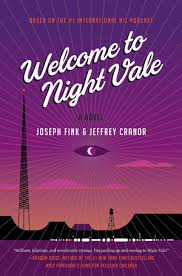
Welcome to Night Vale by Joseph Fink and Jeffrey Cranon (Orbit)

welcometonightvale

“Pawnshops in Night Vale work like this. First you need an item to pawn.”


IT is the tone of the Night Vale podcast that mesmerizes, a kind of surreal X Files, a slow smirk drawn across a nonsense universe where nothing is explained and time works in an alternative universe. Does it work as well in book form? Well it does, if you pick up the humour and have that resonance in your mind. If you can imagine the compulsive soundtrack. The nonsense though requires a bit more concentration on the page without the walking stick of the human voice to nudge you around the non sequitors of the house that speaks, the son that transforms into any shape he feels like adopting, the doppleganger of the man on the phone who is the man standing next to Diane, who is not there at all, and mad old woman Josie and her charming angels one called Erika, the dog pound with no dogs, the tarantula problem…and Jackie the pawnbroker who never gets older than 19 and always pays $11…we are off the envelope here somewhere in the Midwest, the darkest reaches of middle America, a saga of madness. Samuel Becket is on the trail, an existentialist vision perhaps without anyone having freewill.

We are anchored by the nightly newscast:

“Listeners, the Sheriff’s police are out in large numbers tonight in Night Vale. They are not looking for a killer or a missing person. There is no disaster or accident to handle. They are simply wandering around in large numbers…We all feel very safe.”

It is the humour of the absurd. Beyond the podcast, it also materialises in terms of 90 minute live shows delivered comedian-like dead pan but supported by fluent eerry scores penned by different musicians…compulsive, addictive, escapism in abstract…”it is probably safer for you not be in this story anyway”.

On the other hand….”watch out for the librarians of unimaginable powers” and the invisible pies.

Posted in fiction | Tagged , , , | Leave a comment

64 by Hideo Yokoyama (Riverrun)

64

“Snowflakes danced through the evening light.”

THE publisher Riverrun is part of Quercus who famously unearthed the works of the late Stieg Larsson and thereby launched Scandi noire. So here we are again, only this time it is Japan and the troubled geek Lisbeth Salander’s role is taken by the diffident detecto Yoshinobu Mikami. Japan obviously, as Murakami has shown, has potential for the unspeakable happening behind the inscrutable. From the off, there is a very Japanese parallel between the missing daughter who wants to disown her identity, while the police are upholding the principle of anonymity for a woman in a car crash. Mikami has been seconded to press relations. He finds himself facing a gaggle of reporters demanding all be revealed. His superiors insist everything be secret.

To an English audience this is a rather odd stand-off. In British law the name might only be released if the woman was charged and then technically no more details could be revealed before a trial. Not so in Prefecture D where crimes of corruption and nepotism flourish like spring flowers.

This is one side of a triangular plot, the other two being the unsolved kidnap, ransom and murder codenamed 64 of the title, and Mikami’s own daughter who has run away. We, like Mikami, have to confront all this through screens of intense, internal bureaucracy, politics and suspicions. Plus confusingly everyone’s name starts either with an M – Mikuno, Mochizuki, Minako, Michio, Muroi, Meiko, even Mizuki who becomes Mrs Murakushi – or an A – Akikawa, Amamiya, Akama, Ayumi, Amigos.

Mikami one suspects is cut from the usual detecto cloth, passed over for promotion while busy solving another case. He steels himself to be nonchalant. He opens another packet of cigarettes. He drinks cold tea. He acts with care. He gives an ambivalent nod. He supposes, he speculates, he grasps at straws. He feels “vaguely anxious”. Things are “worse than he feared”. Deep down he refuses to be “a scarecrow for Administration”. He is the model of diffidence, “concerned that the careers officer network of informers” don’t get him first. And that is the rub, this is really the secret within a secret within probably another secret (I lost count). He is the Salaryman. Or not. We shall see. Even his wife is a bit of a mystery to him, and to us. Like Maigret, he thinks rather a lot. It is detecto tourism but more important than the missing girls, is that no one loses face.

Posted in fiction | Tagged , , , , , , , | Leave a comment

The story of a new name by Elena Ferrante (Europa)

storyofanewnameferrante“In the spring of 1966, Lila in a state of great agitation, entrusted to me a metal box that contained eight notebooks”.

NEW readers do not start here. The second part of Elena Ferrante’s Neapolitan passionatas is not a sequel, just the next chapter, the explosive repercussions post the wedding as the girls run their new found sexuality up against brooding, entrenched towers of machismo.

We are in a full fury. Two new shops are to be built. Leila hovers between narcissistic muse and volcanic evil. Nerdy, bespectacled Lina is torn between her true love and her lover, between her friend’s adult freedoms and new wealth and her own striving with academia and poverty. She takes her first (luxurious) bath.

And behind all this we feel the shadowy politics of Naples. We are reminded that Don Achille was perhaps murdered by a woman, that Stefano was always the actor, that others are also being swept up in a torrent of hormones. The Solaras have the money and connections while looming for the other boys is a different kind of purgatory, conscription into an Italian army representing just what at this stage in Italian history – the re-built state, a re-run of fascism, a police to a settlement that has its own laws of omertà?

“The months ahead were packed with small events that tormented me a great deal,” Lina declares as she moves through each mood, each shift of politic, each emotional re-alignment, each dilemma aggrandising the petty into this great opera of four books. The scale here is Proust or Balzac which is to say any small detail can assume an import as much as another. Through this, fittingly, the plot has more than a few eye-popping twists.

The deliciousness is all in the detail, the sense of capturing a time, of the emergence of the girls, of the sheer excitement of their presences, being a part of their world, their sisterhood, of living each moment with them, daft, cruel, spontaneous, spiteful, of their femininity, told as it were like a great, uncontainable gush of tenement gossip while each incident resonates through a band of families and a wider society.

The girls are intertwined but opposites, the product of the tenement, the post war scramble to make something of themselves, a determined duo.

Not speaking Italian well enough I am curious of the sub text in which they speak in dialect, in Neapolitan, in higher Italian which doubtless infers more subtleties which is only referred to in translation, but also oddly why, in what is after all a beautifully translated book, the title was changed from the Italian where it is literally a Bad Name.

NB: The final book of the four The Story of the Lost Child has been listed for the first Booker International prize.


Posted in 101greatreads, Biography, fiction | Tagged , , | Leave a comment

Being mortal by Atul Gawande (Metropolitan)

beingmortal

“I learned about a lot of things in medical school, but mortality wasn’t one of them.”

ON the surface this is the story of the death of Atul Gawande’s father, who, which makes it the more poignant, was also a doctor. And it is filled out with detailed accounts of other deaths he has witnessed primarily as a clinician. Or as he concludes “our most cruel failure in how we treat the sick and aged”.

Gawande takes us non medicos on a unique, chronological journey from the hated poor houses at the turn of the last century. He offers one image of the treatment of an elderly dementia patient who wandered at night. The prescription was a ball and chain.  The very term nursing home was an insurance tactic to move old people out of hospitals. “You would have thought we would have burned the nursing homes to the ground. We haven’t…”

Part of the failure in confronting how we deal with our last days, he argues, is one of imagination. Or not our imagination but that of his own profession. There comes a point at the end of life where the Hippocratic oath to keep a patient safe and healthy starts to become obsolete. All we might want is what he terms “sustenance of the soul” and probably no pain. He enlists one revolutionary example of an old folks’ home where first dogs, then cats and then birds were introduced as companions to give patients ownership. One of the most important things he suggests that any of us might want is our own front door and control of who comes through it.

All of this he backs up with froths of statistics. “Our medical system is excellent at trying to stave off death with $12,000 a month on chemotherapy, $4,00 a day intensive care, $7,000 an hour surgery….” all of which accounts for 25% of all American health expenditure being spent at the end of a lifetime, when at the end of the day, death is, after all, inevitable and much of these expensive treatments both intrusive and often unnecessary.

The argument is that doctors and nurses have not worked out dying as well as they, or, more crucially, as we might, like…best read this before you are too infirm to think for yourself.


Posted in 101greatreads, Non fiction | Tagged , , , | Leave a comment

My brilliant friend by Elena Ferrante (Europa)

mybeautifulfriend

“This morning Rino telephoned. I thought he wanted money again and I was ready to say no.”

WE start with a mystery, a disappearance. And also a set of family trees, in case you might need to flip back quickly to check your Scannos from your Sarratores who form an enormous backdrop. We swiftly pick up with the central friends Lena and Lila, with their dolls, Nu and Tina. Although we start in childhood, in first grade, Lena’s voice is the autobiographer who will slowly bring in all this cast of Naples in the ’50s and will quickly explain the brilliance of her new pal.

“We lived in a world in which children and adults were often wounded, blood flowed from the wounds, they festered and sometimes people died”. Lena then gives a few choice examples.

There is a sense of the Italian in the very words and phrases, elegantly translated by Ann Goldstein (who just happens also to be head of copy at the New Yorker), which convey a warm, expansive affection, of the telling of a story in the grand manner, suitable and fitting tributes to all who appear, good and bad, frightening (Elena’s mother), more frightening (the ogre next door) or a rival school beauty Gigliola, daughter of the pastry maker.

Central to all this is Raffaella Cerullo, called Lina but Lila to her friend, a girl of determination. “…she was skinny, dirty and always had a cut or bruise of some sort…with us she spoke a scathing dialect, full of swear words…”

The spinning of the narrative is quite masterful.  Innocuous details assume an unexpected import. There are no crutches, no conceits, or for that matter sentiment but a driving imperative to get on with the important things, the story, the Italianness, the 1950s and as the girls agree, to make some money and get the hell out of their claustrophobic tenement.

As the first of the quartet of Neapolitan novels you might be tempted to fear some hybrid Inspector Montalbano meets the Forsythes, but not at all, it is as original as Don Corleone’s smirk and has its own brio and bustle.

“I hoped to detach myself from that sum of misdeeds and compliances and cowardly acts of the people we knew, whom we loved, whom we carried…”

I especially like this description, for example:

“Rino got angry. Not only that: right before my eyes, he went through a kind of transformation. he became red in the face, he swelled up around the eyes and cheekbones, he couldn’t contain himself and exploded in a series of curses and expletives…”

Transformations are really at the heart of things here, from girlhood, from the legacy of war, from school friends…

Ferrante keeps her own identity as a writer a secret, although her family secrets are surely here. And she is a natural storyteller. Each chapterette opens with a train of thought which then moves usually into a supportive, forward looking episode. And then on Thursday…

She has the sense of a tabloid reporter unearthing the most headline catching nuggets while carefully holding back from interfering. She lets her characters’ dialogue set up the drama. Although effusively, even lavishly Italian in rhythm and rolling lilt, you would not say there is a word out of place.

And we are drawn into the friendship of the two girls, as if a part of their own clique…her friend is not the only brilliant one here.

Posted in 101greatreads, Biography, fiction | Tagged , , , , | 1 Comment

In the cafe of lost youth By Patrick Modiano (MacLehose Press)

lostyouth

“Of the two entrances to the cafe, she always used the narrower one, the one they called the shabby door.”

CLEVER, this. Modiano drills down into a euro-psyche of paranoia, of living in a world of secret policemen, of secrets themselves, a balance or imbalance of freedom and oppressions. The strange Captain keeps a diary of everyone who drinks in a bar because, he says, he wants to fix a moment in time, to bring order to the anarchy of the city, he is a chronicler of imbibers, for what reason, is the rub.

Modiano further stamps the text with repeated and detailed street names almost like a guide book to Paris, a Paris that has now gone perhaps, as have other things. This is what you might call psyco-geography at its best.

At the centre is Louki (not her real name, of course), a beautiful obsession along with her “dark-haired man in a suede jacket”.

Louki prefers to watch movies for the colourful, exotic landscapes  rather than the plot. So her own story is dwarfed by its moody surroundings, by its bagfuls of details. Our heroine is in flight, because she prefers to be leaving not arriving, she likes running away…

As with Modiano’s other books MacLehose Press has produced an edition that is fittingly elegant for a Nobel prize winner, the choice of paper, typography, white space all compliment Modiano’s succinct style. It is a nice thing to hold aswell as to read.

Posted in 101greatreads, Biography, fiction | Tagged , , , , | Leave a comment

The 100 best novels in English by Robert McCrum (Galileo)

100bestnovels“The first classic of English literature I remember reading is Animal Farm. I must have been about 11 years old.”

THE very first novel, Robert McCrum argues, was a protest by a puritan dissenter written from inside prison, Pilgrim’s Progress, in 1678. Fifty years later a pamphleteer and sometime spy Daniel Foe (he would add the De before Foe as an affectation) introduced the conversational story teller as a first person in Robinson Crusoe. In 1726 the satirist Jonathan Swift dreamed up Gulliver’s Travels and then Samuel Richardson wrote the cruel downfall and shame of Clarissa in 1748. Richardson though was not a writer as such but a printer, looking for a profitable use for his machinery.

The little, scholarly background vignettes – the dramas behind the dramas –  to each of these books, most of which we already know, and also to other books – at least another 500 which get a mention in passing – present almost as a thesis in themselves. Straightaway McCrum draws a link between John Bunyan’s Pilgrim’s Progress and Charlotte Bronte, Mark Twain, John Steinbeck and even Enid Blyton. The story of a man in search of the same kind of a truth can also be found, he holds, in modern works as disparate as Tinker Tailor Soldier Spy or even Portnoy’s Complaint.

Great novels share, he suggests, the story telling, the characters, the use of English here as a first language (no translations) and dialogue that moves the narrative along.

The list is cleverly arranged chronologically ending in 2000 with Peter Carey’s True History of the Kelly Gang.

Each author only gets one mention so Jane Austen gets Emma, Thomas Hardy has Jude the Obscure. Virginia Woolf’s Mrs Danoway appears ahead of the Lighthouse while DH Lawrence earns a mention for the Rainbow rather than the more populist Lady Chatterley. The device sidetracks arguments as to which might be their best work (that is another discusion). In that sense it is a list about authors to be explored further, but it also manages to detail how and why the books were written and published at all, some to pay debts, some out of professional jealousy, some politically inspired. The first to be actually commissioned, it seems, was Little Women by Louisa May Alcott in 1868. Alcott had a local reputation around Boston as a “bit of a scribbler”.

The first American work comes from Edgar Allen Poe in 1838 as the Narrative of Arthur Gordon Pym of Nantucket. Many early books had such long, lavish titles. David Copperfield had no less than six monikers before its first, rather splendid, incarnation as The Personal History, Adventures, Experience and Observation of David Copperfield, the Younger of Blunderstone Rectory (Which He Never Meant to be Published On Any Account).

There are are half forgotten classics like the first detective writer Wilkie Collins (‘the godfather’) for Moonstone in 1868 but that does not preclude the presence of Dashiel Hammett’s Maltese Falcon nor Raymond Chandler’s Big Sleep.

Of course, any list is there to be disagreed with, but McCrum makes light of even trying to be definitive.

(What? No Forsyte Saga?  John Galsworthy won the Nobel Prize? Albeit he was published in the same year as James Joyce’s Ulysses, as was the not so often mentioned Babbitt by Sinclair Lewis which McCrum concedes has a difficult opening 50 pages).

The choices have been bitchily criticised for the lack of women writers but given that he is spanning 400 years perhaps he was just reluctant to artificially redress a balance. The earliest female writer is Jane Austen with Emma in 1816 followed by Mary Shelley with Frankenstein in 1818. In fact four of his preferred top 10 books are by women.

He also makes an interesting point that since the arrival of Amazon, sales of books overall have increased, as has the number of books published which makes this road map more relevant (as it does this blog) and essential for anyone who thinks they have a novel in them.

Most of all McCrum encapsulates in one place the great triumph of imagination that is fiction writing and which as Harari argues is a cornerstone of our civilisation and our species.


Posted in 101greatreads, Non fiction, Xetera | Tagged , | Leave a comment

The wallcreeper by Nell Zink (Fourth Estate)

wallcreeper

“I was looking at the map when Stephen swerved, hit the rock, and occasioned the miscarriage.”

A WALLCREEPER is a small, blue grey mountain bird, similar to a nuthatch except it has striking crimson wings which only show in flight.

Nell Zink skillfully uses the title imagery not least in hovering dispassionately above her heroine Tiff to record her whirlwind marriage to researcher geek and bird spotter Stephen.

The writing and plot are scaffold tight, the humour sharp as a beak.

“Tiffany, he said, that means a divine revelation. From Theophany.”

“It means a lampshade,” I said. “It is a way to get round the problem of putting your light under a bushel. The light and bushel are one.”

Three weeks later they are married. Stephen is not quite all he seems, and nor is she. “I was pretty bad as wives go”. We have a love story in reverse. They discover each other slowly after the event, almost an emo-detecto. The tempo is Ramones brisk. Her punchline at the end takes less than half a page.

Her characters are articulate; the imagery precise; the environmental backdrop in Berne and Berlin topical and relevant.

It is an accomplished piece which might/could have been one of those trashy me-and-my-sex tomes, or the underpinning how I-became-an-eco-warrior by mistake, but elegantly Zink weaves personal and professional together, a kind of literary Prada, or as it is set in Germany, say Oska, probably for sure wearing feathers.

Posted in 101greatreads, Biography, fiction | Tagged , , , , | Leave a comment