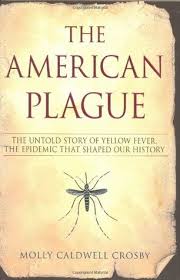
The American plague by Molly Caldwell Crosby (Berkley)

americanplague

“The rain came in west Africa. A massive wind blew in from the Atlantic coast bringing the deluge of water known as the south-west monsoon.”

IT is fitting that there is quote early on here from Edgar Allan Poe. Before science gave us its ghastly, rational explanations, plagues must have seemed like acts of god, revenge for heathen activities, out of the heavens awfulness. Here Crosby tackles one of the big ones, yellow fever, so called because post death the corpse literally turns to nicotine yellow. “Unlike any other disease (it) carried a mysterious horror to it. Its attack was acute and quick, its duration painful.” It struck so suddenly that sometimes someone would say: I think I have the fever, I will just go and lie down. And they would be dead in the morning. Crosby who lives in Memphis focuses on that town’s epidemic of 1878 which proved especially virile. “In July the city boasted a population of 47,000, by September 19,000 remained and 17,000 had yellow fever.”

She has a cinematic eye for the details, the mosquitos in the hold of the ship in Africa, the slack evasive quarantine in New Orleans, the two nuns arriving at a stricken house “a yellow card on the door swinging from a nail”, letters from a husband who stayed behind, the telegram that reads: “Father and mother are lying dead in the house, brother is dying, send me some help, no money, Sallie U”.

We also have the medical detective story. Quarantine – from the Italian for 40 which was how many days ships were held at anchor before being allowed into port –  was the only defense. The idea that a third party might be involved – mosquitos thriving off the filth of a pre-sewer urbanity – would take decades to be understood and the story would move on to another stricken island and entry point for this deadly immigrant, Cuba. It would make good horror cinema this, a mix of Deadwood meets killer zombies (one side symptom saw people going mad and running the streets screaming), the faction is relayed with the compelling, frightening prose of a Michael Crichton thriller staged with meticulous details of late Victorian scenery culled from newspapers of the time.

On the way Crosby drops a few by-the-bys as to the emergence of modern medicine, how children were preferred guinea pigs as blank slates (Edward Jenner who found a vaccine for smallpox destroyed the life of his own son by testing on him), doctors might self experiment (William Hasted self-tested the anaesthetic puissance of cocaine) and here new immigrants were covertly signed up into medical programmes. Soldiers though often volunteered, aware perhaps that their chance of dying of disease was much higher than in some bloody battle and their survival much more likely under controlled hospital conditions.

To disprove the idea that yellow fever might be a germ or transmitted by humans,  soldiers were quarantined in barracks with the dirty sheets and detritus from the yellow fever ward and emerged weeks later unscathed. In parallel, the doctors self infected themselves with bites from the female striped house mosquito…one died and another was irreversibly affected for the rest of his life. As with all great fiction, it is the villain that is the real star in the story, but one she warns that has probably not gone away and lingers on in African and south American jungles, incubated by monkeys…and biding its time.

Posted in 101greatreads, Biography, Non fiction | Tagged , , , , , | 1 Comment

Allen Klein by Fred Goodman (Mariner)

allen klein

“It may have been the dramatic grounds; he may have been impressed that George C Scott and Colleen Dewhurst were renting it. Whatever the reason, Allen Klein wanted the house.”

THE house was where the deals were done. In the unlikely event that you might be unawares, the sub-deck exclaims that Klein was the “man who bailed out the Beatles, made the Stones and transformed rock & roll”. Fred Goodman should know. He is a former editor of Rolling Stone. Here he had access to Klein’s business papers, which, as a prodigious litigator, were extensive.

For all the tomes written about rock & roll, this one gets down and dirty in the nitty gritty legalese.

The opening is pretty Jewish. Immigrant butcher’s son born into the depression makes good. Very good. Brilliant, pathologically obsessive, rude, terrified to be alone, a detail obsessive. Not a particularly nice boy, certainly not someone you would want turning up on your doorstep in the middle of the night but, as his mother (deceased) might have said, no worse than the other record A&R men he dealt with. In a sense this is a business book but also a witness to just how many Jewish people were the midwives at the birth of R&R. Klein is often portrayed as the bogey man of R&R management but like Andrew Loog Oldham perhaps he was actually a part of the whole process, the most incendiary of all, integral not a peripheral suit, just his notes were $. This rather picks up where Oldham’s odd autobiography Stoned peters out.

The juicy bits start to flow as we meet the stellar cast of Sam Cooke, Mickie Most, Oldham, Brian Epstein, Jagger, Lennon etc..it is like a R&R travelator.

Klein, Goodman outlines, argued that the artistic talent counted for more than anything else. So he rewrote the contracts. This particular skill he had learned from auditing record company books to find unpaid royalties. At first this was not even for the artists themselves (who were not paid anything of note anyway) but their publishers and managers. In the the UK he began working with the likes of the Animals, Herman’s Hermits and Donavon (who had to take a £7million tax hit to marry his girlfriend, btw).

Klein had a pretty compelling opening line: “I can make you a million dollars”. He was an accountant, but also a compulsive salesman par excellence. As R&R started to tear up the rule book, Alan was on hand to script the new republic. Not everybody liked that. Not everyone liked that Allen wanted to know where the royalties were.

We are leading up here to the nuclear confrontations of Klein and Lennon on one side and McCartney and the Eastmans on the other. By this point the Beatles were already broken, almost bankrupt. Soft deals done by their original manager Brian Epstein meant the record companies were making tens of millions a week. The tax man was coming in for his 90 per cent of the boys’ take plus the band was haemorrhaging what they did have in the altruistic, hippy cash cow of their own Apple corporation where the staff were literally helping themselves to the money out of the newly installed cash points outside the office.

Klein and Lennon hit it off instantly. Lennon needed him.  Klein equally had a messianic zeal to secure his life’s ambition of managing the big one, the Beatles.  He done his homework.  He knew every one of Lennon’s songs. He was a fan. They would become mates, also with Yoko. Lennon related to Klein as a street wise practitioner. They were equals.

The problem would be Paul’s girlfriend. Linda Eastman’s family were lawyers. They also fancied a piece of the action. And with a bit of digging Klein uncovered a touchy point that Lee Eastman was actually Leo Epstein, like himself a Russian Jew who started as an entertainment lawyer but had diversified into fine art.

Paul was especially embittered by how the Beatles song catalogue had been purloined down the line and ended up with another famous Jew in TV tycoon Lew Grade bypassing the boys altogether thanks to Dick James, aka Leon Isaac Vapnick. The band was between a rock and a hard place.

This is just one acrimonious anecdote from the early testosterone driven meeting with John Eastman aimed at a rapprochement. Eastman comes out of the bathroom in Klein’s house waving a box of suppositories for everyone to see. “Why Alan, I thought you were the perfect arsehole”.

Of all the histories of R&R, this one touches on the saddest truth of the Beatles. The boys may have sung about peace and love but backstage the corporates had them by the cahoonas. No one really expected the whole R&R thing to last more than a few years so when it began to morph into viral money the whole circus became surreal. Klein eventually would find himself tailed by the IRS for five years looking for evidence of misdemeanour.

In this reading Klein facilitated the first big stadium shows of the Rolling Stones and was central in George Harrison creating the first charity rock event for Bangladesh, indeed for most of Harrison’s post Beatles catalogue and even ended up owning both My Sweet Lord and He’s So Fine from which it was allegedly plagiarised. That is Allen did, not George. George just wrote one of them. Allen wrote the contract.

Klein knew where the money was.  He spread contracted revenues across 20 years to minimise the tax impact on his clients, the interest on the interest however was not accounted for. That went to fund the financial Disneyland of suites at the Dorchester, the red eye flights across the Atlantic, the Rolls Royces and later the lawyers and lawyers. No one ever paid when Allen was around.

There is an argument that he ripped the bands off. But they just wanted to be stars. That is what they signed up to do. They didn’t, no one did, except perhaps Klein, know just how much money that might make. Klein had the financial imagination.

The English born pugilistic promoter Don Arden also gets a namecheck here which rather validates how it was at the sharp end or in his case the end of a shotgun His story can be found in Mr Big (Robson). He is Sharon Osbourne’s father.

Reading again the aspirations of those times, often so beautifully articulated in song and spirit, it seems we have moved a very, very long way away from such ideals. The forensic evidence, sadly, is here. “Fucking suits,” as Lennon said.

Posted in 101greatreads, Biography, Non fiction | Tagged , , , , , , , , , | Leave a comment

The story of the lost child by Elena Ferrante (Europa)

stopry of the lost child

“From October 1976 until 1979, when I returned to Naples to live, I avoided resuming a steady relationship with Lila. But it wasn’t easy.”

OF COURSE,  it was not easy. Lila “remained the same restless creature with an irresistible force of attraction”. By the time that Lena reveals that the two of them are opposites: “I fair, she dark, I calm, she anxious, I likable, she malicious”, we know them well enough to suspect that our narrator is not as insightful or as objective as she thinks. She has become increasingly and in parts overwhelmingly emotional. She is in equal parts happy and unhappy as if on a playground seesaw that flips her up in the air as it hits the ground. Calm is not a word that springs to mind. Passionate, perhaps.

The bigger themes by now in this the fourth and last tome of the series come tumbling out of the cupboard, the role of women, of gender, of corruption, of motherhood and daughters. The student ideals of the ’60s and ’70s are bundled up in  the turbulent lives of their friends and the killer irony of Lela’s new career. Old tenements and modern mores rub shoulders. The children of the first books are maturing into elegant, dramatic portraits, Ferrante moves them around to get them to make her points for her and mark the passage of time.

If you have got this far, then you only need to be advised that she keeps her nerve as a writer and even drills down into the depths and allows herself a confessional aside: “it is more and more difficult to keep the thread of the story taut”….but her characters do that for her.

The axis though is always the girls relationship…“I’m a scribble on a scribble, completely unsuitable for one of your books; forget it Lenu, one doesn’t tell the story of an erasure”. In that Lila is wrong.

As with the first book, this is really two books wrapped as one, the first part entitled simply Maturity, a torrent of everyday events, the second more personal and reflective, a slow climb to an achingly intense crescendo, and yes a stiletto twist. The latter opens with this heroic passage:

“I left Naples definitively in 1995, when everyone said that the city was reviving. But I no longer believed in its resurrections. Over the years I had seen the advent of the new railway station, the dull tower of the skyscraper on Via Novara, the soaring structures of Scampia, the proliferation of tall, shining buildings above the gray stone of Arenaccia, of Via Taddeo da Sessa, of  Piazza Nazionale. Those buildings, conceived in France or Japan and rising between Ponticelli and Poggioreale, with the usual breakdowns and delays, had immediately, at high speed, lost all their lustre and become dens for the desperate. So what resurrection? It was only cosmetic, a powder of modernity applied randomly, and boastfully, to the corrupt face of the city.”

A masterpiece.

Posted in 101greatreads, Biography, fiction | Tagged , , , | Leave a comment

The vegetarian by Han Kang (Portobello)

vegetarian“Before my wife turned vegetarian, I had always thought of her as completely unremarkable in every way.”

HAD this abrasive exercise in misogynic chauvinism, puppet women, mad dreams, bizarre pornography been written by a man I wager it might have found its way into the rubbish bin. Kang though is female. We are invited to think her odd kaleidoscope reflects the hidden soul of Korea, but for me it is driven by the same western, or outsider, voyeurism that was responsible for comfort stations. It is not literature, it is smut, school boy smut, the 20th century fantasy of the submissive Asian woman slaking male lusts. Technically it is fluently written/translated but the three parts have little/nothing to do with each other linked only by an inarticulate victimhood which reaches an anonymous if grisly conclusion. The vegetarian of the title is somewhat academic.

The fact that it won the Man Book International is inexplicably depressing, the more so when the short list also included the last of the Elena Ferrante Neapolitan novels which surely will count as one of the punctuation points of modern writing. This can only go down as a snigger.


Posted in 101greatreads, fiction | Tagged , , | Leave a comment

Grief is the thing with feathers by Max Porter (Faber)

grief

“There is a feather on my pillow.”

THERE are only three characters here, the crow, the dad and twin boys sharing the grief after their mother dies. Each has their perspective. The dad: ‘wondering what to do. Shuffling around‘. The boys literal: ‘Where are the fire engines? Where is the noise and clamour of an event like this?’. And sage pagan old crow: ‘Oi, look, trust me. Did I or did I not faithfully deliver St Vincent to Lisbon?’

Crow was the volume of Ted Hughes black poems he wrote between 1966 and 1969 after the death of his wife Sylvia Plath and which he regarded as his masterpiece. Notionally here dad is working on Hughes again. Where Ted’s crow was a symbol, an etching, here he has come to life, he is animated:

“Head down, bottle top, potter /Head down, mop-a-lot, hopper/He could learn a lot from me/That is why I am here.”

The crow is in the drama. The crow is the grief. He almost has a cockney lilt to his banter. Dad is coping, the twin boys are romping, the bird is the manifestation, the reality.

It is poetry as prose, contained within a novel-like context but the crow has wings and can take us to other dark parts of the netherworld, as in his bad dreams.

Rather nicely, Porter, who has been a Granta editor as well as a bookseller himself, offered the work to Hughes’ publishers Faber. Luckily Hannah Griffiths at Faber got it straight away and they have produced an edition worth the keeping.

Here is a sample of the quality of the writing:

“On the left we have the dad. This image occupies the functional position of the here-goes, the ask, what I like to call the George Dyer-on-the-shitter, the left flank, the hoist, the education spot, the empty church, the torture step, the pain panel, the muscular”.

It repays re-reading a few times. And more.


Posted in 101greatreads, fiction | Tagged , , , , , | Leave a comment

Mothering Sunday by Graham Swift (Scribner)

morthering sunday

“Once upon a time, before the boys were killed and when there were more houses than cars, before the male servants disappeared and they made do, at Upleigh and at Beechwood, with just a cook and a maid, the Sheringhams had owned not just four horses in their own stable, but what might be termed a ‘real horse’, a racehorse, a thoroughbred.”

I HAD not intended to review this until Jon Snow chose it as his Good Read for BBC Radio 4, so perhaps there is room for an alternative view. Balance, as the BBC is always saying. I admire the tight precision of Graham Swift’s writing, and the format here with a cover of a striking detail from Modigliani’s Reclining Nude all augur well, 129 pages with lots of white space beckon as an easy read. The Guardian and the Independent both rated this as Swift’s best book yet, a polite cliché when reviewers do not really know what to say but feel obliged to flatter. I don’t agree (and I would not mind reading back through his other dozen books to make my case. I have fond memories of Last Orders, for example).

The first part is shimmeringly brilliant as the opening 62 word sentence illustrates well enough. The hinge being that Mother’s Day is the loneliest day of all for an orphan. It is calm, in tune with its 1920s era, erotic, beautiful even. But then we have a plot cliché like Swift has got fed up with his characters and mentally said oh sod it, I want to write about something else instead. A schism appears. Part two is another book, which if it were a true story would be amazing, but it is not, as far as I am aware, so it peters out as so much well, nonsense. Events and characters of part one have no bearing on part two. For me this is a cardinal sin for the story teller, editors and publishers who acquiesce and why writers like Ferrante and Rowling and even crime writers who stick to their vision succeed.

A disappointment as large as the opening is a pleasure.

On the same show Trevor McDonald upped the stakes with the challenging 1,232 pages albeit important Master of the Senate: The Years of Lyndon Johnson (Volume 3) by Robert A Caro which highlights the strange historical conundrum of Johnson being both architect and overlord of the Vietnam war and the Texan who stood up for civil rights legislation which indirectly led to Barak Obama’s presidency.

The third book was one I would have included here, but it was published in 1996, Bill Bryson’s hilarious Notes From  Small Island. 


Posted in Biography, fiction | Tagged , , , , , , , | Leave a comment

The life-changing magic of tidying by Marie Kondo (Vermillion)

tidying

“When I tell people that my job is teaching others how to tidy, I am usually met with looks of amazement.”

I DO NOT recall if I ever actually wrote the notorious essay A Day In The Life of a Sixpence at school but it remains in my consciousness: A writer should be able to write about anything, we were taught. So, write a book about…tidying. A whole book?

Marie has an advantage here. People actually pay her to show them how to tidy their homes. There is a three month waiting list for her services, or was when this was written but by now it will be considerably longer. She has mined a slim, shiny passage into the human condition to the point it seems completely essential to know.

One mark of good writing is sticking to message and Marie does not waver. She is resolute. “Do not tidy one day at a time”, she instructs. Do it as one big project and then never worry about it again. And knowing your subject.

She speaks of her tasks (or your tasks if you instruct her) in the most beautifully enthused fashion. Tidying is not a chore, it is a mission. You must put your days of “potato ball socks” behind you.

I confess to a certain concern looking around my study at just what would happen if Marie came through the door. The same fear her little sister felt when Marie turned her attention to her room.

Fortunately her clients are mostly in Tokyo where she assures me the average woman may own as many as  160 tops (I am safe on that one). One client took her to stand under a secluded waterfall to meditate. “There is,” she assures us, “a significant similarity between meditating under a waterfall and tidying”.  This tome is all chutzpah, charm and yes charisma, Miss mindful. And in a way it has got a serious point. The secret, her secret, is to stack vertically, not horizontally. Before that you will have to have encountered the taboo of loungewear, learned how to fold and show respect to those socks and to organise troublesome papers. Quite.

Posted in 101greatreads, Non fiction | Tagged , , , | Leave a comment

Those Who Leave and Those Who Stay by Elena Ferrante (Europa)

ThoseWhoLeave

“I saw Lila for the last time five years ago, in the winter of 2005”.

FERRANTE starts the third book of her Neapolitan quartet with a burst of energy, bubbling to get on with things. She leaps forward, gathering her cast, her flock even, around her and is quickly revealing more of herself. The opening is the familiar device, an introductory come-on from further ahead in time, but then we are quickly back in a present tense with where we left off…her fledgling career as a writer has already begun to create ripples…

Separated from her great pal, she is more introvert, swept up in a tumult of revolutionary politics and early feminism, causes both that beckon from the desperation of her childhood. Our main engagement is in how others react to her fiction (which we have not read and can only guess second hand) and storms brewing (which are equally not articulated in any detail as yet), confronting her new Italy (“a confusion of space and time, of distant moods”) unfurling like a flag in front of her, pleading with her to believe what others believe, even to step up and grasp the emblem, to be what they want.

Beneath this runs an earnest girlish humanity: “I recalled the powerful emotion I had felt when I held the child in my arms and, since he didn’t calm down, I couldn’t restrain myself. I got up, and, following the trail of his wailing, reached a door through which light filtered. I knocked.  Silvia answered rudely.”

Each chapterette has its own sting in the tail, like this one: “You acted the lady, bitch, and look what you have become.” Or a come on: “His clumsy gait, his flat feet, the tangle of his hair moved me.” It is more than enough to make the tea cups in Downton Abbey tremble and tinkle.

I worry how TV will deal with this masterpiece.  Like other long dramas, there will be the temptation to shorten it, as Lena does for her own fiction, but that would dilute or spoil the grand vista and vision. Some of the hinges are just too intimate for the camera. The strength lies in the telling from inside the hem of the skirt, the sole of the slum, the page jacket of the academic book, the sand in the sandwich, the rattle of the train carriage, the sharp tongue of her mother, the unseen family intimacies, the latent undercurrent of sexualities, all of which will be invisible on camera.

There is a very dark passage, and we are more than 1, 000 pages into our story now,  Lena is left to her own moody musings and the one thing she cannot share with Lila, sex. She has writers block. The text becomes note form. She did that, he did that etc. Was this perhaps an unconsummated book five? For a short period it is as if Elena F, author and Elena G, heroine are locked in some dreadful internal squabble, but then Lila snaps her out of it.

-“You must be mad!”

Ferrante is subtle in slipping in the nuances of the backdrop. This is as good a social history as you may find, she is better one suspects even than her own heroine, it is very believable, we walk down a frisson of real life.

Posted in 101greatreads, Biography, fiction | Tagged , , | Leave a comment

Welcome to Night Vale by Joseph Fink and Jeffrey Cranon (Orbit)

welcometonightvale

“Pawnshops in Night Vale work like this. First you need an item to pawn.”


IT is the tone of the Night Vale podcast that mesmerizes, a kind of surreal X Files, a slow smirk drawn across a nonsense universe where nothing is explained and time works in an alternative universe. Does it work as well in book form? Well it does, if you pick up the humour and have that resonance in your mind. If you can imagine the compulsive soundtrack. The nonsense though requires a bit more concentration on the page without the walking stick of the human voice to nudge you around the non sequitors of the house that speaks, the son that transforms into any shape he feels like adopting, the doppleganger of the man on the phone who is the man standing next to Diane, who is not there at all, and mad old woman Josie and her charming angels one called Erika, the dog pound with no dogs, the tarantula problem…and Jackie the pawnbroker who never gets older than 19 and always pays $11…we are off the envelope here somewhere in the Midwest, the darkest reaches of middle America, a saga of madness. Samuel Becket is on the trail, an existentialist vision perhaps without anyone having freewill.

We are anchored by the nightly newscast:

“Listeners, the Sheriff’s police are out in large numbers tonight in Night Vale. They are not looking for a killer or a missing person. There is no disaster or accident to handle. They are simply wandering around in large numbers…We all feel very safe.”

It is the humour of the absurd. Beyond the podcast, it also materialises in terms of 90 minute live shows delivered comedian-like dead pan but supported by fluent eerry scores penned by different musicians…compulsive, addictive, escapism in abstract…”it is probably safer for you not be in this story anyway”.

On the other hand….”watch out for the librarians of unimaginable powers” and the invisible pies.

Posted in fiction | Tagged , , , | Leave a comment

64 by Hideo Yokoyama (Riverrun)

64

“Snowflakes danced through the evening light.”

THE publisher Riverrun is part of Quercus who famously unearthed the works of the late Stieg Larsson and thereby launched Scandi noire. So here we are again, only this time it is Japan and the troubled geek Lisbeth Salander’s role is taken by the diffident detecto Yoshinobu Mikami. Japan obviously, as Murakami has shown, has potential for the unspeakable happening behind the inscrutable. From the off, there is a very Japanese parallel between the missing daughter who wants to disown her identity, while the police are upholding the principle of anonymity for a woman in a car crash. Mikami has been seconded to press relations. He finds himself facing a gaggle of reporters demanding all be revealed. His superiors insist everything be secret.

To an English audience this is a rather odd stand-off. In British law the name might only be released if the woman was charged and then technically no more details could be revealed before a trial. Not so in Prefecture D where crimes of corruption and nepotism flourish like spring flowers.

This is one side of a triangular plot, the other two being the unsolved kidnap, ransom and murder codenamed 64 of the title, and Mikami’s own daughter who has run away. We, like Mikami, have to confront all this through screens of intense, internal bureaucracy, politics and suspicions. Plus confusingly everyone’s name starts either with an M – Mikuno, Mochizuki, Minako, Michio, Muroi, Meiko, even Mizuki who becomes Mrs Murakushi – or an A – Akikawa, Amamiya, Akama, Ayumi, Amigos.

Mikami one suspects is cut from the usual detecto cloth, passed over for promotion while busy solving another case. He steels himself to be nonchalant. He opens another packet of cigarettes. He drinks cold tea. He acts with care. He gives an ambivalent nod. He supposes, he speculates, he grasps at straws. He feels “vaguely anxious”. Things are “worse than he feared”. Deep down he refuses to be “a scarecrow for Administration”. He is the model of diffidence, “concerned that the careers officer network of informers” don’t get him first. And that is the rub, this is really the secret within a secret within probably another secret (I lost count). He is the Salaryman. Or not. We shall see. Even his wife is a bit of a mystery to him, and to us. Like Maigret, he thinks rather a lot. It is detecto tourism but more important than the missing girls, is that no one loses face.

Posted in fiction | Tagged , , , , , , , | Leave a comment