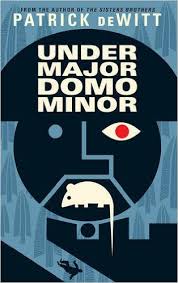
Under major domo minor by Patrick deWitt (Granta)

undermajordomominor

“Lucien Minor’s mother had not wept, had not come close to weeping in their parting.”

THE much anticipated (in these quarters) second book from Patrick deWitt, the follow up to Scissor Sisters. The two share striking graphic covers, and sharp titles, a play on character names.

I imagine deWitt having watched a box set of the Lord of the Rings all weekend resolving that the one thing it lacked was a sense of fun.

The writing is quick. “The valise stood alert on the floor beside him”. The women are “lard-armed”.

We are in some unidentified land.  There are trains and barons but no specifics just a castle and mountains, nor any sense of period, except an archaic tone in the narrative; “…there occurred an untoward happening.”

The effect blindfolds the reader, removes any sense of the everyday. We are forced to follow the thread of narrative without any familiar handles to grasp. Some imagery is almost Dali-esque: “The cut and style of each man’s outfit was dissimilar to his fellows’: one wore long trousers, another knickers with tall boots, one sported a shearling collar, while his neighbour trailed a scarf. Even their rifles were dissimilar, the lengths of the bayonets varying drastically.” The castle is Escher-like.

Chapters are short and concise, to be read in sandwich sized bites…each one leading up to a page turning sense of riddle, of mystery, of ooh! of aah!! of an edge of the seat expectation. The characters too linger in the mind.

There is a phrase half way through that catches the mood: “an exhilaration, for how curious life was, how unfathomably novel, and occasionally, wonderful.” Or again: “an invigorating concoction of jubilation and dire agitation”.

Humour is tricky in the naive, but all round this is a  wonderfully unpredictable journey into the bizarre, more fairy than fable perhaps, in which the chacters themselves have slightly altered perspectives, peculiar as it says, or in the the case of L pondering the question of the lie: “He wondered if it wasn’t man’s finest achievement, and after some consideration, decided that it was.”

At the back deWitt credits a list of other writers he has been reading including Dahl and Donleavy, but for me one missing might be Lewis Caroll.


Posted in fiction | Tagged , , , | Leave a comment

Notes on the Man Booker prize 2015

ONE of the Amazon reviewers of Marlon James’s winning Brief History of Seven Killings said that: “If you are interested in Jamaica, corruption, sex and killings, this is a must read”. My problem is I am not interested in that kind of portrait of Jamaica, in that kind of corruption, in that kind of violence which at times is disturbingly well written. If I want to hang around on a street corner and play gangster I can do that closer to home. I don’t. And I don’t want to read about it. Another review called it a “chore”.

More charitably, I  have Killings down among a small clique of recent books, which are defined by their density, by thick woolly verbal jumpers, literary milkshakes if you like. Similar might be the first translation from the Irish of Mairtin O Cadhain’s Dirty Dust which has the most wonderful, laugh out loud opening lines. The Wake by Paul Kingsnorth, written in a style of middle English but which has been picked up by the uber theatre talent Mark Rylance who will surely make something good of it. The only one of the genre I have included here so far is from Eimear McBride which is mercifully short compared to the others. They all belong in a category you might call prose-poetry, experiments in language or that non sequitor beloved of university courses, creative writing.

For a pre-eminent literary prize like the Man Booker I would prefer a winner that converted people to reading more books, something more predictably populist. I want it to be a best seller, not a killjoy. Over the last few years the Man Booker has yielded for me a couple of favourite classics, neither of which won, one from Ruth Ozeki and one from Patrick deWitt. The last winner that I have included here so far was from 2007 by Anne Enright.

Too many people I suspect are daunted by the sheer act of reading these days, of giving up time and other things to invest in a book. If you look at the bestseller lists, you notice how many are serials, repeats of the same thing, like favourite TV series. They are crimos and love stories or girls coming of age. Readers are voting to find their favoured universe and inhabit it. You probably do not want to live in any of this year’s shortlisted books except possibly  Spool of Blue Thread which is meant to be an ambling long read of a comfortable slice of Americana.

The others could have used some help. For me this is not a criticism of the writing – in sheer writing terms the words in this selection of books have been very much to the fore – but of the process. There is a rush to print. Each of the novels would have benefited from a moment’s pause,  the skills of an editor, to focus, adjust, trim, tweak, and, yes, cut, but this is a skill publishers seemingly no longer feel they need and/or we have a generation of very timid editors indeed. Given how much money is potentially at stake (for a relatively small investment in most novels), this lack of care and attention seems absurd. The process has become relentless to the point that the product is shoddily produced, but no matter there will be another bus along soon and one after that and maybe that will work…no matter that shirts are not tucked in, shoelaces not tied, buttons are undone.

A patriotic concern is that only one of the short list, the tough love of Sunjeev Sahota’s Runaways deals with UK issues and concerns. Does this reflect a wider inarticulation of the debates or non debates in this country, are we mugged by too much information and stifling our writers from explaining the surrounding context? Or are we not commissioning them to do so? We are, we are invited to think, happy to wrap ourselves in a blanket of BBC dross. Or maybe like TV news we, or in this case the judges,  prefer to look at things father away from home?

Of course you may disagree but the books listed here as in the 101 represent a more dynamic set of literary values. You can say that is a personal, subjective judgement. I cannot object, but I have the sense that I am not alone. Brooklyn is now coming out as a fim. Hurrah! Killings, I am afraid, will not.

Posted in fiction, Outtakes | Tagged , | Leave a comment

A brief history of seven killings by Marlon James (Oneworld)

7killings

“I know I was fourteen. That me know. I also know that too many people talk too much, especially the American who never shut up, just switch to a laugh every time he talk ’bout you, and it sound strange how he can put your name beside people we never hear ’bout, Allende Lumumba, a name that sound like a country that Kunta Kinte come from.”

Hey, Marlon, man. Me hear you wun something… Yeah, man, the Man Booker. What’s that man, Man Booker? Man it is the Man Booker, man. Wassat, man? A book prize, man, the Man Booker. Bookerr, like a book of something? Is a name, man, that’s all, man. Wot you doing writing books down here…? Is that wot they reading in Sandals? Yea, in Sandals in their sandals, reading. Wot you wrote? Me wrote, man. We spend our lives trying to get up there where they are reading about what its like down here? I guess. Is it any good? Wassat? Yerbook, man, you Man, book, man? Yeah its magnanimous, wonderlicious. Maybe I read it. Why you wanna read it? You live it. Me live it. The madness, you know.

Notes on the Man Booker 2015


Posted in 101greatreads, fiction | Tagged , | Leave a comment

Nora Webster by Colm Toibin (Penguin)

norawebster

“You must be fed up with them. Will they never stop coming?”

WE are back in Enniscorthy on the south east tip of Ireland midway between Dublin and Cork. We have already met Nora tangentially in Brooklyn. Eilis’s mother called her the “nicest of people in the whole town”. And there is the photograph taken at Cush. And Eilis’s brother Jack Lacey who moved to Birmingham.

The sea howls. The sky is bruised. She put fresh scones on a plate with melting butter and poured the tea. In a subtle way that sentence shows how well Toibin writes. It moves us along without fuss, the butter is melting, she is pouring the tea. Things are happening all around. It is alive.

We begin in grand Irish style with a funeral. I can’t tell you how sorry I am. Nora is widowed with the two boys. The two girls are away at school.

Starting with a death is a bit of an advantage for a story teller because it brings everyone into focus without prejudicing any future actions or in this case reactions. Not that you are expecting a mad axeman out of this slice of middle Eiredom. Toibin draws you carefully into his village.

It was as “though she had been in a car accident, it was this wandering in a sea of people with the anchor lifted”. This sea ebbs with nuns, with the Troubles in the north, with chat from the golf club, with the need to go back to work. There is emancipation, out of grief.

There are some wonderful, deep characters here too. I totally like the bit part Billy who is tone deaf but marries the music teacher, a former nun. He builds her a soundproof studio for classes so he does not have to hear her. The edges of each character carefully overlap in the village, in the factory, in the politics, big and small, their concerns shuffling like gossip around town and family…almost exploding with tension at the town quiz.

We are on the cusp of rural life, of a distant America, of an Ireland past, all rubbing along side by side, an Ireland in the ’60s and ’70s. Nora has angst over whether she should buy a record player…a stereo record player, that is. Or a phone?

Her journey out of widowhood is also that of the other people of Enniscorthy, and around, at the time.

Posted in 101greatreads, fiction | Tagged , , , , , | Leave a comment

A spool of blue thread by Anne Tyler (Vintage)

Spool

“Late one July evening in 1994,  Red and Abby Whitshank had a phone call from their son Denny.”

I AM bemused as to what this is doing on the Man Booker 2015 short list. It is a completely different proposition to the other contenders. This is Anne Tyler’s 20th book. The list of admiring plaudits at the front make her out to be some kind of American Solzhenitsyn. Nick Hornby declares she is the “best line-and-length novelist in the world”. Leaving that remark aside for a moment (this is not a cricket match), the subject matter alone is the kind of suburban American dream to which all the heroes of the other short-listed books might and do desperately aspire.

We have normality, Waltons-warm and comforting. Two dogs, the house that grandpa built, Abby and Red getting on a bit now and have the family to look after them. All the other writers are notable wordsmiths where this is an East coast stream of consciousness, a ramble in the front parlour.

It is also, you might say, a girl’s book where four of the others are written by men (and it shows) and the fifth is about men (sort of).

This is easy, cake-icing writing, loads of conversational dialogue so you rattle along quite happily at speed, a chat per page. Its concerns are, well, Nora was “a beautiful woman who did not know she was beautiful”. Got it? As they gather round for a family lunch “people kept saying: I’m sorry is this your glass or mine?”. And then “I am exhausted…It seems preparing for a trip gets more tiring each year”.

As far as the Man Booker 2015 is concerned this is like entering the Crossroads motel for an Oscar.

Posted in fiction | Tagged , , , | Leave a comment

So you don’t get lost in the neighbourhood by Patrick Modiano (Maclehose)

modiano neighbourhood

“Almost nothing. Like an insect bite that initially strikes you as very slight. At least that is what you tell yourself in a low voice so as to reassure yourself.”

THE perfect novel, I might speculate, would be 155 pages long with plenty of white space, say 230 words a page or 35,000 words in total,  enough for some central characters and a cast. For example the length of a Maigret story or an Agatha Christie murder. You can have bigger but essentially you would be bolting on a second module. Concision is a benefit.

Take this by way of an example of brevity:

“The notes retraced her career path. Arrival in Paris when very young from provincial France. Job in a nightclub in rue de Ponthieu. Room in a hotel in the Odeon district. She goes around with students from the Ecole des Beaux-Arts. List of people questioned and whom she may have met in the night club, list of students at the Beaux-Arts. Body found in a hotel bedroom, 15 th arrondissement”.

Around this Modiano weaves a mystery of supreme paranoia, a victim (who?) as he says in his opening line of an insect bite…an infection. The street geography and the aspen tree outside of Daragane’s window frame a tale of mind games. The past is unpacked like some valuable box of antiques.

Beautifully polished, beguiling, leading not to trite Hawaii 50 style of ending, but a riddle.

See also here. This translation is by Euan Cameron.

Posted in 101greatreads, fiction | Tagged , | 1 Comment

The Year of the Runaways by Sunjeev Sahota (Picador)

Runaways“Randeep Sanghera stood in front of the green-and-blue map tacked on the wall. The map had come with the flat, and though it was big and wrinkled, and cigarette butts had once stubbed black islands into the mid Atlantic, he’d kept it, a reminder of the world outside.”

Picador might have popped a few easy to translate phrases in the front of this book, but to get you started: Gurdwara is a Sikh place of worship; chunni is the long scarf women wear around their head and shoulders, charmaars (which my spell check keeps wanting to change unfortunately to charmers) are leather workers and hence of low caste in Hindi eyes where the cow is sacred.

Sahota uses this vernacular to create atmosphere and a cultural barrier. His  story is about immigration, timely perhaps, but not, perhaps, about assimilation. He balances both sides from India and England;  four journeys loosely intertwined,  each ducking under the shredded, discredited red tape of UK immigration law and taking different avenues.

We are in the harsh shadowlands of the newly arrived, the newly hopeful. Caught in the abandonment of old friends (Commonwealth) for new friends (Europe). There are riots in Bihar, a plane to Turkey, a truck to unfriendly Paris and then the back of a tomato lorry to Southall. Marriage is arranged.  Eventually one emotes: “what decadence this belonging was…”

Sahota is skilful with the what, why, where, and when, which is more than can be said for his characters who are flotsam in different ways, victims of their duty. All they want is a job. Any job. Money, to send home, to get home. They carry their culture on their backs like snails. There is a telling, chilling bit where they encounter first generation immigrant cousins who tell them to stop staring…at everything.

Sahota keeps his nerve and the sentimentality to a minimum, expectations are more informed by where they came from than where they are going, which just makes the reader more fearful for them.

The shock and charm is underlined using an essentially English style of story telling to apply to non English values. It is an accomplished work of novel making that has earned it a short listing for the Man Booker 2015, albeit judges might have preferred something more predictably gin and Raj but it affirms and stirs many a prejudice.


Posted in fiction, In progress | Tagged , , , , , | Leave a comment

The Fishermen by Chigozie Obioma (One)

Fishermen

“We were fishermen. My brothers and I became fishermen in January of 1996 after our father moved out of Akure, a town in the west of Nigeria, where we had lived together all our lives.”

LIKE the Seven Killings book (also long listed for the Man Booker), this has the patois of the street, albeit related from Michigan now where Obioma is a Fiction Fellow, which sort of sounds right too, an FF. It perhaps helps if you are used to the dynamics of extended families.

“Father was an unusual man. When everyone was taking up the gospel of birth control, he – an only child who had grown up with his mother longing for siblings – had a dream of a house full children, a clan from his body.”

And these boys are a rumbustious handful of scallywags. The style, I am informed, is to follow the west African tradition of story telling at which their mother is adept. She relays precisely the misdemeanours of the young brothers to the said father who returns each week, usually to administer a belting. It is Lake Woebegone meets Omi-Ala, a dreadful river.

Once you get used to the style, it can be rich and lyrical:

“Mother was a falconer….She owned copies of our minds in the pockets of her own mind and so could easily sniff troubles early in their forming, the same way sailors discern the forming foetus of a coming storm”.

There are other occasional but glorious passages that arrive through the chaos:

“Every year, as this day approached, it seemed as if a band of a thousand invisible surgeons, armed to the teeth with knives, trephines, needles and extraordinary anaesthetic materials, came with the influx of the north wind and settled in Akure. Then at night-time, while the people slept, they would commit frantic, temporal lobotomy of their souls in quick painless snatches, and vanish at dawn before the effects of the surgeries began to show. The people would wake with bodies sodden with anxiety, hearts pulsating with fear, heads drooping with the memory of loss, eyes dripping with tears, lips gyrating in solemn prayers, and bodies trembling with fright. They would all become like blurred pencil portraits in a child’s wrinkled drawing book, waiting to be erased. In that grim condition, the city would retract inwards like a threatened snail.”

A notable theme of the Man Booker 2015 candidates is the strength of the writing, the penmanship if you like, over the more traditional virtues of the novel – plot, characterisation, narrative, description, relationships. There is a lot of I. And more I.


Posted in Biography, fiction | Tagged , , , , , , , , | 1 Comment

A Little Life by Hanya Yanagihara (Picador)

alittlelife

“The eleventh apartment had only one closet, but it did have a sliding glass door that opened onto a small balcony, from which he could see a man sitting across the way, outdoors in only a T shirt and shorts even though it was October, smoking.”

Women have been parked in the background here, mentioned second hand in conversation, as if in battleground despatches, seen across a room. There is only one mama in this yarn and that is Hanya Yanagihara herself, not in person but moving her boys around.

In the context of the Man Booker long list it might just seem like the entry for Hawaii – see my notes here on some of the others – but that would be a book jacket error. This is educated, intelligent, professional, immigrant USA, the corners of respectable society many writers rarely go near, heavily and handsomely informed on, not least, academia, art and  law. This is a world of “grants and residences and fellowships and awards“.

Yanagihara loves her characters. She has a driven sense of curiosity about them. She takes her time etching out their troubles, mysteries and motivations, unravelling them little by little as if each one is a cocoon, coaxing them into situations, into reminiscences.

“…the conversation often turned to his classmates’ childhoods, which they had barely left but about which they were curiously nostalgic and certainly obsessed.”

We have this disparate band of housemates/collegemates bound by their scholarship and ambitions, a Friends for 2015, or more precisely Friendships of which there is some eloquent interplay.

One says: “I enjoyed hearing him think”.  A level intelligence  crackles through the prose and dialogues. She uses a clever device of narrating in the first person irrespective of who is talking so you have to stay alert.

So far so good, even brilliant, but then there is a change of mood and the plot sort of rolls over to reveal its dark underbelly of success and slowly we are in a world where Yanagihara is less comfortable. Transparently she does not really know so well issues like taking crystal meths, self harming, abuse in different guises (especially male). Exposition is replaced by straight description, laid on thicker and thicker.

She has set up marvelously (among others) the New York attorney with issues, the shark in the courtroom, sometimes even Perry Mason style, in a wheelchair. But to use an analogy that avoids giving too much away, her Perry Mason is more intersted in his own self pity, his own self abuse, his own relationships than the drama of the cases which he admits are his escape and salvation. The focus is the dark hours of the night not the clear sunshine of the morning. And ultimately we have two books bolted untidily onto each other – one might have been an investigation of the other but effectively they inhabit different universes and have very little to say to each other.

Yanagihara is also a woman writing about boys/men. She disrobes their masculinity helped in part by one of her characters, Jude, the obscure for sure, who is male but perhaps pansexual, necessarily non-sexual. But having no women around, slowly the boys get subjugated into assuming her female concerns and behaviour and we get gender confusion, even though any of the main characters could as easily have just been more believable as, well, just women.

A Little Life might have been a masterpiece as A Little Book but at 720 pages it is also carrying a lot of cellulite.

Posted in 101greatreads, fiction | Tagged , , , , , , | 3 Comments

The Illuminations by Andrew O’Hagan (Faber)

Illuminations“Snow was falling past the window and in her sleep she pictured a small girl and her father in a railway carriage”.

We have two modern themes here,  dimentia and computer war games in Afghanistan. They are wrapped around a little family history, inter generational, the one gentle and determined, the other teenage Tommy.

Some of the Alzheimer’s is told in a touching way. Annie needs a tin opener to feed her ceramic rabbit a bowl of tomato soup.

With her pal Maureen, they form an amiable Raymond Briggs sort of duo in sheltered housing.

“Annie’s flat was like a palace. Maureen loved the story it told, not that she knew it, but a person with taste always has a story.”

Annie cannot remember. Nor can anyone else. Remember what? There are clues, though.

Grandson Luke’s tale is more abrasive, war picture library, predictable, Lee Child, depressing in another way. That they communicate through Maureen’s letters is a safety zone. The contrast is stark and distracting, realistic enough perhaps.

This might be the English entrant for the Man Booker prize 2015. It competes in an ideological beauty pageant.

Hello, My came is Andrew. I am 293 pages long in hardback. My hobbies are charming old ladies in northern Britain. I have a sub theme about photography.

Or

Hello, I am Marlon. I am 688 pages long in paperback. I do very sharp Caribbean ghetto.  My hobby is violence.

Or

Hello, I am Chicoze. I am 301 pages long in hardback. I do the Nigerian story of my brothers growing up. Lake Woebegone meets Omi-Ala, a dreadful river.

All the above are a form of  literary tourism, guide books to places nice book reading middle class people don’t and wouldn’t want to go but might want to be informed, at a distance, under the duvet. The same might be said of Satin Island, a tome for the universe of the technocrat.

Of course, laudably even, the Booker list may desire to encouragez les autres but Tolstoy wrote about Anna Karenina to depict a Russia of his time, so too Checkhov or Irene Nemirovsky for between the wars France. They create the prism, not the person, through which we glimpse myriad different perspectives of the world around us, then and now.

The above are all accomplished writing exercises, but not for me in the same orbit as this, which is not listed. I read on, Macduff.


Posted in fiction, In progress | Tagged , , , , , , , , , , | Leave a comment