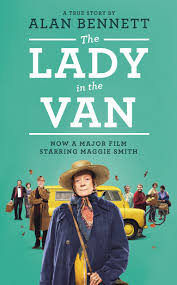
The lady in the van by Alan Bennett

ladyinvan

“I ran into a snake this afternoon,’ Miss Shepherd said. ‘It was coming up Parkway. It was a long grey snake – a boa constrictor, possibly…'”

POSSIBLY, is one of Miss Shepherd’s trademark conversational gambits in this miniature masterpiece, a short profile of a great British eccentric who parked her van(s) in the dramatist’s garden for the best part of two decades in Camden Town.

The insights are double edged, revealing as much about the author as portraitist, himself a bit of a great British eccentric, possibly. 

By way of supporting role there is the backdrop of Camden itself taken over by a generation of knockers-through, with its large semi detached villas, never entirely decayed, and the Williams and Glynns bank outside of which Miss S sells her tracts, chalking their titles on the pavement stones, the barred windows of the convent…it takes one eccentric to appreciate another.

Brevity though is no obstacle to the whole media circus coming to town, this original text having evolved into radio, a stage play and now a film with Maggie Smith assuming the lead peculiarities of Miss Shepherd, not her real name but borrowed as it were from the Good Shepherd.

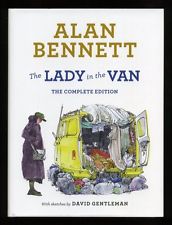
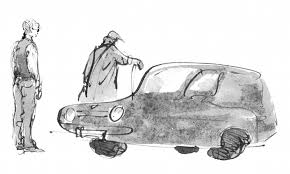
ladyinvan3And there is also a marvellous Complete Edition which wraps up an introduction and the stage play script revealing the full workings of plot and humour, the bridge between diary and drama,  including delicious extra details like Miss S’s encounter with the Virgin Mary (outside the post office) and her perennial painting of her van with bits of Madeira cake mixed into the yellow emulsion for extra effect. It is a special tome with drawings by David Gentleman.ladyinvan4

The diary was first published in 1989 in the London Review of Books. The gestation for writing projects to reach media maturity is counted in decades, barely in a mortal’s lifetime; in Bennett’s case notwithstanding his success with the Madness of King George (1994) and History Boys (2004) and of course being part of the same media family of Camden itself. Writing is sluggish business, commercially speaking. What we might think of as modern, is in fact last century, looking back down the years.

Another book too that finally also reached the big screen this year, Patricia Highsmith’s Carol was first published in 1952. Highsmith died in 1995. It has taken more than half a century to reach a mass audience. The Bennett effect is only half as quick.


Posted in 101greatreads, Biography, Non fiction | Tagged , , , | Leave a comment

Books of the year 2015

THERE were some real stand out books this year, albeit none of them seemed to make a dent on the usual literary prizes. I especially recommend for Christmas stockings and for getting the new year off to a fine start:

Sapiens, a brief history of mankind by Yuval Noah Harari – will make you think again

The burning room by Michael Connelly – masterful cop plot

The buried giant by Kazuo Ishiguro – inexplicably not listed for any of the big fiction prizes, a towering work


Posted in Xetera | Tagged , | Leave a comment

City of Bohane by Kevin Barry (Vintage)

bohane

“Whatever is wrong with us is coming in off that river. No argument: the taint of badness on the city’s air is a taint off that river.”

A GANGLAND fantasy set in the tenements of some futuristic Irish city. The inhabitants “are given to bouts of rage and hilarity which makes us unpredictable”, and may not be unconnected to the amount of herb and poppy they smoke.

It is not only the river that taints the city, but the violent winds that blow “49 weeks out of the year, the effect is not physical only…but philosophical.”

The 98 steps are policed by the Fancy gang, so called because mod-like they like to dress fancy: “A Fancy boy would wear clicker’d clogs with crimson sox pulled to the top of the calf and worn beneath three quarter length trackie cut-offs, with a tweed cap set back to front, a stevedore donkey jacket with hi-viz piping, the hair greased back and quiffed – oh we must have looked like proper fucking rodericks – with a little silver herb-pipe on a leather lace around the neck”.

It is a strip cartoon with rich, sticky prose for images. Some of the dialogue can be hard work but it has its own rewards every now and then.

“‘Do you hear me clearly?’

‘Cathedral bells, Mr Hartnett’.”

The long man likes his shots and seeds and…still listens to his old ma who directs the chaos from her bed, aged 90+…Well written nonsense enhanced by a love triangle of hoodlums that eventually reaches a crescendo not so much as a novel but more as a bawdy, western-style ballad behind-the-bike-sheds.


Posted in fiction | Tagged , , , | Leave a comment

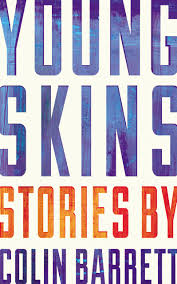
Young skins by Colin Barrett (Vintage)

young skins

“My town is nowhere you have been, but you know its ilk. A roundabout off a national road, an industrial estate, a five screen Cineplex, a century of pubs packed inside the square mile of the town’s limits. The Atlantic is near, the gnarled jawbone of the coastline with its gull-infested promontories is near.”

THERE is an argument that the short story is a better media for our times, the 45 to the novel’s 33. It fits better with shortened, Facebook attention spans. It transfers to film without shackling the director with too much detail. Calm with Horses here is 70 or so pages but could make a fine script if the evangelical ending is not too daunting.

The other stories are all from the same constituency, the same era revolving around that great Irish theme: those who stay behind and those who leave, “the hard scrabble tutelage of those who come out of the other side of their damage.” And we are back in Enniscorthy and Roscommon, the next generation on from Colm Toibin where “households team with ever expanding factions of brothers and sisters”.

These are the tiger children, a norties generation, a feral community where adults have largely been overrun, a kind of Lord of the Flies 2015. “Beyond a certain age all old dears, looked the same”.

We have a funeral cameo, a mine, a murderous macabre, we meet Mattan the pool shark, Tansy the psycho, Minion, an expert bar-grift and the lovers of rock star Maryanne. The dialogue is all brogue wit. This is a suicide note: “I am going to put myself to sleep for a bit longer than usual. Call it eternity”.

Or this snappy description:

“One’s a Connolly, spotty faced like a dropped bolognese…”

It is a land, as Ursula tells us “where everyone deserves better.”

We have another Irish talent, of serious note.

Posted in 101greatreads, fiction | Tagged , , , , , | Leave a comment

A concise Chinese-English dictionary for lovers by Xiaolu Guo (Vintage)

concise chinese

“Usually the man says a thing, and the woman questions it.”

AN easy, very literal conceit: young Chinese girl meets middle aged white Englishman. Be my guest, he says. And so she moves in with him.

Unfortunately for her he turns out also to be a bisexual drifter cum sculptor with commitment issues. Each chapter has its own marker word to describe their affair and her learning English with different stilted nuances for Chinese and English, so the first chapter is Alien. Standing in the queue at Heathrow the sign says Alien and Non Alien:

“I am alien, like Hollywood film Alien. I live in another planet.”

Where she is all feisty, warrior-traveller from enlightened China, he is a bit wet. In fact he is very wet. It is a book about misunderstanding. He wants to read the Guardian and she wants to practise her English. The stereotypes are inverted, he is the one who gets objectified. She gets the interest in pornography, has lesbian dreams, while he, symbolically, moulds body parts in the bath.

“I met you; a man was born in the year of Rat. A rat never has a stable home, like me, born the year of the goat. Two unstable animals…”

There are some funny plays on the English: “‘That is your clitoris’, you tell me. ‘Liquorice?’ I found there the colour of my sex is brown. I never know the colour of my sex before”.

I also liked “peterfiles and perverts”.

All this is set on a timetable, not her biological clock but running down her visa in time to master English and win him over before she gets deported and/or ostracised at home…The ending is quite touching.

It says the characters are not real (but the love is) but you wonder…

Posted in fiction | Tagged , , | Leave a comment

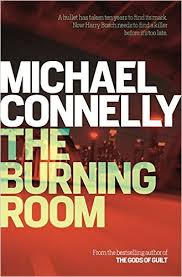
The burning room by Michael Connelly (Orion)

burning room

“Deep down Bosch knew the dead were the dead and they no longer suffered the cruelties of life.”

I lIKE Harry, he is the sort of detective you might want on your block, ex-Vietnam ‘gator, single parent, coffee obsessive, jazz-listener, been round the block, a quiet guy. As he says:

“The good ones all had that hollow space inside. The empty place where the fire burns. For something. Call it justice. Call it the need to know. Call it the need to believe that those who are evil will not remain hidden in darkness forever”.

The chapters are organised like police reports, a masterclass in storytelling: the body, the background, the team, the press, visit the crime scene, etc…

Connelly belongs to that old Hollywood adage: tell ’em what you are going to do, then tell ’em what you are doing, and then tell ’em what you just did.  It is a complex tale he weaves which starts with the seemingly random shooting of a Mariachi player. There is also a backdrop of troubles at the LAPD with threats to pensions, cuts in budgets, shady deals with street gangs, doubts about the honesty of the new intake of officers. The decline is mirrored by the shrivelling of the press, somewhat bitterly noted, because Connelly himself once trod his beat as a crime reporter.

We are in the dark waters where politics and murder meet. You get little tips as you go: The plan was…This would be important…which is sort of handy if you are reading in chunks.

Connelly can’t write really, or he overwrites. Harry walks through a door marked Entrance. But that also gives an edge of realism. He sounds like what he is, a detecto.

Literally, in one instance, he sniffs out a miscreant from the smell of coffee and the ping of a text message.

It is slated to go to a TV series and this will make fine TV. The producers will not have the publisher’s qualms and will slash out the verbiage while the camera hoovers up pages of description and leave us with the core of substantial characters and tangled plot lines. The book form feels like a bit of cultural archeology, but as Harry confides to his new sidekick Lucky Lucy: “Cases are made with patience…not lightning strikes.” Good novels too.

Posted in 101greatreads, fiction | Tagged , , , | Leave a comment

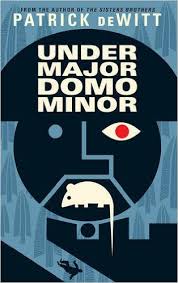
Under major domo minor by Patrick deWitt (Granta)

undermajordomominor

“Lucien Minor’s mother had not wept, had not come close to weeping in their parting.”

THE much anticipated (in these quarters) second book from Patrick deWitt, the follow up to Scissor Sisters. The two share striking graphic covers, and sharp titles, a play on character names.

I imagine deWitt having watched a box set of the Lord of the Rings all weekend resolving that the one thing it lacked was a sense of fun.

The writing is quick. “The valise stood alert on the floor beside him”. The women are “lard-armed”.

We are in some unidentified land.  There are trains and barons but no specifics just a castle and mountains, nor any sense of period, except an archaic tone in the narrative; “…there occurred an untoward happening.”

The effect blindfolds the reader, removes any sense of the everyday. We are forced to follow the thread of narrative without any familiar handles to grasp. Some imagery is almost Dali-esque: “The cut and style of each man’s outfit was dissimilar to his fellows’: one wore long trousers, another knickers with tall boots, one sported a shearling collar, while his neighbour trailed a scarf. Even their rifles were dissimilar, the lengths of the bayonets varying drastically.” The castle is Escher-like.

Chapters are short and concise, to be read in sandwich sized bites…each one leading up to a page turning sense of riddle, of mystery, of ooh! of aah!! of an edge of the seat expectation. The characters too linger in the mind.

There is a phrase half way through that catches the mood: “an exhilaration, for how curious life was, how unfathomably novel, and occasionally, wonderful.” Or again: “an invigorating concoction of jubilation and dire agitation”.

Humour is tricky in the naive, but all round this is a  wonderfully unpredictable journey into the bizarre, more fairy than fable perhaps, in which the chacters themselves have slightly altered perspectives, peculiar as it says, or in the the case of L pondering the question of the lie: “He wondered if it wasn’t man’s finest achievement, and after some consideration, decided that it was.”

At the back deWitt credits a list of other writers he has been reading including Dahl and Donleavy, but for me one missing might be Lewis Caroll.


Posted in fiction | Tagged , , , | Leave a comment

Notes on the Man Booker prize 2015

ONE of the Amazon reviewers of Marlon James’s winning Brief History of Seven Killings said that: “If you are interested in Jamaica, corruption, sex and killings, this is a must read”. My problem is I am not interested in that kind of portrait of Jamaica, in that kind of corruption, in that kind of violence which at times is disturbingly well written. If I want to hang around on a street corner and play gangster I can do that closer to home. I don’t. And I don’t want to read about it. Another review called it a “chore”.

More charitably, I  have Killings down among a small clique of recent books, which are defined by their density, by thick woolly verbal jumpers, literary milkshakes if you like. Similar might be the first translation from the Irish of Mairtin O Cadhain’s Dirty Dust which has the most wonderful, laugh out loud opening lines. The Wake by Paul Kingsnorth, written in a style of middle English but which has been picked up by the uber theatre talent Mark Rylance who will surely make something good of it. The only one of the genre I have included here so far is from Eimear McBride which is mercifully short compared to the others. They all belong in a category you might call prose-poetry, experiments in language or that non sequitor beloved of university courses, creative writing.

For a pre-eminent literary prize like the Man Booker I would prefer a winner that converted people to reading more books, something more predictably populist. I want it to be a best seller, not a killjoy. Over the last few years the Man Booker has yielded for me a couple of favourite classics, neither of which won, one from Ruth Ozeki and one from Patrick deWitt. The last winner that I have included here so far was from 2007 by Anne Enright.

Too many people I suspect are daunted by the sheer act of reading these days, of giving up time and other things to invest in a book. If you look at the bestseller lists, you notice how many are serials, repeats of the same thing, like favourite TV series. They are crimos and love stories or girls coming of age. Readers are voting to find their favoured universe and inhabit it. You probably do not want to live in any of this year’s shortlisted books except possibly  Spool of Blue Thread which is meant to be an ambling long read of a comfortable slice of Americana.

The others could have used some help. For me this is not a criticism of the writing – in sheer writing terms the words in this selection of books have been very much to the fore – but of the process. There is a rush to print. Each of the novels would have benefited from a moment’s pause,  the skills of an editor, to focus, adjust, trim, tweak, and, yes, cut, but this is a skill publishers seemingly no longer feel they need and/or we have a generation of very timid editors indeed. Given how much money is potentially at stake (for a relatively small investment in most novels), this lack of care and attention seems absurd. The process has become relentless to the point that the product is shoddily produced, but no matter there will be another bus along soon and one after that and maybe that will work…no matter that shirts are not tucked in, shoelaces not tied, buttons are undone.

A patriotic concern is that only one of the short list, the tough love of Sunjeev Sahota’s Runaways deals with UK issues and concerns. Does this reflect a wider inarticulation of the debates or non debates in this country, are we mugged by too much information and stifling our writers from explaining the surrounding context? Or are we not commissioning them to do so? We are, we are invited to think, happy to wrap ourselves in a blanket of BBC dross. Or maybe like TV news we, or in this case the judges,  prefer to look at things father away from home?

Of course you may disagree but the books listed here as in the 101 represent a more dynamic set of literary values. You can say that is a personal, subjective judgement. I cannot object, but I have the sense that I am not alone. Brooklyn is now coming out as a fim. Hurrah! Killings, I am afraid, will not.

Posted in fiction, Outtakes | Tagged , | Leave a comment

A brief history of seven killings by Marlon James (Oneworld)

7killings

“I know I was fourteen. That me know. I also know that too many people talk too much, especially the American who never shut up, just switch to a laugh every time he talk ’bout you, and it sound strange how he can put your name beside people we never hear ’bout, Allende Lumumba, a name that sound like a country that Kunta Kinte come from.”

Hey, Marlon, man. Me hear you wun something… Yeah, man, the Man Booker. What’s that man, Man Booker? Man it is the Man Booker, man. Wassat, man? A book prize, man, the Man Booker. Bookerr, like a book of something? Is a name, man, that’s all, man. Wot you doing writing books down here…? Is that wot they reading in Sandals? Yea, in Sandals in their sandals, reading. Wot you wrote? Me wrote, man. We spend our lives trying to get up there where they are reading about what its like down here? I guess. Is it any good? Wassat? Yerbook, man, you Man, book, man? Yeah its magnanimous, wonderlicious. Maybe I read it. Why you wanna read it? You live it. Me live it. The madness, you know.

Notes on the Man Booker 2015


Posted in 101greatreads, fiction | Tagged , | Leave a comment

Nora Webster by Colm Toibin (Penguin)

norawebster

“You must be fed up with them. Will they never stop coming?”

WE are back in Enniscorthy on the south east tip of Ireland midway between Dublin and Cork. We have already met Nora tangentially in Brooklyn. Eilis’s mother called her the “nicest of people in the whole town”. And there is the photograph taken at Cush. And Eilis’s brother Jack Lacey who moved to Birmingham.

The sea howls. The sky is bruised. She put fresh scones on a plate with melting butter and poured the tea. In a subtle way that sentence shows how well Toibin writes. It moves us along without fuss, the butter is melting, she is pouring the tea. Things are happening all around. It is alive.

We begin in grand Irish style with a funeral. I can’t tell you how sorry I am. Nora is widowed with the two boys. The two girls are away at school.

Starting with a death is a bit of an advantage for a story teller because it brings everyone into focus without prejudicing any future actions or in this case reactions. Not that you are expecting a mad axeman out of this slice of middle Eiredom. Toibin draws you carefully into his village.

It was as “though she had been in a car accident, it was this wandering in a sea of people with the anchor lifted”. This sea ebbs with nuns, with the Troubles in the north, with chat from the golf club, with the need to go back to work. There is emancipation, out of grief.

There are some wonderful, deep characters here too. I totally like the bit part Billy who is tone deaf but marries the music teacher, a former nun. He builds her a soundproof studio for classes so he does not have to hear her. The edges of each character carefully overlap in the village, in the factory, in the politics, big and small, their concerns shuffling like gossip around town and family…almost exploding with tension at the town quiz.

We are on the cusp of rural life, of a distant America, of an Ireland past, all rubbing along side by side, an Ireland in the ’60s and ’70s. Nora has angst over whether she should buy a record player…a stereo record player, that is. Or a phone?

Her journey out of widowhood is also that of the other people of Enniscorthy, and around, at the time.

Posted in 101greatreads, fiction | Tagged , , , , , | Leave a comment