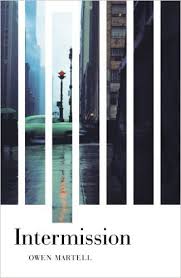
Intermission by Owen Martell (Windmill Books)

intermission

“It was late in the evening, after dinner and Debby, before Harry got a chance to open the paper.”

OWEN Martel told me that Dylan was probably not the greatest Welsh writer called Thomas, but only the second, or perhaps third best after…Wikipedia lists seven notable literary Thomases….

In the same way Bill may not be the best known Evans to surface in America, Wikipedia lists more than 50 pages to choose from. Ostensibly this is the story of the jazzman’s traumatic silence after the death in a car crash of his bassist Scott LaFaro. Equally it could be the story of Welsh expatriates like Bill’s father, Harry snr who might, after a few glasses of whisky, mention that it was a pity Wales did not follow the Irish secession from Britain in 1916. Instead he and many other families headed to New York…

Some background: Bill Evans was the pianist for Miles Davis. He formed his own trio which recorded one of the seminal jazz albums Sunday at the Village Vanguard. Days after, the double bassist Scott Lafaro died in a car crash. Evans went into shock and called a hiatus which is the story, or parenthesis in his life, of this book.

One mark of a good writer is that he/she can write about anything, so “the meeting of eyes had something zoological about it, a scoping out of caged beasts”.

The story is told from the perspective of each of the Evans family who dance obliquely around Bill’s silences, careful not to upset him like he is a prized piece of fragile family porcelain…a trip to the golf course becomes an event, a small triumph. The only person he really responds to is his niece Debby, for whom another album from the sessions Waltz for Debby was taken. The little girl tends him with imaginary lemonade and efficient kindness.

The piano is also a part of this story.  “The white keys, exposed again to the lamplight, are oysterous, the black lace with silver where his fingers, for all their apparent glide, have left snail-trail deposits”. And so is summer in New York. “The heat hit him like waves, yielding the day’s accumulation slowly, like a poisoner dosing his victims”.

It is also a story about a blank, nothing happening, faithfully, nothing happens, although Evans real life was not short of dramas  like heroin addictions, running off with a young waitress, and older brother and narrator here Harry’s ultimate schizophrenia and suicide.

Martell waves a flag for jazz and for Welsh writing.

Btw: StuffAboutNames.com tells me there are 75 other Owens listed as writers, but only four other Martells and while we are on the etymological, Windmill is an imprint of the galactic Random House, dedicated among other things to exceptional new talent. Good tilt, boys and girls.

Posted in Biography, fiction | Tagged , , , , , | Leave a comment

David Bowie’s 100 best reads

The late David Bowie was an enthusiastic reader. In 2013, he posted  his 100 favorite reads on his Facebook page. Here it is:

Interviews With Francis Bacon by David Sylvester
Billy Liar by Keith Waterhouse
Room At The Top by John Braine
On Having No Head by Douglass Harding
Kafka Was The Rage by Anatole Broyard
A Clockwork Orange by Anthony Burgess
City Of Night by John Rechy
The Brief Wondrous Life Of Oscar Wao by Junot Diaz
Madame Bovary by Gustave Flaubert
Iliad by Homer
As I Lay Dying by William Faulkner
Tadanori Yokoo by Tadanori Yokoo
Berlin Alexanderplatz by Alfred Döblin
Inside The Whale And Other Essays by George Orwell
Mr. Norris Changes Trains by Christopher Isherwood
Halls Dictionary Of Subjects And Symbols In Art by James A. Hall
David Bomberg by Richard Cork
Blast by Wyndham Lewis
Passing by Nella Larson
Beyond The Brillo Box by Arthur C. Danto
The Origin Of Consciousness In The Breakdown Of The Bicameral Mind by Julian Jaynes
In Bluebeard’s Castle by George Steiner
Hawksmoor by Peter Ackroyd
The Divided Self by R. D. Laing
The Stranger by Albert Camus
Infants Of The Spring by Wallace Thurman
The Quest For Christa T by Christa Wolf
The Songlines by Bruce Chatwin
Nights At The Circus by Angela Carter
The Master And Margarita by Mikhail Bulgakov
The Prime Of Miss Jean Brodie by Muriel Spark
Lolita by Vladimir Nabokov
Herzog by Saul Bellow
Puckoon by Spike Milligan
Black Boy by Richard Wright
The Great Gatsby by F. Scott Fitzgerald
The Sailor Who Fell From Grace With The Sea by Yukio Mishima
Darkness At Noon by Arthur Koestler
The Waste Land by T.S. Elliot
McTeague by Frank Norris
Money by Martin Amis
The Outsider by Colin Wilson
Strange People by Frank Edwards
English Journey by J.B. Priestley
A Confederacy Of Dunces by John Kennedy Toole
The Day Of The Locust by Nathanael West
1984 by George Orwell
The Life And Times Of Little Richard by Charles White
Awopbopaloobop Alopbamboom: The Golden Age of Rock by Nik Cohn
Mystery Train by Greil Marcus
Beano (comic, ’50s)
Raw (comic, ’80s)
White Noise by Don DeLillo
Sweet Soul Music: Rhythm And Blues And The Southern Dream Of Freedom by Peter Guralnick
Silence: Lectures And Writing by John Cage
Writers At Work: The Paris Review Interviews edited by Malcolm Cowley
The Sound Of The City: The Rise Of Rock And Roll by Charlie Gillete
Octobriana And The Russian Underground by Peter Sadecky
The Street by Ann Petry
Wonder Boys by Michael Chabon
Last Exit To Brooklyn By Hubert Selby, Jr.
A People’s History Of The United States by Howard Zinn
The Age Of American Unreason by Susan Jacoby
Metropolitan Life by Fran Lebowitz
The Coast Of Utopia by Tom Stoppard
The Bridge by Hart Crane
All The Emperor’s Horses by David Kidd
Fingersmith by Sarah Waters
Earthly Powers by Anthony Burgess
The 42nd Parallel by John Dos Passos
Tales Of Beatnik Glory by Ed Saunders
The Bird Artist by Howard Norman
Nowhere To Run The Story Of Soul Music by Gerri Hirshey
Before The Deluge by Otto Friedrich
Sexual Personae: Art And Decadence From Nefertiti To Emily Dickinson by Camille Paglia
The American Way Of Death by Jessica Mitford
In Cold Blood by Truman Capote
Lady Chatterly’s Lover by D.H. Lawrence
Teenage by Jon Savage
Vile Bodies by Evelyn Waugh
The Hidden Persuaders by Vance Packard
The Fire Next Time by James Baldwin
Viz (comic, early ’80s)
Private Eye (satirical magazine, ’60s – ’80s)
Selected Poems by Frank O’Hara
The Trial Of Henry Kissinger by Christopher Hitchens
Flaubert’s Parrot by Julian Barnes
Maldoror by Comte de Lautréamont
On The Road by Jack Kerouac
Mr. Wilson’s Cabinet of Wonder by Lawrence Weschler
Zanoni by Edward Bulwer-Lytton
Transcendental Magic, Its Doctrine and Ritual by Eliphas Lévi
The Gnostic Gospels by Elaine Pagels
The Leopard by Giusseppe Di Lampedusa
Inferno by Dante Alighieri
A Grave For A Dolphin by Alberto Denti di Pirajno
The Insult by Rupert Thomson
In Between The Sheets by Ian McEwan
A People’s Tragedy by Orlando Figes
Journey Into The Whirlwind by Eugenia Ginzburg

Posted in Xetera | Leave a comment

The paying guests by Sarah Waters (Virago)

PayingGuests“The Barbers had said they would arrive by three. It was like waiting to begin a journey, Frances thought.”

SARAH Water’s writing career follows the trusted big crimo formula. She does not have a central hero/ine but her themes are distinct. You know what you are getting. A one girl crusade to offset the heterosexuality of Mills and Boon. Girls to the fore, skiving their cares away. A carefully prepared period backdrop. The conversation in the publisher’s office might have been: Can you write the same book again? But different? Yes, another 600 pages, please. Waters crimes though are not to be solved but rather committed with awe, angst, glee.

Her Little Stranger was listed as number 45 in the flakey BBC poll of the best English novels, sandwiched between Salman Rushdie’s Midnight’s Children and Hilary Mantel’s Wolf Hall. Umm.

Her new novel is a forensic analysis of a passionate affair that barely overlooks a heart flutter or a floorboard creaking. It won the Sunday Times fiction book of the year.

Her singular skill is to let her story unravel through her characters so the plot unfolds in a present tense. Her period is picked off with timely adjectives…pluck… queer…a fizz of impatience… leisurely yodelling yawns.

As you might argue about Fifty Shades of Grey, it is firstly a love story, yes between women but not so you would say it was seedy: “How well she filled her own skin. She might have been poured generously into it, like treacle”. Waters can write.

Or this early meeting on the stairs. “Her kimono parted as she landed, exposing more of her night-dress, and giving an alarming suggestion of the rounded, mobile unsupported flesh inside.”

We are on the cusp of the end of world war 1. There is a sense of, as yet undefined, hope and freedom to come. Frances’ two brothers have been killed. Her father has died leaving a  financial mess. Her mother and her have let go the servants and taken in the paying guests.

Here is a rather splendid image: “Their friendship sometimes struck Frances as being like a piece of soap – like a piece of ancient kitchen soap that had got worn to the shape of her hand”.

The asphyxiating, inevitable denouement gets the same meticulous chronicling, a whole closet of angsts, guilts, deceits which can hardly be as sexy as the chase of the first half and are more testing of our sympathies…the formula badly needed a gear change but eventually France’s demons become flesh, the chain slips back onto the cogs for a final disentanglement of limbs post the protracted clinch between passion and guilt.

There is an elegant appraisal of early lesbian fiction by Margaret Talbot here in the New Yorker.

Posted in fiction | Tagged , , | Leave a comment

Into the wild by Jon Krakauer (Pan)

intothewild

“Greetings from Fairbanks. This is the last you shall hear of  me Wayne”.

JON Krakauer wrote one of the great Everest books Into Thin Air, which I have not included here because it was written in 1997. This work is from the same time, originally published as a magazine article commissioned by the magazine Outside about a disappearance in 1992. Then Krakauer retraced the last months of his would-be vagabond hero for this book.

His style has the concision, the name checking of Truman Capote and the story more than a little of Modiano except we are in the netherlands, underneath the comfortable blanket of the American dream, armed only with a journal, a few postcards, a few reminiscences.

Chris, aka Alex, McCandless, college educated, from a good family,  renounces everything to live the life on the road, giving his savings to Oxfam, hopping freight trains, scoring mission beds. His dream is to travel to Alaska, inspired by his hero Jack London in tales like White Fang and Call of the Wild. But as the reporter in Krakauer points out, London was not perhaps the best of role models, killing himself at 40, “a fatuous drunk, obese and pathetic”.

But Alaska, it seems, “has always been a magnet for dreamers and misfits”.

Krakauer skilfully picks up this mystery and turns it into an exquisite examination of the psychology of taking risks in general, the quest for danger and the thin line between bravery and foolishness. On the way he manages to include a terrifying climb of his own and end on a detective story twist to boot.

Posted in 101greatreads, Biography, Non fiction | Tagged , , | Leave a comment

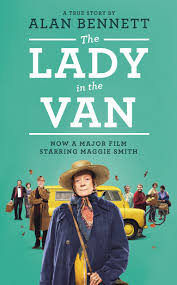
The lady in the van by Alan Bennett

ladyinvan

“I ran into a snake this afternoon,’ Miss Shepherd said. ‘It was coming up Parkway. It was a long grey snake – a boa constrictor, possibly…'”

POSSIBLY, is one of Miss Shepherd’s trademark conversational gambits in this miniature masterpiece, a short profile of a great British eccentric who parked her van(s) in the dramatist’s garden for the best part of two decades in Camden Town.

The insights are double edged, revealing as much about the author as portraitist, himself a bit of a great British eccentric, possibly. 

By way of supporting role there is the backdrop of Camden itself taken over by a generation of knockers-through, with its large semi detached villas, never entirely decayed, and the Williams and Glynns bank outside of which Miss S sells her tracts, chalking their titles on the pavement stones, the barred windows of the convent…it takes one eccentric to appreciate another.

Brevity though is no obstacle to the whole media circus coming to town, this original text having evolved into radio, a stage play and now a film with Maggie Smith assuming the lead peculiarities of Miss Shepherd, not her real name but borrowed as it were from the Good Shepherd.

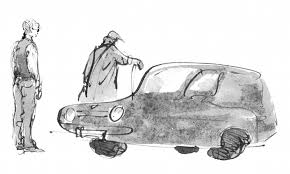
ladyinvan3And there is also a marvellous Complete Edition which wraps up an introduction and the stage play script revealing the full workings of plot and humour, the bridge between diary and drama,  including delicious extra details like Miss S’s encounter with the Virgin Mary (outside the post office) and her perennial painting of her van with bits of Madeira cake mixed into the yellow emulsion for extra effect. It is a special tome with drawings by David Gentleman.ladyinvan4

The diary was first published in 1989 in the London Review of Books. The gestation for writing projects to reach media maturity is counted in decades, barely in a mortal’s lifetime; in Bennett’s case notwithstanding his success with the Madness of King George (1994) and History Boys (2004) and of course being part of the same media family of Camden itself. Writing is sluggish business, commercially speaking. What we might think of as modern, is in fact last century, looking back down the years.

Another book too that finally also reached the big screen this year, Patricia Highsmith’s Carol was first published in 1952. Highsmith died in 1995. It has taken more than half a century to reach a mass audience. The Bennett effect is only half as quick.


Posted in 101greatreads, Biography, Non fiction | Tagged , , , | Leave a comment

Books of the year 2015

THERE were some real stand out books this year, albeit none of them seemed to make a dent on the usual literary prizes. I especially recommend for Christmas stockings and for getting the new year off to a fine start:

Sapiens, a brief history of mankind by Yuval Noah Harari – will make you think again

The burning room by Michael Connelly – masterful cop plot

The buried giant by Kazuo Ishiguro – inexplicably not listed for any of the big fiction prizes, a towering work


Posted in Xetera | Tagged , | Leave a comment

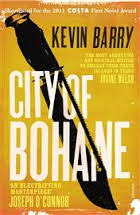
City of Bohane by Kevin Barry (Vintage)

bohane

“Whatever is wrong with us is coming in off that river. No argument: the taint of badness on the city’s air is a taint off that river.”

A GANGLAND fantasy set in the tenements of some futuristic Irish city. The inhabitants “are given to bouts of rage and hilarity which makes us unpredictable”, and may not be unconnected to the amount of herb and poppy they smoke.

It is not only the river that taints the city, but the violent winds that blow “49 weeks out of the year, the effect is not physical only…but philosophical.”

The 98 steps are policed by the Fancy gang, so called because mod-like they like to dress fancy: “A Fancy boy would wear clicker’d clogs with crimson sox pulled to the top of the calf and worn beneath three quarter length trackie cut-offs, with a tweed cap set back to front, a stevedore donkey jacket with hi-viz piping, the hair greased back and quiffed – oh we must have looked like proper fucking rodericks – with a little silver herb-pipe on a leather lace around the neck”.

It is a strip cartoon with rich, sticky prose for images. Some of the dialogue can be hard work but it has its own rewards every now and then.

“‘Do you hear me clearly?’

‘Cathedral bells, Mr Hartnett’.”

The long man likes his shots and seeds and…still listens to his old ma who directs the chaos from her bed, aged 90+…Well written nonsense enhanced by a love triangle of hoodlums that eventually reaches a crescendo not so much as a novel but more as a bawdy, western-style ballad behind-the-bike-sheds.


Posted in fiction | Tagged , , , | Leave a comment

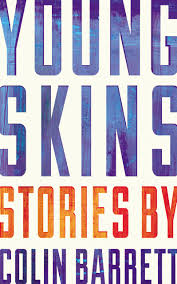
Young skins by Colin Barrett (Vintage)

young skins

“My town is nowhere you have been, but you know its ilk. A roundabout off a national road, an industrial estate, a five screen Cineplex, a century of pubs packed inside the square mile of the town’s limits. The Atlantic is near, the gnarled jawbone of the coastline with its gull-infested promontories is near.”

THERE is an argument that the short story is a better media for our times, the 45 to the novel’s 33. It fits better with shortened, Facebook attention spans. It transfers to film without shackling the director with too much detail. Calm with Horses here is 70 or so pages but could make a fine script if the evangelical ending is not too daunting.

The other stories are all from the same constituency, the same era revolving around that great Irish theme: those who stay behind and those who leave, “the hard scrabble tutelage of those who come out of the other side of their damage.” And we are back in Enniscorthy and Roscommon, the next generation on from Colm Toibin where “households team with ever expanding factions of brothers and sisters”.

These are the tiger children, a norties generation, a feral community where adults have largely been overrun, a kind of Lord of the Flies 2015. “Beyond a certain age all old dears, looked the same”.

We have a funeral cameo, a mine, a murderous macabre, we meet Mattan the pool shark, Tansy the psycho, Minion, an expert bar-grift and the lovers of rock star Maryanne. The dialogue is all brogue wit. This is a suicide note: “I am going to put myself to sleep for a bit longer than usual. Call it eternity”.

Or this snappy description:

“One’s a Connolly, spotty faced like a dropped bolognese…”

It is a land, as Ursula tells us “where everyone deserves better.”

We have another Irish talent, of serious note.

Posted in 101greatreads, fiction | Tagged , , , , , | Leave a comment

A concise Chinese-English dictionary for lovers by Xiaolu Guo (Vintage)

concise chinese

“Usually the man says a thing, and the woman questions it.”

AN easy, very literal conceit: young Chinese girl meets middle aged white Englishman. Be my guest, he says. And so she moves in with him.

Unfortunately for her he turns out also to be a bisexual drifter cum sculptor with commitment issues. Each chapter has its own marker word to describe their affair and her learning English with different stilted nuances for Chinese and English, so the first chapter is Alien. Standing in the queue at Heathrow the sign says Alien and Non Alien:

“I am alien, like Hollywood film Alien. I live in another planet.”

Where she is all feisty, warrior-traveller from enlightened China, he is a bit wet. In fact he is very wet. It is a book about misunderstanding. He wants to read the Guardian and she wants to practise her English. The stereotypes are inverted, he is the one who gets objectified. She gets the interest in pornography, has lesbian dreams, while he, symbolically, moulds body parts in the bath.

“I met you; a man was born in the year of Rat. A rat never has a stable home, like me, born the year of the goat. Two unstable animals…”

There are some funny plays on the English: “‘That is your clitoris’, you tell me. ‘Liquorice?’ I found there the colour of my sex is brown. I never know the colour of my sex before”.

I also liked “peterfiles and perverts”.

All this is set on a timetable, not her biological clock but running down her visa in time to master English and win him over before she gets deported and/or ostracised at home…The ending is quite touching.

It says the characters are not real (but the love is) but you wonder…

Posted in fiction | Tagged , , | Leave a comment

The burning room by Michael Connelly (Orion)

burning room

“Deep down Bosch knew the dead were the dead and they no longer suffered the cruelties of life.”

I lIKE Harry, he is the sort of detective you might want on your block, ex-Vietnam ‘gator, single parent, coffee obsessive, jazz-listener, been round the block, a quiet guy. As he says:

“The good ones all had that hollow space inside. The empty place where the fire burns. For something. Call it justice. Call it the need to know. Call it the need to believe that those who are evil will not remain hidden in darkness forever”.

The chapters are organised like police reports, a masterclass in storytelling: the body, the background, the team, the press, visit the crime scene, etc…

Connelly belongs to that old Hollywood adage: tell ’em what you are going to do, then tell ’em what you are doing, and then tell ’em what you just did.  It is a complex tale he weaves which starts with the seemingly random shooting of a Mariachi player. There is also a backdrop of troubles at the LAPD with threats to pensions, cuts in budgets, shady deals with street gangs, doubts about the honesty of the new intake of officers. The decline is mirrored by the shrivelling of the press, somewhat bitterly noted, because Connelly himself once trod his beat as a crime reporter.

We are in the dark waters where politics and murder meet. You get little tips as you go: The plan was…This would be important…which is sort of handy if you are reading in chunks.

Connelly can’t write really, or he overwrites. Harry walks through a door marked Entrance. But that also gives an edge of realism. He sounds like what he is, a detecto.

Literally, in one instance, he sniffs out a miscreant from the smell of coffee and the ping of a text message.

It is slated to go to a TV series and this will make fine TV. The producers will not have the publisher’s qualms and will slash out the verbiage while the camera hoovers up pages of description and leave us with the core of substantial characters and tangled plot lines. The book form feels like a bit of cultural archeology, but as Harry confides to his new sidekick Lucky Lucy: “Cases are made with patience…not lightning strikes.” Good novels too.

Posted in 101greatreads, fiction | Tagged , , , | Leave a comment