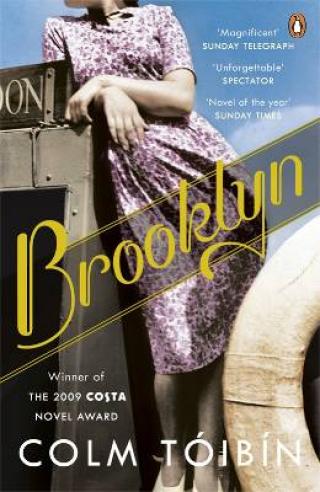
Brooklyn by Colm Toibin (Penguin)

brooklyn

“Eilis Lacey, sitting at the window of the upstairs living room in the house on Friary Street, noticed her sister walking briskly from work.”

Another major Irish talent. This one from County Wexford. A professor no less in creative writing. You probably knew that. This won the 2009 Costa novel award. Talk among yourselves while I catch up.

His writing is deceptive. Nothing is happening. He might be telling you about your loved cousin and is etching in colours and thoughts as he rambles. His heroine Eilis complains of the lack of news and details in her letters from home while hers are written in the third person. Toibin has no such inhibitions. It is the 1950s we deduce, the post war diaspora of an Irish family to…well the title gives it away. We are in the brownstone stoops with the Jewish and the Italians and the Poles. The humour catches you like a dig in the ribs, the dialogue crackles and the narrative is so carefully drawn that every sentence becomes essential.

Often men writing as women (or women writing as men) is a trapdoor, but Toibin keeps a polite distance, the invisible, neutral companion. Small vignettes fill in the details. A Sunday job, a conversation with a brother, a journey on a ship…Toibin is careful to stay tightly focussed on his characters. For him it is the story telling that is the all, even there is a smack of the village gossip in his approach…did-you-hear-what-happened-when-the-Lacey-girl went-to-the-u-s-of-a? You believe it because it is so uncontrived, so mundane, so everyday. Momentous moments – personal and historic – are passed around like scones in a front parlour chat. More tea, father?

Curiously Wikipedia says Toibin does “not favour story telling”. Well Mr Encyclopedia, perhaps there is more than one way to tell a story? Sometimes plot debases. This is a pure form. A historic form, legend being passed down. This might have been called the Ballad of Eilis Lacey.  A story in the wiki explanation I presume would therefore be a shoot-em-up Dan Brown or a Geoffrey Archer or a Lee Childs.

One rule of good writing Toibin observes here is:  Never lose focus. Stay on the the subject. Never waiver. It is the same as telling a joke – there is just an Englishman, an Irishman and a Scotsman. Nothing else. It is one reason even celebrity claptrap can work because it is just me, me, me. Ultimately people are interesting, if you let them. They, after all, own the condition. The camera does much of this for film, but cannot get under the shirt, into the feelings, the motivations, the fears beneath the surface. And where here passages can be linked across days, months the focus on the person is the same. In film, this would be a visual penance and ultimately boringly one dimensional. Eilis is far from one dimensional.

Posted in 101greatreads, Biography, fiction | Tagged , , , , | 1 Comment

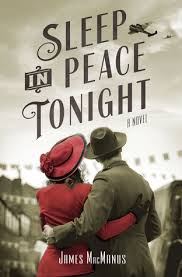
Sleep in Peace Tonight by James MacManus (Duckworth)

sleep

“The seaplane came into view just as the winter sun had begun to settle into the English Channel.”

WOLF Hall for another era. Bring up the Brogue. We are at the court of king Winston.

Britain 1941. The empire is on its knees. Rommel is disembarking in North Africa. France has fallen. Greece is falling. The North Atlantic convoys are being decimated by U boat torpedoes. Nazi invasion is expected in the summer. The government will retreat to the Cotswolds.

Enter Harry Hopkins, Roosevelt’s private envoy. One of two drunken, lecherous, chain smoking Americans out to to save the known (as in understood) world in the face of the righteous Mothers of America who want to keep their boys at home and the concessionists mediating for a post war peace with Hitler. It is a western narrative, egged on by papa Churchill, big eating, big smoking, indefatigable, desperate to draw the world’s biggest democracy into war. So desperate his daughters consort to persuade ambassadors and broadcasters.

We know this take on the world war 2, but fact and fiction are blended, like in Roger Rabbit or Woody Allen mixing old film footage with modern characters. Meet Leonora, a graphic cardboard cutout with sawdust for knickers. Hopkins has not slept for three weeks. Boom! Bombs explode around them. There is an especially cartoon moment when Churchill is naked in the bath dictating policy and asking Hopkins to pass him the soap.

MacManus has an ear for dialogue and an eye for the social mores of the time. Leonora is smoking Gaulouse – they are all smoking everywhere, three or four packs a day – sourced from the French resistance. She sits “below the salt” at the high table, ie not an invitee of import.

This is another potentially great work thwarted by its please-make-me-into-a film script. The camera snatches the decisive moments of history as if they were just another cup of tea. Or in this case glass of whisky. In fact each of the main characters has a different tipple of choice.

For Churchill empire was a by-product of trade. For the American Hopkins it was imposition. But it is Churchill the warrior who sees immediately the mistake that lost Hitler the war, overruling his generals in attacking Russia on three fronts where one single sabre swing through an unbelieving Soviet shambles probably would have secured Moscow and victory in the east.

I was told it was a book about London and the blitz. It is not. The filter on the lens though is oddly Americana. It is about war correspondents shuffling between Claridges and the Savoy and drinking black market alcohol. As a Londoner I felt intruded on, although hardly any more than a peasant in Tudor England.


Posted in Biography, fiction | Tagged , , , | Leave a comment

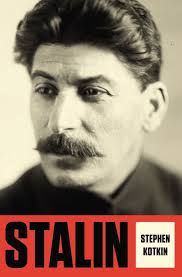
Stalin by Stephen Kotkin (Penguin)

stalin

“Russia’s double headed eagle nested across a greater expanse than that of any other state, before or since.”

Stephen Kotkin opens with this grandiose statement and proceeds to tell us this is not just a book about Stalin at all but all of modern history. He comes to history with his own ego.

But I like big dick history professors coming out of their library caves throwing tomes of ancientana at us. Usually professors are articulate. The question, from a strictly literary point of view, is how they handle the context and narrative. Some are hostage to their research, others stride on regardless. I came to this one off the back of the erudite, elegant and skilful Lenin by Robert Service (who has also penned a Stalin bio).

Kotkin, is a professor at Princetown. And this is not just one book but the first of a planned trilogy. This one is 949 pages of which 210 are notes and index. The sub deck is Paradoxes of Power 1878-1923. The paradox of course is communism or is that tsarism? Or just power?

My old history master wrote cryptic notes in the margins of our adolescent essays where we might have been saying the obvious or the crass. Ohh he might write with one ! or two !! depending how high his eyebrow might been raised. Had Kotkin been in our class his margins might have been well decorated.  Stalin has a penis, he tells us. Cor!! If the south had won the American civil war things might have been different. Really?!

Personally I wanted to read more about how exiled revolutionaries consorted with peasant girls in Siberia – apparently a regular distraction for political dissidents, Stalin fathered two children while under sentence. And rather less of the stunningly boring birth of socialism between 1900 and 1917. There comes a point where words like socialism, labour, democracy, marxism, communism etc are so overused they become meaningless. The language of 20th century politics is still narrow and limited, as if politics has not changed or evolved and are stuck between the same shafts of the same cart.  We still have a labour party, a working class etc just as they had in Russia in 1850. The only thing we don’t have is an autocractic tsar who served to demonstrate that the key problem with autocracay is that eventually nobody needs you.

The era before Stalin came to power there were no cars, no planes, no X-rays, no telephones and to boot he spent much of his formative time in exile anyway (as did Lenin) and could hardly have grasped what we now take for granted.

He, like Lenin, arrived in power of the biggest nation on the planet with hardly any experience give or take a good school report, a few bank robberies and some petty activism in his home town Georgia which was a little more akin to fascism or nationalism than communism. He faced the same the huge problem that is Russia just as the Tsars had. They lasted 300 years. His influence lasted the best part of a few decades. Arguably Vladimir Putin still faces the same problems.

“Politics is less science than art,” said  Otto von Bismark. “It is not a subject that can be taught.”An interesting gauge to apply to today’s bureaucratically inclined politicos of all sides. Lenin and Stalin made it up as they went along…

Posted in Biography | Tagged , , , | Leave a comment

10 Rules of Writing by Elmore Leonard (William Morrow)

10 rules 2

“These are rules I’ve picked up along the way to help me remain invisible when I’m writing a book, to help me show rather than tell what’s taking place in the story.”

YOU might like to follow the example of Big Issue sellers on London streets and stand outside the offices of publishers, film studios, campuses and even stationers offering would be scribblers and editors copies of this small masterpiece.

Better known for his film scripts like Hombre, Valdez is Coming, 3:10 to Yuma, Get Shorty, Jackie Brown and the TV spin offs serialised as Justified, Leonard started out writing westerns and graduated to urban crime. He died last year.

My edition is filled out by drawings by Joe Cradiello and cardboard thick paper to make it 89 pages which lend it the dignity of print, the sentences presented as poetry rather than prose of what was originally an article for the New Yorker published in 2001.

The second sentence of the introduction above reads like one of Leonard’s own post mortems, before the act as it were:

“If you have a facility for language and imagery and the sound of your own voice pleases you, invisibility is not what you are after and you can skip the rules. Still you might look them over.”

Posted in 101greatreads, Non fiction | Tagged , , , , , , | Leave a comment

The Children Act by Ian McEwan (Jonathan Cape)

ChildrenAct_UK_200

“London. Trinity term one week old. Implacable June weather. Fiona Maye, a High Court Judge, at home on Sunday evening.”

The BBC used to be very good at this kind of drama, a little unassuming well grounded plot that turns into a moral inferno. Fiona is on her second scotch. She is thinking about her third. Talisker. McEwan’s pointillistic prose is well suited to a mess of dots linking up north London details.

Husband Jack is also a whisky man, a bohemian academic who wants to run off with his silent student statistician from Muswell Hill. Couples who know each other so well become like siblings. I am like you brother now, he laments, asking for a last chance…but that is not the whole story, just a framing.

I might have preferred this, a frequent criticism, if he had been the judge and she had been the would be mistress for a sharper cut to the dramatic cloth. Too predictable perhaps these days for here it is Fiona who has married the law and the courts and is consumed by its own marital mores…and being lined up as a potential TV 9 oclock drama queen one suspects. You could hardly find a more eloquent application…


Posted in fiction | Tagged , , | Leave a comment

The Search Warrant by Patrick Modiano (Harvill Secker)

modiano2

“That is her secret.. A poor and precious secret which not even the executioners, the decrees, the occupying authorities, the Depot, the barracks, the camps, history, time – everything that corrupts and destroys you – have been able to take away from her.”

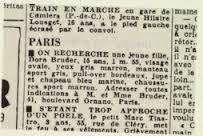
That quote is in fact the last sentence of this wonderful, macabre, paranoid story of Paris and the Nazis. The start is this little scrap of a newspaper small ad for information on a missing girl:

modiano

Written as fiction but more a rare kind of journalism that includes some autobiography intertwined with investigation. Modiano has been awarded the Nobel Prize and this slim tome is testament enough to his stature even in translation by Joanna Kilmartin (who has also translated Francoise Sagan). His first language was in fact Flemish although French is his medium of choice, Paris geography his canvas. This is very much  psycho-geography, the city pieced together as it disappeared over the decades taking its painful stories with it.

This rates as a great Jewish text even if he was not strictly Jewish himself – his mother was Belgian – and the main characters are only tangentially aware of the implications of what that might mean in world war 2 where collusions of authority overlap and where reason is overtaken by process.  Modiano, decades later, still finds fragments of lives in official records.

Why is it that repressive regimes like the Nazis or the Soviets became so obsessive about keeping records of their atrocities? What was the point of numbering Jews? Two of many questions raised here in a small work of genius.

Posted in 101greatreads, Non fiction | Tagged , , , | Leave a comment

The Guest Cat by Takashi Hiraide (Picador)

guestcat

“At first it looked like low flying ribbons of clouds just floating there, but then the clouds would be blown a little bit to the right and next to the left.”

IF you have friends who like cats. Who like gardening. Who may be curious about Japanese mores…as you can see from the opening lines it is wispy, almost meteorological, a book of clues and subtleties, tightly written, economic to the point that the narrator’s wife is reduced to a hazy haiku.

Hiraide begins boldly: “There are a few cat lovers among my close friends, and I have to admit that there have been moments when that look of excessive sweet affection oozing from around their eyes has left me feeling absolutely disgusted.” This he puts down to not having any experience of cats…I am not sure about the friends either, there are not too many here. Notice the word shame in the next line. It is a clue, but all things are relative.

I am listing this a biography because if it is fiction then it is masquerading as an I story and apparently he tells us the first three parts were published separately as short stories before he finished the book as it is. It is short, different and eloquent but no old possum. An impractical cat.

Posted in Biography | Tagged , , , | Leave a comment

Ethel and Ernest by Raymond Briggs (Jonathan Cape)

ethel&ernest

“Monday, 1928”

GRAPHIC novels as a genre can be more informed than screenplays. Film shoots with shot photos and dialogue always seem to end up shamefully in remainder shops, but illustration can also be a dangerous medium too often cliched and repetitive.

Alan Moore and Dave Gibbons Watchmen I count as a towering work of fiction but for me Batman is a movie.

Raymond Briggs biography of his parents coincides with a different era of visual narrative when comics like Beano, Eagle and Bunty were essential reading. The timeline is aptly the same. But this is no fantasy but a sometimes touching portrait across  five decades of his dad the socialist milkman and his mum who dreamed of working in an office, squabbling about class, about politics, about haircuts, horrified when their grammar school boy says he is going to “ART SCHOOL!”.

The drawings are pegs to hang a sketchy, homely tribute to the Briggs family. “So I won’t be a granny after all,” says his mum. Pity really.

A non-speaking black cat suddenly appears circa 1949 and pops in and out through the ’50s which is perhaps something words alone could not describe…

Posted in 101greatreads, Biography, Non fiction | Tagged , , , , , , , , | Leave a comment

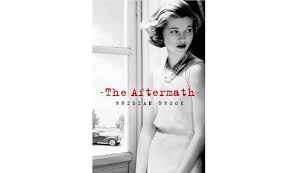
The Aftermath by Rhidian Brook (Penguin)

aftermath

“The beast is here. I’ve seen him. Berti’s seen him. Dietmar’s seen him.”

IT would seem to have taken a long time for writers to get to grips with all the emotions and smells of World War 11, as if they were still on rations and on duty.

Rhidian Brook uncorks a heady mix of despairs in the postwar rubble of Hamburg – the feral children, the wife who is “grieving mother, distant wife and curt occupier“, a precocious son let loose to fraternise, the teenage girl who refuses to recognise the end of war, an English army officer father with a mission, a displaced aristocratic German architect with family and servants…each character might have been diametrically designed to oppose the others…unfashionably here we have a German point of view of the rebuilding and an etching of English gauche sensibilities in 1946.”Germans can’t make tea’.

The scene and character building is TV slick. Rhidian – who does not get any bio on my edition – was a screen writer on TV’s Silent Witness and this is is his third novel, 15 years after the last.

The TV scene shifting is expertly done. In a perverse way the plotting reminds me of an edgier Downton Abbey. There are a great many things we do not like to talk about. The adolescent German girl defies her new English house guest with her pee filled, still warm, chamber pot, not throwing it at him, just presenting it and leaving…

Screenplay takes its illusion of depths from its actors. The camera swallows up in seconds what it might take prose to perform over many minutes. Novels, as a form,  can drill deeper to inform the history and complexity of character, of thought, of situation etc. They can deal with the human condition, subjectively, where the camera must be objective.

Brook scratches deep, but there is more underneath…

Posted in 101greatreads, fiction | Tagged , , , , , , | Leave a comment

Hack Attack by Nick Davies (Chatto and Windus)

hackattack

“This is the strangest story I have ever written.”

This is also a brilliant piece of aggressive, personalised investigative, well written journalism, an expose of British high (and not so high or grand) grandees at work. There is an extra sense of electricity in that the saga is still ongoing. We have entered a sporting contest at half time. The establishment has had its say.  Davies has a rather different version. And he is no lone wolf here but an experienced practitioner not in the “dark arts of journalism” that he wishes to expose but in the intricate geography of the English legal system. He is of a school of journalism that checks its facts.

The protagonists are the highest and mightiest – divided factions of press barons, police, politicians and a vociferous candy of aggrieved celebrities who have had their private lives meddled with. As Davies points out those last might not be so interesting except that one of the victims of phone hacking for example happened to be Her Majesty’s Home Secretary who is, one supposes, notionally in charge of national security. And another was the deputy prime minister.

At the other end of the scale, the actor Hugh Grant was playing cricket and the license plates of all the watching cars were run through the national database to secure the names and addresses of their owners in case a picture opportunity might present itself or something even more salacious.

Davies paints pictures of the News of the World newsroom at the height of its excesses as a mix of paranoiac bullying, a testosterone terror, a Stasi of the modern era able to snoop on calls, texts, emails, databases…no detail too trivial that might not be spun against a victim at some time. Or in the jargon, someone would be monstered.

There is a further frisson in that Davies is not quite as impartial a reporter as he might have been. He has not jetted in from Mars. He is the hack on the attack. These are people he grew up with as colleagues or fellow journalists, a hack himself. There is a quote on the back cover from Sir Harold Evans about a “rottenness at the heart of British life” but Evans also has a bit of an agenda as far as Rupert Murdoch is concerned. And Davies does not pull any punches when it comes to describing his adversaries: “Inside the walls of Murdoch’s castle, there was something like a mass grave full of several decades of buried secrets, so big and stinking…”

This is a particularly English civil war – each wound, each action chronicled in slow motion – Murdoch’s Cavaliers swashbuckling, free wheeling and free marketing on one side, the Guardian’s plebeian legal Roundheads gathering evidence through the corpses on the other. Young James Murdoch, the pretender to his daddy’s throne is cast as The Hammer ie he sees everything as a nail. Everyone here is armoured in lawyers.

As with Watergate and other scandals, it is the cover-up that leaves the lasting stain.

Posted in 101greatreads, Non fiction | Tagged , , , | Leave a comment