The Children Act by Ian McEwan (Jonathan Cape)

ChildrenAct_UK_200

“London. Trinity term one week old. Implacable June weather. Fiona Maye, a High Court Judge, at home on Sunday evening.”

The BBC used to be very good at this kind of drama, a little unassuming well grounded plot that turns into a moral inferno. Fiona is on her second scotch. She is thinking about her third. Talisker. McEwan’s pointillistic prose is well suited to a mess of dots linking up north London details.

Husband Jack is also a whisky man, a bohemian academic who wants to run off with his silent student statistician from Muswell Hill. Couples who know each other so well become like siblings. I am like you brother now, he laments, asking for a last chance…but that is not the whole story, just a framing.

I might have preferred this, a frequent criticism, if he had been the judge and she had been the would be mistress for a sharper cut to the dramatic cloth. Too predictable perhaps these days for here it is Fiona who has married the law and the courts and is consumed by its own marital mores…and being lined up as a potential TV 9 oclock drama queen one suspects. You could hardly find a more eloquent application…


Posted in fiction | Tagged , , | Leave a comment

The Search Warrant by Patrick Modiano (Harvill Secker)

modiano2

“That is her secret.. A poor and precious secret which not even the executioners, the decrees, the occupying authorities, the Depot, the barracks, the camps, history, time – everything that corrupts and destroys you – have been able to take away from her.”

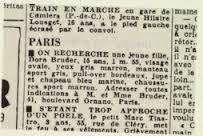
That quote is in fact the last sentence of this wonderful, macabre, paranoid story of Paris and the Nazis. The start is this little scrap of a newspaper small ad for information on a missing girl:

modiano

Written as fiction but more a rare kind of journalism that includes some autobiography intertwined with investigation. Modiano has been awarded the Nobel Prize and this slim tome is testament enough to his stature even in translation by Joanna Kilmartin (who has also translated Francoise Sagan). His first language was in fact Flemish although French is his medium of choice, Paris geography his canvas. This is very much  psycho-geography, the city pieced together as it disappeared over the decades taking its painful stories with it.

This rates as a great Jewish text even if he was not strictly Jewish himself – his mother was Belgian – and the main characters are only tangentially aware of the implications of what that might mean in world war 2 where collusions of authority overlap and where reason is overtaken by process.  Modiano, decades later, still finds fragments of lives in official records.

Why is it that repressive regimes like the Nazis or the Soviets became so obsessive about keeping records of their atrocities? What was the point of numbering Jews? Two of many questions raised here in a small work of genius.

Posted in 101greatreads, Non fiction | Tagged , , , | Leave a comment

The Guest Cat by Takashi Hiraide (Picador)

guestcat

“At first it looked like low flying ribbons of clouds just floating there, but then the clouds would be blown a little bit to the right and next to the left.”

IF you have friends who like cats. Who like gardening. Who may be curious about Japanese mores…as you can see from the opening lines it is wispy, almost meteorological, a book of clues and subtleties, tightly written, economic to the point that the narrator’s wife is reduced to a hazy haiku.

Hiraide begins boldly: “There are a few cat lovers among my close friends, and I have to admit that there have been moments when that look of excessive sweet affection oozing from around their eyes has left me feeling absolutely disgusted.” This he puts down to not having any experience of cats…I am not sure about the friends either, there are not too many here. Notice the word shame in the next line. It is a clue, but all things are relative.

I am listing this a biography because if it is fiction then it is masquerading as an I story and apparently he tells us the first three parts were published separately as short stories before he finished the book as it is. It is short, different and eloquent but no old possum. An impractical cat.

Posted in Biography | Tagged , , , | Leave a comment

Ethel and Ernest by Raymond Briggs (Jonathan Cape)

ethel&ernest

“Monday, 1928”

GRAPHIC novels as a genre can be more informed than screenplays. Film shoots with shot photos and dialogue always seem to end up shamefully in remainder shops, but illustration can also be a dangerous medium too often cliched and repetitive.

Alan Moore and Dave Gibbons Watchmen I count as a towering work of fiction but for me Batman is a movie.

Raymond Briggs biography of his parents coincides with a different era of visual narrative when comics like Beano, Eagle and Bunty were essential reading. The timeline is aptly the same. But this is no fantasy but a sometimes touching portrait across  five decades of his dad the socialist milkman and his mum who dreamed of working in an office, squabbling about class, about politics, about haircuts, horrified when their grammar school boy says he is going to “ART SCHOOL!”.

The drawings are pegs to hang a sketchy, homely tribute to the Briggs family. “So I won’t be a granny after all,” says his mum. Pity really.

A non-speaking black cat suddenly appears circa 1949 and pops in and out through the ’50s which is perhaps something words alone could not describe…

Posted in 101greatreads, Biography, Non fiction | Tagged , , , , , , , , | Leave a comment

The Aftermath by Rhidian Brook (Penguin)

aftermath

“The beast is here. I’ve seen him. Berti’s seen him. Dietmar’s seen him.”

IT would seem to have taken a long time for writers to get to grips with all the emotions and smells of World War 11, as if they were still on rations and on duty.

Rhidian Brook uncorks a heady mix of despairs in the postwar rubble of Hamburg – the feral children, the wife who is “grieving mother, distant wife and curt occupier“, a precocious son let loose to fraternise, the teenage girl who refuses to recognise the end of war, an English army officer father with a mission, a displaced aristocratic German architect with family and servants…each character might have been diametrically designed to oppose the others…unfashionably here we have a German point of view of the rebuilding and an etching of English gauche sensibilities in 1946.”Germans can’t make tea’.

The scene and character building is TV slick. Rhidian – who does not get any bio on my edition – was a screen writer on TV’s Silent Witness and this is is his third novel, 15 years after the last.

The TV scene shifting is expertly done. In a perverse way the plotting reminds me of an edgier Downton Abbey. There are a great many things we do not like to talk about. The adolescent German girl defies her new English house guest with her pee filled, still warm, chamber pot, not throwing it at him, just presenting it and leaving…

Screenplay takes its illusion of depths from its actors. The camera swallows up in seconds what it might take prose to perform over many minutes. Novels, as a form,  can drill deeper to inform the history and complexity of character, of thought, of situation etc. They can deal with the human condition, subjectively, where the camera must be objective.

Brook scratches deep, but there is more underneath…

Posted in 101greatreads, fiction | Tagged , , , , , , | Leave a comment

Hack Attack by Nick Davies (Chatto and Windus)

hackattack

“This is the strangest story I have ever written.”

This is also a brilliant piece of aggressive, personalised investigative, well written journalism, an expose of British high (and not so high or grand) grandees at work. There is an extra sense of electricity in that the saga is still ongoing. We have entered a sporting contest at half time. The establishment has had its say.  Davies has a rather different version. And he is no lone wolf here but an experienced practitioner not in the “dark arts of journalism” that he wishes to expose but in the intricate geography of the English legal system. He is of a school of journalism that checks its facts.

The protagonists are the highest and mightiest – divided factions of press barons, police, politicians and a vociferous candy of aggrieved celebrities who have had their private lives meddled with. As Davies points out those last might not be so interesting except that one of the victims of phone hacking for example happened to be Her Majesty’s Home Secretary who is, one supposes, notionally in charge of national security. And another was the deputy prime minister.

At the other end of the scale, the actor Hugh Grant was playing cricket and the license plates of all the watching cars were run through the national database to secure the names and addresses of their owners in case a picture opportunity might present itself or something even more salacious.

Davies paints pictures of the News of the World newsroom at the height of its excesses as a mix of paranoiac bullying, a testosterone terror, a Stasi of the modern era able to snoop on calls, texts, emails, databases…no detail too trivial that might not be spun against a victim at some time. Or in the jargon, someone would be monstered.

There is a further frisson in that Davies is not quite as impartial a reporter as he might have been. He has not jetted in from Mars. He is the hack on the attack. These are people he grew up with as colleagues or fellow journalists, a hack himself. There is a quote on the back cover from Sir Harold Evans about a “rottenness at the heart of British life” but Evans also has a bit of an agenda as far as Rupert Murdoch is concerned. And Davies does not pull any punches when it comes to describing his adversaries: “Inside the walls of Murdoch’s castle, there was something like a mass grave full of several decades of buried secrets, so big and stinking…”

This is a particularly English civil war – each wound, each action chronicled in slow motion – Murdoch’s Cavaliers swashbuckling, free wheeling and free marketing on one side, the Guardian’s plebeian legal Roundheads gathering evidence through the corpses on the other. Young James Murdoch, the pretender to his daddy’s throne is cast as The Hammer ie he sees everything as a nail. Everyone here is armoured in lawyers.

As with Watergate and other scandals, it is the cover-up that leaves the lasting stain.

Posted in 101greatreads, Non fiction | Tagged , , , | Leave a comment

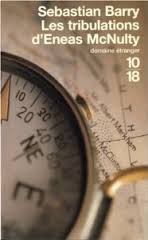
The Whereabouts of Eneas McNulty by Sebastian Barry (Faber)

eaneas3

“In the middle of the lonesome town, at the back of John Street, in the third house from the end, there is a little room. For this small bracket in the long paragraph of the street’s history, it belongs to Eneas McNulty”

The first of the McNulty family trilogy opens in boyhood innocence and is then swiftly and contagiously wrapped in the religious, moral, financial and political shenanigans of Sligo  now on the borders of north and southern Ireland, while the rest of the world is off to World War 1.

The scripting is not as sumptuously skilful here as in the later books – Scripture and Gentleman – but it is more of a film text, tackling its dramas head on. It is enmeshed in a period peasant brogue and Barry’s customary love of a phrase. The title can be read or spoken in different ways for each character in the novel.

Both mother and father McNulty – I have read the story is  based around Barry’s grandfather Jack – are subtley, cleverly  cast in different lights in different books. Over 16 years Barry has learned new skills.

Here he works hard, perhaps too hard,  on the often unexpected hardships of the Irish diaspora, so there are some episodes which just seem to be saying see-how-tough-that-was, like in a western with too much fighting and plenty of opportunities cinema-wise for the hero to look meaningfully at the camera. Like in a western we have comrades on both sides of a conflict, we have much hitching up of the saddles for traveling, Irish style.

Is Eneas a coward or a victim or as in a Thomas Hardy novel just overshadowed by the unfair machinations of the world around him? Just fate? Whatever his is a human face “blown off the road of life by history’s hungry breezes”.

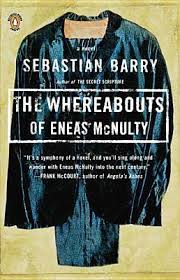
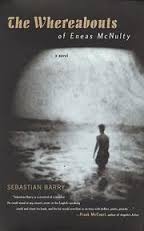
The covers of different editions also make interesting comparison.eaneas2eneas4eneas5eneas6

Eneas’s cause becomes a scream against the violent cliches of so called patriotism, notional freedom, of mad nationhood, of insane, unnatural injustices…and astutely Barry also manages to illustrate that his problems are not unique to Ireland.

Superficially people might suggest that this and Temporary Gentleman – tales of two quite different brothers – are just bookends to the centrepiece of Secrets but their contributions are in a different key and their rhythm and timing beautifully salient. The passing of the years, which might have been beyond one book, also brings with it new bouleversing judgements and realisations into the larger family even national drama.

The dialogue and the imagery as ever with Barry is wonderfully rich throughout:

“If a salmon senses the least scattering of dirt in his home river, away out maybe in the farthest skirt of the estuary, he will not deign to enter, or she. The salmon is as clean as a pig in its nature though unlike the pig it will not lie down in the dirt that men force on it.”

Posted in 101greatreads, fiction | Tagged , , , , , | Leave a comment

Zeitoon by Dave Eggers (Hamish Hamilton)

zeitoon

“On moonless nights the men and boys of Jableh, a dusty fishing town on the coast of Syria, would gather their lanterns and set out in their quietest boats…”

America likes rules. After the 10 commandments came another 10,000 lesser imperatives. No jaywalking. No ball games here. No smoking. No blacks. US media is saturated with law and order, the badge, the police dramas, the wild west, the urban badlands.

And then came hurricane Katrina to blow the whole of New Orleans to splinters and wash the the streets with mud from the broken levies. And here we have Zeitoon, the last man standing, or more accurately paddling, in New Orleans. The man who broke the rule and stayed behind.

Unfortunately for him, the hurricane did not blow away the laws and new lawmen (and unlawful men) who would return. This is not a fiction but the real life experience of Abdulrahman Zeitoon as told to Dave Eggers, better known for his quarterly literary review McSweeney’s and his fiction but here working in faction, a po faced telling of one man’s American super-sized nightmare (which also has a real life sequel, and that is discounting Syria itself).

Faction is an underused format these days but more worthwhile than a lot of what Joseph O’Connor refers to as so much wilber, apeing life rather than portraying it. This is a first class example of the genre, reportage as novel.

The opening imagery above of the fishermen taking their lanterns to lure the sardines on dark nights is poetically drawn image of the helicopters to come…

Posted in 101greatreads, Biography, Non fiction | Tagged , , , , | Leave a comment

The Thrill of it All by Joseph O’Connor (Harvill Secker)

thrill

“My name is Robbie Goulding. I was once a musician. For five years in the 1980s I played guitar with The Ships.”

I gave my first copy to my daughter in New York who is into her music. The second copy was grabbed by my partner. The cover is slick with raised chords on a guitar, very cute, very proud, very wannit.

You might think rock’n’roll is a good enough parody of itself but the opening pages here have O’Connor sending it up beyond even its wildest, loudest riffs. This is a rare thing a funny novel, gut bustingly funny, laugh out loud, snigger and snitch  – funnier than anything else I have written about on here. Humour is more difficult than drama and pain, obviously, but joyous when you find it like this. O’Connor takes a deep breath and just lets it rip out through his second in command Robbie, would be number two to the elegant, bisexual, made-up, cross dressing Vietnamese orphan Fran. In Luton. (and we have yet to meet the gorgeous Trez who walks into their “scum-speckled swamp of dilettantism“). It has been shortlisted for the Bollinger, Wodehouse, Everyman Comic Novel of 2014 which sounds like a joke itself (but apparently is real enough).

From the start we have our own new language…of “slobberments, shitehawks, drollery, lottery-spittle, pangsious, burbles…the Catholic chaplain was cottage cheese on legs”.

And lexiconically explained so “a person who takes his relatively small suffering far too seriously” is a wilbur, after William Butler Yeats.

And we get a lesson in PLOs, being People Like Ourselves ie who do not drink coffee. This is Luton 1980, and being of an age I can recall such places, such prejudices, where sharing a cup of tea meant having a family history and asking for the black stuff was to be up yourself. When Rob fails his exams he is sent by his zoo keeper father to shovel flamingo shit, literally…

Linguistically this is marvellous stuff. There is an amazing 12 page lambasting of  layabout sons by an Irish father that straddles generations, countries and petty seething prejudices which goes down as one of the greatest rants in literature (that I have read) or in this case might be deemed a Dylan-esque Sad Eyed Lady of the Lowlands. “Jimmy’s head…was by now a hellacious shade of red that no English adjective could describe. Ensanguined and fierce, it was redness itself.”

I will just give you the opening of the boys’ audition for a drummer. “We saw thrashers, smashers, belters, welters, thudderers and twelve cymbal jazz boys. Groovers, whimpers, rinky dink stompers…” etc for the best part of a page.

O’Connor attacks this riotous text with the rhythm and energy of that drum beat – more Ramones or Sex Pistols – and rampant screaming guitar solos, so it becomes a rock’n’roll anthem all to itself, a totally believable fantasy of the cool. And he still manages to slip a bit of social commentary between the licks.

After all, it takes a certain amount of insane courage to spend your last pennies in New York on a Stratocaster guitar.

Like Sebastian Barry I would feature him in my literary world cup team. Eimear McBride may have picked up the literary dongs this summer but these boys are a class apart, but she is Irish too.

Of course you might say it is a bit of a boy’s book, or a book for men of a certain age to which I completely fess up but can testify to the veracity and accuracy of the mood. It was like that and this is an appropriate epitaph to 70 years of boys with guitars.

The momentous ending feels a shade hurried (“hurry up there, Joseph, you promised it would be finished ages ago”)  and I would take issue with the writing of the reportage interviews which seem a little too Luton Evening Post and not sufficiently  New Musical Express (which was the repository of all the best music journalism at the time). Otherwise, great stuff. A riot.


Posted in 101greatreads, fiction | Tagged , , , , , , , | Leave a comment

The Temporary Gentleman by Sebastian Barry (Faber)

TemporaryGentleman

“It’s a beautiful night and no mistake. You would never think there was a war somewhere”

In a Literary World Cup, my money would be on Ireland. I read a sarky review of one of Sebastian Barry’s novels in the New Yorker saying his prose was verbose. Coming from an American that seemed a bit rich, but I have also come to think of it as an underhand compliment. Barry is not American and America would prefer to own the best writing. Tough, USA, you lose on penalties.

There are a few mooring ropes back to Sligo that will be familiar to readers of Secret Scriptures – the cafe Cairo, Strandhill, the tailoring for the lunatic asylum – all of which help to keep this high flying kite on the ground. (This is Jack McNulty’s story and there is also the Whereabouts of Eanas McNulty which I have not read as yet, so in effect this is part of a trilogy around the three brothers). If Scriptures was a drum and bass combo, this is a different affair, a flute if you like, a one level love mystery story, told with lilt and the same writing of things down at the end of a life as in Scriptures. The accent is in the vernacular which gives humour, a joy in the telling, a setting up of the preposterous everyday woven with impending doom…of teasing out of some kind of unseen morality.

From the opening pages, page 3 in fact, we know immediately we are into dramatic uncharted territory and in the company of someone with an uncommon skill with words. “The only illuminations were the merry lights of the ship….the land ahead was favoured only by darkness, a confident brush-stroke of rich, black ink”.

That black ink reappears later like a chorus imagery.

This is also,  for me, the perfect size of a book at 268 and a few pages for prelims, 9×5 with plenty of white space, say 250 words a page, thick cream paper, the kind you might write on with a fountain pen, plus chapter breaks, not too daunting or serious but sufficiently enticing and what one might say proper space for the telling of a story without reverting to any verbosity at all, room for treasure in its trove.

The setting is as much Ghana as Ireland, it is the ’20s, WW2, and the ’50s, not an embedded Irish story but one  of a post old Ireland era, an Irishman abroad, we have or are moving on. There remain fondly detailed descriptions of pre-WW2 life including a magnificent account of the organ rising up in the Picture House in Sligo on hydraulic lifts (irony, irony originally designed for Zeppelins) which runs to one sentence of more than 250 words and is worth the price of admission alone. To return to the world cup analogy for a moment, this, on page 51, the start of chapter six, is a moment of descriptive triumph, the game changes, and the literary goal is scored. Pick that one out of the back of your net Captain America.

In a way this reminds me of John Williams’ Stoner but is much more topical, has more brio, and far more beautiful language. Where Stoner is languid, the Gentleman is dandy. Like Stoner, Jack is a man of a certain time, a military engineer who struggles with and to express his relationship with the beautiful Mai and recounts his life as if in despatches jumping from one crisis to the next, and equally one bottle to the next as “the buveur of Sligo” while she is “murdering her friends at tennis“.

War brings with it Ireland’s ambivalence and Barry keeps picking off little vignettes even through a most knowledgeable, irony irony here again,  explanation of Jack’s bomb disposal duties. “There was a chivalry in the fact that only an officer would defuse a bomb…” from which the book takes its title. But Barry and Jack do all this without fuss or fanfare and the narrative grammar is slipped in with the quiet efficiency of the stiletto.

Jack’s inability to articulate anything beyond his hopeless love and admiration of Mia is mirrored by her although she is obviously superbly articulate in other company.  So for him she morphs into a metaphor for Ireland. Ostensibly it is a book about a relationship, the relationship is really with the muddled family politics of mother Ireland which allows all kinds of issues to flow through even race itself. What is or was Irishness, what is mother even. Because Jack takes all the guilt and shame on himself we can as readers see that maybe he protests too much. Maybe it is not all his fault. But this is not a sentimental maudlin read by any means, more of a romp.

As good as Secret Scriptures? On a par.

Barry has the tricks of the great story teller up his sleeve and carefully chooses when to use them. (which is hardly something you would say about Stoner – 2-0 to Ireland)

BTW: There is an interesting interview with Barry here 

Posted in 101greatreads, fiction | Tagged , , , , , , , | 3 Comments