Sapiens, a brief history of humankind by Yuval Noah Harari (Harvill Secker)

sapiens

“About 13.3 billion years ago, matter, energy, time and space came into being in what is known as the Big Bang.”

YOU will like this one. It is about you. Us. The master species. The wise ones.  Dr Harari’s middle name is Noah which is sort of appropriate. Albeit, his idea of brief is 70,000 years. And you might not appreciate his characterisation of us as mass killers…

Harari writes cleanly without adjectives. He draws comfortably on a large reading across different academic disciplines from physics to biology to anthropology and more.  His history is not history as in what date did king Alfred burn the cakes. It is the line between history and biology or what is it that made us such a force on the planet. Our intellect? Luck? Religion? Instinct? Our hormones? He works his way through the usual suspects shuffling them between references and scrubbing around the scrolls for data or even evidence. But history as he points out is “something that very few people have been doing while everyone else was ploughing fields and carrying water buckets”. Harari is one of the very few, a learned agnostic set apart from the struggles of the world.

Early on, he makes a couple of fascinating assertions that underpin a vision. The first is that it was homo sapiens ability to imagine fictions that helped us assert ourselves. Where other species think literally – a tree is a tree – sapiens imagined chopping it down and floating it down river. Imagined a god living nearby. And later we could imagine whole civilisations, as we have. And as he points out some of the familiar modern edifices are really not that tangible after all, just imagineering. “Myths, it transpired,  are stronger than anyone could have imagined“.

He also points out, interestingly,  that the optimum social grouping for sapiens is probably around 150, anymore than that and we struggle to maintain a sense of cohesive society. In a group that big we can gossip and bicker and politicise with our family,  friends and neighbours but any larger and we lose touch. It is an interesting number when you think about, say, school class sizes. One group of 150 people can relate to another group of 150 but each of us alone perhaps cannot do more. You can share beliefs but you don’t interact or not so well.

One of the key points in our early cognitive history is the ability to categorise and catalogue – without it we could not organise any form of structured progress. As you read, you may find that where you thought you were a liberal humanist, perhaps in fact you align closer to a Buddhist or even an evolutionary. History as he points out is not determinist, but capricious, swift, random. His not to argue why, just how.

He ends on a surprisingly positive, optimistic note (provided we don’t blow ourselves up) and then postulates: “The next stage of history will include…fundamental transformations in human consciousness and identity”. And  it is very nearly here already.


Posted in 101greatreads, Non fiction | Tagged , , , , | Leave a comment

The Buried Giant by Kazuo Ishiguro (Faber)

Buried Giant

“You would have searched a long time for the sort of winding lane or tranquil meadow for which England later became celebrated.”

We are in Shrek country. Frodo-land. There are ogres, sprites, curses. It is middle England, post Arthurian, pre millennium. Ishiguro laces his tale with ‘the mist of forgetfulness’ and the modern themes of Alzheimer’s, collective amnesias post despotic regimes, racism and even ageism. We know from his other writing, that he is playing with us…

His elderly couple set off on a journey to find their son not being completely sure they will even recognise him. But they have a quest in this strange unconstructed world of burrowed tunnels, of a handsome boatman, of mad, old and sometimes wise women…There is talk of dragons. And of love. Axl invariably talks to his wife as “princess”. Their dialogue is formally polite, from a time when talking or even just verbalising was more important. Ishiguro is Japanese (although he came to the UK when he was five but did not get a passport until he nearly 30) and this old England smells a bit oriental too. A bit Basho.

Their discourses fill in the pieces around a puzzle but soon other characters find their own voices too. These varying elements are  colourful jousting lances rammed through a plot of…well a dark ages road trip, not without a bit of Indiana Jones adventure somewhat heightened by the strange cast whose actions are hard to predict even for themselves which helps draw us deeper into their world.

There is a certain relaxation in wallowing around in all this warm bath of olde worlde fantasy. We are looking safely down the binoculars of our narrator’s history. I keep being reminded, quite randomly, that this was a time when England was as much a murderous mess as the Middle East or Africa seems now. Is that the point? An allegory…I won’t spoil it for you.

Posted in 101greatreads, fiction | Tagged , , | Leave a comment

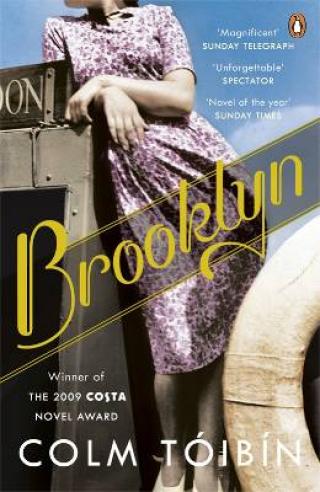
Brooklyn by Colm Toibin (Penguin)

brooklyn

“Eilis Lacey, sitting at the window of the upstairs living room in the house on Friary Street, noticed her sister walking briskly from work.”

Another major Irish talent. This one from County Wexford. A professor no less in creative writing. You probably knew that. This won the 2009 Costa novel award. Talk among yourselves while I catch up.

His writing is deceptive. Nothing is happening. He might be telling you about your loved cousin and is etching in colours and thoughts as he rambles. His heroine Eilis complains of the lack of news and details in her letters from home while hers are written in the third person. Toibin has no such inhibitions. It is the 1950s we deduce, the post war diaspora of an Irish family to…well the title gives it away. We are in the brownstone stoops with the Jewish and the Italians and the Poles. The humour catches you like a dig in the ribs, the dialogue crackles and the narrative is so carefully drawn that every sentence becomes essential.

Often men writing as women (or women writing as men) is a trapdoor, but Toibin keeps a polite distance, the invisible, neutral companion. Small vignettes fill in the details. A Sunday job, a conversation with a brother, a journey on a ship…Toibin is careful to stay tightly focussed on his characters. For him it is the story telling that is the all, even there is a smack of the village gossip in his approach…did-you-hear-what-happened-when-the-Lacey-girl went-to-the-u-s-of-a? You believe it because it is so uncontrived, so mundane, so everyday. Momentous moments – personal and historic – are passed around like scones in a front parlour chat. More tea, father?

Curiously Wikipedia says Toibin does “not favour story telling”. Well Mr Encyclopedia, perhaps there is more than one way to tell a story? Sometimes plot debases. This is a pure form. A historic form, legend being passed down. This might have been called the Ballad of Eilis Lacey.  A story in the wiki explanation I presume would therefore be a shoot-em-up Dan Brown or a Geoffrey Archer or a Lee Childs.

One rule of good writing Toibin observes here is:  Never lose focus. Stay on the the subject. Never waiver. It is the same as telling a joke – there is just an Englishman, an Irishman and a Scotsman. Nothing else. It is one reason even celebrity claptrap can work because it is just me, me, me. Ultimately people are interesting, if you let them. They, after all, own the condition. The camera does much of this for film, but cannot get under the shirt, into the feelings, the motivations, the fears beneath the surface. And where here passages can be linked across days, months the focus on the person is the same. In film, this would be a visual penance and ultimately boringly one dimensional. Eilis is far from one dimensional.

Posted in 101greatreads, Biography, fiction | Tagged , , , , | 1 Comment

Sleep in Peace Tonight by James MacManus (Duckworth)

sleep

“The seaplane came into view just as the winter sun had begun to settle into the English Channel.”

WOLF Hall for another era. Bring up the Brogue. We are at the court of king Winston.

Britain 1941. The empire is on its knees. Rommel is disembarking in North Africa. France has fallen. Greece is falling. The North Atlantic convoys are being decimated by U boat torpedoes. Nazi invasion is expected in the summer. The government will retreat to the Cotswolds.

Enter Harry Hopkins, Roosevelt’s private envoy. One of two drunken, lecherous, chain smoking Americans out to to save the known (as in understood) world in the face of the righteous Mothers of America who want to keep their boys at home and the concessionists mediating for a post war peace with Hitler. It is a western narrative, egged on by papa Churchill, big eating, big smoking, indefatigable, desperate to draw the world’s biggest democracy into war. So desperate his daughters consort to persuade ambassadors and broadcasters.

We know this take on the world war 2, but fact and fiction are blended, like in Roger Rabbit or Woody Allen mixing old film footage with modern characters. Meet Leonora, a graphic cardboard cutout with sawdust for knickers. Hopkins has not slept for three weeks. Boom! Bombs explode around them. There is an especially cartoon moment when Churchill is naked in the bath dictating policy and asking Hopkins to pass him the soap.

MacManus has an ear for dialogue and an eye for the social mores of the time. Leonora is smoking Gaulouse – they are all smoking everywhere, three or four packs a day – sourced from the French resistance. She sits “below the salt” at the high table, ie not an invitee of import.

This is another potentially great work thwarted by its please-make-me-into-a film script. The camera snatches the decisive moments of history as if they were just another cup of tea. Or in this case glass of whisky. In fact each of the main characters has a different tipple of choice.

For Churchill empire was a by-product of trade. For the American Hopkins it was imposition. But it is Churchill the warrior who sees immediately the mistake that lost Hitler the war, overruling his generals in attacking Russia on three fronts where one single sabre swing through an unbelieving Soviet shambles probably would have secured Moscow and victory in the east.

I was told it was a book about London and the blitz. It is not. The filter on the lens though is oddly Americana. It is about war correspondents shuffling between Claridges and the Savoy and drinking black market alcohol. As a Londoner I felt intruded on, although hardly any more than a peasant in Tudor England.


Posted in Biography, fiction | Tagged , , , | Leave a comment

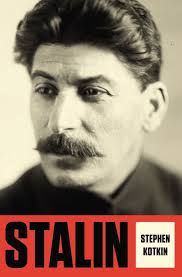
Stalin by Stephen Kotkin (Penguin)

stalin

“Russia’s double headed eagle nested across a greater expanse than that of any other state, before or since.”

Stephen Kotkin opens with this grandiose statement and proceeds to tell us this is not just a book about Stalin at all but all of modern history. He comes to history with his own ego.

But I like big dick history professors coming out of their library caves throwing tomes of ancientana at us. Usually professors are articulate. The question, from a strictly literary point of view, is how they handle the context and narrative. Some are hostage to their research, others stride on regardless. I came to this one off the back of the erudite, elegant and skilful Lenin by Robert Service (who has also penned a Stalin bio).

Kotkin, is a professor at Princetown. And this is not just one book but the first of a planned trilogy. This one is 949 pages of which 210 are notes and index. The sub deck is Paradoxes of Power 1878-1923. The paradox of course is communism or is that tsarism? Or just power?

My old history master wrote cryptic notes in the margins of our adolescent essays where we might have been saying the obvious or the crass. Ohh he might write with one ! or two !! depending how high his eyebrow might been raised. Had Kotkin been in our class his margins might have been well decorated.  Stalin has a penis, he tells us. Cor!! If the south had won the American civil war things might have been different. Really?!

Personally I wanted to read more about how exiled revolutionaries consorted with peasant girls in Siberia – apparently a regular distraction for political dissidents, Stalin fathered two children while under sentence. And rather less of the stunningly boring birth of socialism between 1900 and 1917. There comes a point where words like socialism, labour, democracy, marxism, communism etc are so overused they become meaningless. The language of 20th century politics is still narrow and limited, as if politics has not changed or evolved and are stuck between the same shafts of the same cart.  We still have a labour party, a working class etc just as they had in Russia in 1850. The only thing we don’t have is an autocractic tsar who served to demonstrate that the key problem with autocracay is that eventually nobody needs you.

The era before Stalin came to power there were no cars, no planes, no X-rays, no telephones and to boot he spent much of his formative time in exile anyway (as did Lenin) and could hardly have grasped what we now take for granted.

He, like Lenin, arrived in power of the biggest nation on the planet with hardly any experience give or take a good school report, a few bank robberies and some petty activism in his home town Georgia which was a little more akin to fascism or nationalism than communism. He faced the same the huge problem that is Russia just as the Tsars had. They lasted 300 years. His influence lasted the best part of a few decades. Arguably Vladimir Putin still faces the same problems.

“Politics is less science than art,” said  Otto von Bismark. “It is not a subject that can be taught.”An interesting gauge to apply to today’s bureaucratically inclined politicos of all sides. Lenin and Stalin made it up as they went along…

Posted in Biography | Tagged , , , | Leave a comment

10 Rules of Writing by Elmore Leonard (William Morrow)

10 rules 2

“These are rules I’ve picked up along the way to help me remain invisible when I’m writing a book, to help me show rather than tell what’s taking place in the story.”

YOU might like to follow the example of Big Issue sellers on London streets and stand outside the offices of publishers, film studios, campuses and even stationers offering would be scribblers and editors copies of this small masterpiece.

Better known for his film scripts like Hombre, Valdez is Coming, 3:10 to Yuma, Get Shorty, Jackie Brown and the TV spin offs serialised as Justified, Leonard started out writing westerns and graduated to urban crime. He died last year.

My edition is filled out by drawings by Joe Cradiello and cardboard thick paper to make it 89 pages which lend it the dignity of print, the sentences presented as poetry rather than prose of what was originally an article for the New Yorker published in 2001.

The second sentence of the introduction above reads like one of Leonard’s own post mortems, before the act as it were:

“If you have a facility for language and imagery and the sound of your own voice pleases you, invisibility is not what you are after and you can skip the rules. Still you might look them over.”

Posted in 101greatreads, Non fiction | Tagged , , , , , , | Leave a comment

The Children Act by Ian McEwan (Jonathan Cape)

ChildrenAct_UK_200

“London. Trinity term one week old. Implacable June weather. Fiona Maye, a High Court Judge, at home on Sunday evening.”

The BBC used to be very good at this kind of drama, a little unassuming well grounded plot that turns into a moral inferno. Fiona is on her second scotch. She is thinking about her third. Talisker. McEwan’s pointillistic prose is well suited to a mess of dots linking up north London details.

Husband Jack is also a whisky man, a bohemian academic who wants to run off with his silent student statistician from Muswell Hill. Couples who know each other so well become like siblings. I am like you brother now, he laments, asking for a last chance…but that is not the whole story, just a framing.

I might have preferred this, a frequent criticism, if he had been the judge and she had been the would be mistress for a sharper cut to the dramatic cloth. Too predictable perhaps these days for here it is Fiona who has married the law and the courts and is consumed by its own marital mores…and being lined up as a potential TV 9 oclock drama queen one suspects. You could hardly find a more eloquent application…


Posted in fiction | Tagged , , | Leave a comment

The Search Warrant by Patrick Modiano (Harvill Secker)

modiano2

“That is her secret.. A poor and precious secret which not even the executioners, the decrees, the occupying authorities, the Depot, the barracks, the camps, history, time – everything that corrupts and destroys you – have been able to take away from her.”

That quote is in fact the last sentence of this wonderful, macabre, paranoid story of Paris and the Nazis. The start is this little scrap of a newspaper small ad for information on a missing girl:

modiano

Written as fiction but more a rare kind of journalism that includes some autobiography intertwined with investigation. Modiano has been awarded the Nobel Prize and this slim tome is testament enough to his stature even in translation by Joanna Kilmartin (who has also translated Francoise Sagan). His first language was in fact Flemish although French is his medium of choice, Paris geography his canvas. This is very much  psycho-geography, the city pieced together as it disappeared over the decades taking its painful stories with it.

This rates as a great Jewish text even if he was not strictly Jewish himself – his mother was Belgian – and the main characters are only tangentially aware of the implications of what that might mean in world war 2 where collusions of authority overlap and where reason is overtaken by process.  Modiano, decades later, still finds fragments of lives in official records.

Why is it that repressive regimes like the Nazis or the Soviets became so obsessive about keeping records of their atrocities? What was the point of numbering Jews? Two of many questions raised here in a small work of genius.

Posted in 101greatreads, Non fiction | Tagged , , , | Leave a comment

The Guest Cat by Takashi Hiraide (Picador)

guestcat

“At first it looked like low flying ribbons of clouds just floating there, but then the clouds would be blown a little bit to the right and next to the left.”

IF you have friends who like cats. Who like gardening. Who may be curious about Japanese mores…as you can see from the opening lines it is wispy, almost meteorological, a book of clues and subtleties, tightly written, economic to the point that the narrator’s wife is reduced to a hazy haiku.

Hiraide begins boldly: “There are a few cat lovers among my close friends, and I have to admit that there have been moments when that look of excessive sweet affection oozing from around their eyes has left me feeling absolutely disgusted.” This he puts down to not having any experience of cats…I am not sure about the friends either, there are not too many here. Notice the word shame in the next line. It is a clue, but all things are relative.

I am listing this a biography because if it is fiction then it is masquerading as an I story and apparently he tells us the first three parts were published separately as short stories before he finished the book as it is. It is short, different and eloquent but no old possum. An impractical cat.

Posted in Biography | Tagged , , , | Leave a comment

Ethel and Ernest by Raymond Briggs (Jonathan Cape)

ethel&ernest

“Monday, 1928”

GRAPHIC novels as a genre can be more informed than screenplays. Film shoots with shot photos and dialogue always seem to end up shamefully in remainder shops, but illustration can also be a dangerous medium too often cliched and repetitive.

Alan Moore and Dave Gibbons Watchmen I count as a towering work of fiction but for me Batman is a movie.

Raymond Briggs biography of his parents coincides with a different era of visual narrative when comics like Beano, Eagle and Bunty were essential reading. The timeline is aptly the same. But this is no fantasy but a sometimes touching portrait across  five decades of his dad the socialist milkman and his mum who dreamed of working in an office, squabbling about class, about politics, about haircuts, horrified when their grammar school boy says he is going to “ART SCHOOL!”.

The drawings are pegs to hang a sketchy, homely tribute to the Briggs family. “So I won’t be a granny after all,” says his mum. Pity really.

A non-speaking black cat suddenly appears circa 1949 and pops in and out through the ’50s which is perhaps something words alone could not describe…

Posted in 101greatreads, Biography, Non fiction | Tagged , , , , , , , , | Leave a comment