Hare with Amber Eyes by Edmund de Waal (Vintage)

hare amber eyes

Edmund de Waal pronounces in his prologue that this story could almost tell it itself. Yes and no, Edmund.

To anyone whose family were part of the same exodus from Odessa to Vienna to Paris as Russia, as then was, impaled itself on revolutions there is vicarious interest in the minor details he unearths about the fabulously wealthy Ephrussi brothers.

This wealth emanates from cornering the grain markets in the port city and routing the profits into huge infrastructure projects to build rail, roads, public buildings. Banking in short, although how far these foppish boys were actually involved in the moneymaking is unclear or skipped over here. There is more about spending it than making it.

One of the brothers, Charles, who de Waal admits to having some difficulty with at the start, channels this wealth into his passion for art then collecting which leads him to all things Japanese with all manner of new artifacts arriving for the first time in Paris circa 1870. New houses were being decorated in layers of things Japanese – porcelain, jade, silks, bowls. It was the era of le Japonisme.

Charles has a mistress, Louise, an unlikely figure cast as a respectable mother of five, whom he meets illicitly at galleries where the couple collude in buying art to collect. A sort of vicarious sexuality. And then Charles discovers and buys this obscure sub genre, the netsuke, miniature individually carved figurine caricatures that could be passed around society salons as conversation pieces “witty, ribald, sly” and very tactile, sometimes overtly pornographic,  most of which pre-date Perry’s discovery of Japan itself. netsuke1 netsuke2

The hare of the title is one such more polite item. Rats were another popular theme, their long tails lending themselves to wrapping around the body. And rat catchers 🙂 I told you that in 111 words. De Waal takes 66 pages.

But it is this collection that De Waal himself inherits and sets himself a potentially fascinating but mostly unrequited task of discovering their histories. This is like the primary school essay Day In the life of a Sixpence piece (or today a dollar or a euro or a bus pass).

Unfortunately, if a family can be said to be egoistic, the focus is on their own Ephrussi story rather than the far more intriguing netsuke possibilities of who these comic, sexualized bits of art might have been commissioned by hundreds of years previously? Or why? Were these just an early manifestation of pornography or did they have a symbolism or significance or even a use?

There is a third sub strata here which also might have produced fine fodder for a more accomplished author which is the Ephruzzi’s desire, lust even, as perhaps of a great many immigrants, to be accepted in a foreign country, to be part of the establishment and in gauche and rather surreal ways what that actually means to the ambitions of different members of the family with the financial means, unlike most other immigrants,  to achieve almost anything they might want.

He might also have made much more of the essential jewishness of the story…and the parallel prejudices of the French seeing Japanese men on their streets for the first time…

Ultimately de Waal’s art is as a potter who has taken four months off, which turn into two years, to become the family biographer. In that he is probably too close to write what might have been written…

Although he professes himself not to be interested in money (they are all a bit lucky like that in this book) there is nevertheless a fairly obvious desire to aggrandise his otherwise obscure inheritance. Ultimately none of the three or four themes really wrap up satisfactorily in any literary sense and each tends to get in the way of the other, so no one wins out…apart from the netsuke of course who get some cheap, bit grubby PR at the expense of what should have been the bigger issues.

Posted in Biography, Non fiction, Outtakes | Tagged , , , | 1 Comment

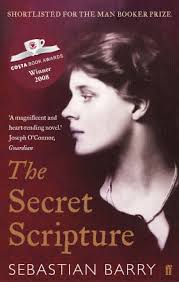
The Secret Scripture by Sebastian Barry (Faber)

secretscriptures

“The world begins anew with every birth, my father used to say. He forgot to say, with every death it ends. Or did not think he needed to. Because for a goodly part of his life he worked in a graveyard.”

This is not a story – as we might be sucked into thinking – about the madwoman and her keeper but in part already a parable of the violence of young men that seems even more relevant now with Syria, Taliban, Africa et al as in all the troubles of Ireland itself.

Irish writers seem to inherit a literary gene passed  down through generations of story tellers that allows them to play with fiction. Barry you sense immediately is up there with the elite and this title walked off with the Costa book of the year 2008. He tells a story like he is shuffling a pack of cards…like you might be in a small snug on the west coast surrounded by neighbours, the fug of a fire and a pint of black…

The use of words is electric: “His long whitening beard was sharp as an iron axe. It was very hedgelike, saintlike.” And from description to snagging, nagging notions on the human spirit: “Of course I was young, very young but, as I remember it, no one is ever quite so old as a fifteen year old girl.”

Barry is cunning , holding back information or at least reflecting a single perspective. We are very strictly in the Present Tense here. We have no more foresight than the characters themselves. We are blinkered by the reality of now, not distracted by the import of history and other events.

The effect is reinforced by a double narration, both trying with their very different ambitions to tell the same story, the story of the “savage fairy tale” that was Ireland in the 1930s, bound by a mutual shyness and empathy. As the tellings intertwine they become as taut in their own ways because they also share different impediments to plain speaking. Both have history.

We span a life, we span a century but we are also ushered around each narrative tributary in the sure knowledge that joy and tragedy are coming to the beachside dancehall just as surely as the back hill folks come down for a waltz. His actors are modern in that their emotions seem timeless, events just arbitrary or in fact an excuse for a lavish visual conceit. The imagery is landscape large, a point reinforced when Roseanne talks of French painters and does not want to give their names in case she misspells their names.

“Happy. Just straightforward ordinary girls we were. We liked to bring as much despair as we could to the lads. Who watched on the sidelines of our happiness like sharks, devouring our attributes with their eyes.”

I am deliberately not giving much away here. What makes this storytelling so clever is how each vignette manages to suprise and delight on its own, told in rich, rich prose of the kind the Irish seem to have a monopoly but this is again doubled up as an Irish story, as told by an Irish writer , about Ireland.

His heroine may have gone to watch newsreels but she is still the waitress at the Caffe Cairo, 1929. The dark forces are still those of Irish foloklore. She describes De Valera by the slick of his hair. There is mention of the 77 and one is half expected to know all this backdrop history. The unsureness also lends edge. Do you need to know, should you know, does it make any diference? What after all is truth or sanity, the more so when it is stretched across from the start of modern – or at least post bedlam – psychiatry to present day.

In great writing often the substance is the human condition itself and  to explain that away in narrow confines with labels like patriotism, catholicism, love etc is to diminish it.

Posted in 101greatreads, fiction | Tagged , , , | Leave a comment

Life: Keith Richards (Phoenix)

life keith2

Chapter One; In which I am pulled over by police officers in Arkansas during our 1975 tour and a stand off ensues…

It is not the salacious tittle tattle or the schoolboy sniggering (or the size of one M. Jagger’s penis) that sets this title apart,  but perhaps it is that the Rolling Stone’s music is still an (the) anthem in London illustrates the depth of adventure and brio that spawned the world’s self styled greatest rock and roll band. Even the opening lines are self deprecating for the amazing story that follows, however much we think we might have known, even those who lived it in parallel with the band vicariously through every single release, every mega concert, every girlfriend. It is a wonderful true story of our time.

There is, out of many, an anecdote where Keith Richards girlfriend Patti gets pregnant. His response he declares was to change the dungeon into a nursery.

One of the best parts is the opening saga of life growing up in Deptford, south London before all the drugs and dramas…but also elegant exposition on how the music changed the 20th century (“we were just unpaid PR for Chicago blues”)….

A word also for the brilliant job done by co writer ex- Sunday Times reporter James Fox – who has just signed to do similar for artist Damien Hirst – who brings context and organisation and as Richards jokes: “it is impossible sometimes not to be a parody of oneself”.

The book like the music though is not parody. Nor is this just showbiz schmaltz…

Posted in 101greatreads, Biography, Non fiction | Tagged , | Leave a comment

Mistress by James Patterson (Arrow)

mistress

I was curious to read something that was really popular, a best seller to compare with other books here. Does popularity equal literature? Does it matter? Are readers the ultimate accolade?

So I turned to the “world’s bestselling thriller writer” the incredibly prolific James Patterson here working with one David Ellis. Patterson’s credits run to three pages of listed books from the 21 Alex Cross novels to the 13 Women’s Murder Club series etc…He trots them out pretty quickly, airport foyer fodder darling, “secrets, lies and deadly conspiracy”. Oohhh. Fasten your safety belts…

His web site tells me he has sold 275 million books and he holds the New York Times record for the most number of hardback books in print…

Let’s  see, it goes like this:

1. Hero on secret mission in girl’s flat

2. He leaves, girl dies

3. Hero stopped by policeman for traffic offence

4. Hero was in love with girl

5. Police suspect foul play

6. Hero is very very rich

7. Hero flies own Cesna to the wake

8. We learn she was having an affair with someone else and told her friends lies about what she really did

8. On the way back, his plane runs out of fuel mid-air

9. He crash lands – the petrol tank has been tampered with

10. Whoever killed her, tried to kill him. They are out to get him too…

We are on page 50, chapter 12, big type. The blurb tells me the “the pages turn themselves”. There is certainly not much to slow you up. It is all present tense, first person stuff. It is all going off…not many adjectives, or sub clauses.

Between all this we gather that hero Ben is dysfunctional and obsessed with the kind of trivia you could use in a pub quiz. “Truman was our 33rd president but 32nd to hold the office” and flashes of movies he has seen so you feel up to date, both cute devices in themselves.

But the most jaw dropping facts, more than the shawl of skulduggery that is about to enfold him, is how rich this Ben is. “I walk over to my plane, a Cesna 172N Skyhawk, 1979 model. I bought it two years ago tapping into the trust fund…”. Oh gee, wow Ben, you are a lucky guy then…

So do we care at all? Are we engaged? It is early days but the feeling is disposable distraction, an action movie without the squeal of the wheels or the smell of the jet fuel…I am finding myself more interested in Patterson himself than Ben.

Patterson was an adman who retired and took up full time writing in only 1996 although he had been churning out the Thomas Berryman series 20 years earlier. Wiki says his current score is 95 novels and he has had 19 consecutive number ones in the New York Times. Stephen King said he was a “terrible writer” which is not fair or of it was, is not really the case now, to which he responded, “he’s taken shots at me for years. It’s fine. My approach is to do the opposite with him – heap praise.” He has been a vocal supporter of books and bookshops and denies he received an advance of $150m for his last batch of books. He lives, as they say, with his wife Susan in Palm Beach.

Patterson has also championed the idea of working in writing teams. Here with David Ellis, trained lawyer and winner of the  Edgar Allen Poe award for best first novel…and has his own serial ‘edge-of-the-seat’ crimo series with defence attorney Jason Kolarich.

11. Then hero Ben goes to his secret country retreat, in case he is being followed..

12. And he is being followed –  bang! bang!

13. He jumps in the lake and the best thing ever is surfacing again after holding his breath under the dock

14 He gets away by stealing a neighbour’s truck

15. But he is being followed…

16. Bang! Bang! again…

One acid test of great writing might be that it transfers seamlessly into other medium and interestingly as yet no Patterson oeuvre has migrated into block busting film mode. As yet, one supposes that Hollywood’s script departments are not unaware of him. But so far here the world is mindless. Things happens. And then something else happens. The world falls in. The girl falls out of the car. Events are unconnected and random. It is a chase of sorts but asks perhaps why we ready anyway? Just to not have to think? To let the words and characters just live out some time for us, writing as therapy, as Mills and Boon fantasy, as shoot ’em up westerns?

In that context other writers are more relevant here – David Peace for example. Or Stephen King whose Green Mile is a contender both in book and film although written in 1996.

Posted in fiction, Outtakes | Tagged , , | Leave a comment

Leviathan by Philip Hoare (Fourth Estate)

leviathan

“Perhaps it is because I was nearly born underwater”

A wonderful book of journalistic discovery about whales. I read it too long ago to review it properly but it stays in my mind as one of the reasons to start this blog. If you like Moby Dick…if you want to know about isinglass…if you want to know about a boy from Southampton and his quest for knowledge…great read.

Posted in 101greatreads, Non fiction | Tagged , , , | 1 Comment

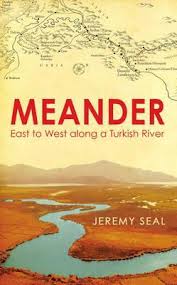
Meander by Jeremy Seal (Chatto & Windus)

meander

“I would have gone down the Meander years ago if I’d known it existed.”

Apart from the maps, which are almost as deliberately confusing as perhaps the suspicious Turkish military might have intended for foreigners, this is a brilliantly informative re-telling of a history that has been hidden beneath centuries of western prejudice and self interest.

The Meander is a river in Turkey which winds around and around and from which we take the word itself. Jeremy Seal sets out to navigate it in a small canoe but this is no travel book really rather a journey back beyond Biblical times that restates the importance of this part of the world as being at the heart of Mediterranean ambitions and politics, the axis of east and west, infidel and christianity, old and new right up, even to an extent to today…

His descriptions are precise and evocative. “It had not crossed my mind that laying my hands on a trowel might present a problem in a place like Dinar. How but with trowels had the chillies, peppers and aubergines that run amok in the scruffy little town’s kitchen gardens been planted? What of the geraniums that bloomed in rusty cooking oil tines at the foot of whitewashed walls?”

And they lay questions into the present and past importance of Turkey as a nation and how it was shaped in the modern context. The living history comes from the people he encounters as he tries to chart a course down the river, which is mostly but not always still flowing. Across this he interlays the older magnificence of empire and lays down a different context to that taught at least in my school which was just a one sided jingoistic narrow crusader view. This is the heathen version. the question is who were the heathen?

Posted in 101greatreads, Non fiction | Tagged , , , | Leave a comment

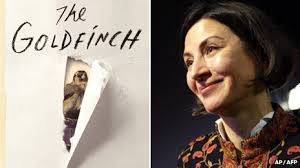
Goldfinch by Donna Tartt (Little, Brown)

goldfinch


I should post a reservation about BIG books in general. Both the Booker listed Kills and the winning Luminaries are substantial door-holders, so is Donna Tartt’s Goldfinch, fewer pages but denser type, smaller margins. Such expansiveness demands more time, more intimacy, more attention and not necessarily in the first two examples at least to advantage. I resent the literary monopoly taken on my time. One expects  a bigger payback.

That said Tartt makes the opening 150 pages or so an elegant captivating train ride into a New York trauma.

She has a number of qualities in her writing, noticeably a camera like roving attention to details, a reverse pornography if you like where she carefully dresses each of the people we meet and their surroundings. She also seems to demonstrably like her characters as if she is as curious as we are to know about them.  “Over his clothes, a rich paisley robe with satin lapels almost fell to his ankles”.

She moves her plot scenery around seamlessly, idly shuffling the cards of her tale, a coquette perhaps. The dialogue is sharp almost too much so in the case of Theo’s pal Andy rowing with his father. The characters, carved as lovingly as by any sculptress, around our guilt-inclined boy hero…So far so good…

Tartt is from Grenada, Mississippi. She has that calm southern sense of a drawl. She takes her time, perhaps not the shrill, alcohol driven drive of a Tennessee Williams but blessed like Irish writers often are with a cadence, a lilt, a poetry even. We could be sitting on the porch while she unfolds all this…

The comparison is with Martin Amis. Both are unusually gifted with words, writers in search of a story worth the telling. Tartt perhaps has the edge in her portraitures. I want to be on the guest list of one of  Mrs Barbour’s socialite parties. And she is the better story-teller. Amis perhaps is the sharper lyricist.

But then we hit this fundamental, almost elementary flaw. She is a woman writing as a man/boy. In the opening pages, it is almost an irrelevance. Theo could be either girl or boy but then we lurch into the teenage relationship with the wonderful Boris and we are moved outside any comfort zone of the sexes. This is a 50 something year old woman describing an adolescent relationship between two boys. And she does not get it or does not get inside the virile male humour that binds them. They are firecrackers going off in different directions.

Writing across the sexes is tricky, often fatal. Sometimes it can work where it is obvious what is happening, say the Time Traveller’s Wife or Gone Girl where you know his angst is really her turning the stilletto in his emotional ribs. Here Tartt is losing control. Her characters have gone rogue. She describes their antics like an aunt, but she is using the first person and cannot cross the natural divide.

Part three opens with a quote from Francois de la Rochefoucauld: “We are so accustomed to disguise ourselves to others that in the end, we become disguised to ourselves” which is unfortunate because at this stage we, and we are on page 370, as readers are uncertain as to who is really who, our narrator has no core, our world is shifting randomly, coincidentally trying to get back to something we sensed 200 pages earlier…More the pity because there are two subplots here which might have been books on their own, the superb Boris and the dog road movie.

Tartt now slams her foot on the literary brakes and is trying to get things back in order for which she resorts to some fairly incredible coincidences like she has has been taking the same drugs as her boy heroes…

Apart from the sex issue there is an issue of age. This text is not really believable as that of a young teenage boy. It is more of a twenty-something student angst rant. What keeps us – or me – going is not his concerns childish or otherwise but the fascinating cast of people around him described with the finesse of a Royal Copenhagen vase.

“Fair haired, brick red in the face, with startling robin’s-egg eyes, he was paunchy from drinking…”

Even the house assumes personality:

“But as much as I missed the nervous tingle of her presence, I was soothed by the house…old portraits and poorly lit hallways, loudly ticking clocks. It was as if I’d signed on as a cabin boy on the Marie Celeste…I moved about through stagnant silences, the pools of shadow and deep sun, the old floors creaked underfoot like the deck of a ship…Hobie’s presence below stairs was an anchor, a friendly weight: I was comforted to hear the tap of his mallet floating up…”

Even as the plot wears thin like a cigarette that has burnt down and all that is left now is the smoke and the mawkish meanderings of the teenage narrator become more nonsensical, Theo’s lens on the world around him does not miss a speck of dust, a fading of the curtains or the goodly humour of his consorts. We are with him in a travelogue, a timeologue even as he himself becomes more and more opaque as if he is being consumed by the telling…swept up by the people around him.

“Mrs DeFrees, a dealer in nineteenth century water colours who for all her stiff clothes and strong perfumes was a hugger and cuddler, with old lady-ish habits of liking to hold your arm or pat your hand as she talked…”

We are witnessing a literary mutiny where the hero and central character is being subsumed. This might not matter except it is written in the first person and we cannot escape him and his feeble transience.

Ultimately the analogy is with one of Hobie’s lovingly restored pieces of old furniture. Is it original? Does it matter? Where is the perception? Like the furniture pieces, the novel is a lash up of six or seven stories, none of which are satisfying taken to their conclusion. Everything is built around our vacuous victim self obsessed narrator who in a very teenage way is just not appreciating the fascinating cast assembled around his life or even us as readers. Finally he outrageously says: “No one is going to read this…” Oh, yes they are Theo, we just did. That is 700 pages out of my life.

So instead we take refuge in DT herself as Author, a self conscious schizophrenia. Theo is her day job. This is her office of characters. She hovers her cursor over the plot screen as she pleases. And she is bitchy enough that the other young female characters are as thin as paper, anorexic pawns that do not threaten her command of your attention, or if you want to believe this, which I don’t, more victims of post stress disorders.

The closest we get to human contact or emotions is when Theo reveals he was so nervous that he just “threw himself on top of this girl”. Now let us pause a moment here, Donna. Theo 16, Julie 27. Bedroom. Explain? Explore? Cause? Effect? Nah.

Eventually I am wanting a sequel, not necessarily written by Tartt herself, where all these captivating characters can be gathered up and resolved, the story lines rounded off and given a final context, a life that is not full of arbitrary coincidences or just needlessly slamming a few people together as if something important is being said. “Ten years later…”

Tartt finally cops out with the grandiose statement that the book is about the : “polychrome edge between truth and untruth”. Nah it isn’t.

There is a point about halfway where a delicious plot beckons but she double-backs and re-creates almost the same thing again like she wants a double barrelled shooting. The first set up is very old fashioned Graham Greene, the second very Martin Amis like sleazy. But it is a sawn off shot gun and the narrative pellets scatter.

One feels the wheels of publishing behind this book. Donna, you are big talent, you must write a big book. Come back in 10 years with an opus. Make it so big no one can argue with you.

And a few years later, a couple of hundred pages in, there is a second conversation which says: Oh, and give me a movie in there. But I am half way through? Got to have a movie in there. And as with the the Booker winning Luminaries if ever this makes the big screen some Hollywood screenwriter will have to start this story half way through.

Posted in fiction, Outtakes | Tagged , , , | Leave a comment

Ghost Light by Joseph O’Connor (Secker)

ghost light

“In the top floor room of the dilapidated townhouse across the Terrace, a light has been on all night.”

O’CONNOR becomes the first writer in this blog to have two books listed in the 101 lists. No apologies there. As the title implies this is a haunting book.

It is a love story that slowly, slowly reveals itself and its beginnings with the first traumatic performance of J.M Synge’s Playboy of the Western World in Dublin 1907.

He writes in the second person ie “You are 65 now” which gives it a brotherly-sisterly intimacy. An aching, non judgemental sadness. O’Connor says in the acknowledgements that he grew up a mile away from the house where Synge died but the historical skeleton on which it hangs is only shuffled in later.

It is a star biography of a star without star cliches, of a time – up to 1952 – and era and a politic and mores which invites you to know more which if you are not Dublin Irish you might not…

Posted in 101greatreads, fiction | Tagged , | Leave a comment

Star of the Sea by Joseph O’Connor (Secker)

star of the seaIT is a while since I read Joseph O’Connor’s masterly narration of the Irish migration post famine distilled into the tale of a single boat’s crossing. It was as I recall the first book to be introduced on Richard and Judy’s TV book club. And the first of an epic trilogy.

Tony Eagleton in the Guardian talked of the Dickensian space and the richness of the prose overlaid on to the harrowing poverty of the subject matter, the different voices of different classes interwoven in a brooding, touching saga. Pre the road story came the boat story.

Eagleton says: ” There are several novellas tucked inside this well-upholstered text, along with cameos of the East End, snapshots of Victorian Belfast and vignettes of the Irish land-owning aristocracy.”

NB: There is a newer updated entry on re-reading posted here https://wordpress.com/block-editor/post/101greatreads.com/3064

Posted in 101greatreads, fiction | Tagged , , | Leave a comment

Jim Crace and the new religionists

HarvestJIM Crace has a knack of creating brooding invisible forces that help create a framework beyond the obvious. In his Booker listed Harvest the prime protagonists hardly speak for themselves at all but just infect the narrative with a sense of guilt, evil, puissance.

Victims both, one obviously in the stocks and on the cross, the other as a free spirit who gives the central village a sense of morality, the she-devil who even packs our narrator’s suitcase for him, wordlessly, actions presumed.

quarantineAnd in Quarantine – an odd title for a biblical setting in that the word is according to Oxford dictionary derived from the 17th century italian quarantina meaning 40 days – we have the prospect of a great deal more evil doing.

The first paragraph sets up the nuances:

“Miri’s husband was shouting in his sleep, not words that she could recognise but simple, blurting, fanfares of distress. When, at last, she lit a lamp to discover what was tormenting him, she saw his tongue was black – scorched and sooty. Miri smelled the devil’s eggy dinner roasting on his breath, she heard the snapping of the devil’s kindling in his cough. She put her hand on to his chest; it was soft, damp and hot, like fresh bread. Her husband, Musa, was  being baked alive. Good news.”

Not being religious I cannot speak for the inferences of writing about a man named Jesus from Galilee in the text although for once the son of god takes, however much one is tempted to want it differently, second place to some of the of other characters stranded on the scree into which one might read many new parables.

Posted in fiction, Outtakes | Tagged | Leave a comment