The girl who wasn’t there by Ferdinand von Schirach (Abacus)

Girlwhowasn'tthere

“On a fine spring day in the year 1838, a new kind of reality was created on the Boulevard de Temple in Paris”

That reality was of course photography which is part of the theme here. To those of us schooled by Morse, Lewis, the newly admirable Endeavour, Agatha, GK et al…plus having had the American experience of Chandler, Spillane, Elroy, Burke etc there is a certain benchmark for crime. This application to join is from a German lawyer Ferdinand von Schirach. There is that old joke about Europe being a happy place when the Italians run the kitchens, the Swiss the railways, the Germans make the cars and we do the TV crime.

I don’t want too often to dissect novels that are not up to scratch but in this case what is annoying is that it was on promotion prominently in Waterstones on the same week that the Booker prize long list was announced – and they were not there or only a few of them.

But what is also curious is the plaudits which are repeated twice on the openers and on the backcovers.

Effortlessly, classy prose“, says the Observer which is an odd thing to say about a translation. I will give you an example so you judge just how classy this stuff is:

He sat at the window and watched the passersby in the street“. Or: “She opened her mouth, but no words came out“.

The Guardian tells me the novel is “an examination of the disconnection between truth and reality“. That I suspect means it is nonsense which unfortunately is what it becomes.

The Sunday Times tells me Schirach is “celebrated“. Not in my parish and not for this.

The Times declares the story “intriguing” which as it is chopped up into two, even three batches, you would have to read the first 111 pages before you knew what to be intrigued about.

The Independent neatly calls it a “a centaur of a story” i.e. the two mismatched bits have been lashed together.

The Telegraph says Schirach is one of the most “distinctive voices in European fiction“. Presumably that means euro-trash or eurovision fiction.

Give Schirach his due – these musings are not his fault. His reputation I suspect is based on his earlier work which, crucially, was supposedly taken from his case notes so was more factional.

He starts out promisingly, I admit, in a Donna Tartt sort of way building a character and a family slowly and then wallop suddenly half way through we go off the tracks like someone has suggested to him to turn it into a crimo and make lots of money like that (dead) Swedish guy. Suddenly he wants to shoot a picture of his girlfriend surrounded by 16 or so naked men with erections. I kid you not. We also have a quite promising character who apparently does not exist anymore. This is fiction Ferd, did no one tell you? As to the court scenes, Rumpole, Rumpole, Rumpole…

Peter Preston wrote in the Guardian about restaurant critics forgetting what it was they were supposed to be doing. In the same way, accusations might levelled at the publishing circus. There must be, there are, better books in Europe. In German too.

The disconnection is between the reviews and what is printed on the pages in this book.

Posted in fiction | Tagged , , , , , , | Leave a comment

Satin Island by Tom McCarthy (Jonathan Cape)

satinisland


“Turin is where the famous shroud is from, the one showing Christ’s body supine after crucifixion: hands folded over genitals, eyes closed, head crowned with thorns. The image isn’t really visible on the bare linen. It only emerged…”

U is an anthropologist. The Company anthropologist. The Company is a mystical modern accumulation of the kind you might overhear being talked about in marketing-speak in a coffee bar or a Japanese restaurant. U’s task is, notionally, to articulate its form.

We are very, very up to date here,  we are the contemporary, a connected universe of images, texts, Skype, the chapters organised as sound bites, his boss Pyeman speaks in paradigms like a Mark Zuckerberg or Larry Page. Each numbered section might be another web page.

U’s role is to think. What he thinks about is partly top secret and partly on the same ground as Yuval Noah Harari’s Sapiens, notably the idea of the company as a self invented fiction, notably also Schrodinger’s Cat, is it alive or dead?

“Shapes were happening inside my thought: or, rather shapings, a preliminary set of shifts and swirls, coherences and separation…”

Unfortunately, U has also got writer’s block. Or as he might speculate, the block has got him.

In a sense this is psycho-geography tracking the familiar digital imagery of what he calls the Amazon of new corporate culture. It improves when he meets some real people but eventually it is a smart-arse game which as he acknowledges the critical reader can entertain him or her self tracking some of them (borrowings, echoes references)  down. Thanks. Tom.

Posted in fiction | Tagged , , , | 2 Comments

All the light we cannot see by Anthony Doerr (Fourth Estate)

allthelight

“Leaflets. At dusk they pour from the sky. They blow across ramparts, turn cartwheeels over rooftops…Urgent message to the inhabitants of this town. Depart immediately to open country.”

He is the orphan radio repairer. German. She is the blind daughter of the locksmith. French. Small chapters switch between them as war approaches dragging each in different directions and together. Both have major relationships, he with his younger, pretty sister. She with her wonderful father.

The compelling lure is what kind of book is this? The backdrop is war but beyond that the question is; is it a mystery adventure, a scientific detective, a Dan Brown style romp, a love story, all four? Could this really have happened? Is it her story or his?

“Your trouble, his friend says, is you still think your life is about you.”

Doerr writes so tightly it could be a film script; his pen just a camera lens really, occasionally breaking out into describing  Dr Geffard as “an ageing mollusk expert whose beard smells permanently of damp wool.” It is easy reading. We know the history surrounding them both, but there is a certain war-naif as the childrens’ worlds collapse among the grimages of conflict. They do not know as much as we think we do, which invites us to revisit loyalties and perceptions.

The genre is much followed by popular writers – singular character(s), neutral description, vivid dialogue, each chapterette a new scene, not the typical travelogue approach though, more a timeologue. Achingly slowly we reach the cusp of a great drama as the combinations of plot click into place. And we are given…a key.

It won the Pulitzer prize for fiction 2015.

Posted in fiction, In progress | Tagged , , , | Leave a comment

Blood, bones and butter by Gabrielle Hamilton (Vintage)

blood,bones and butter

“We threw a party. The same party every year, when I was a kid. It was a spring lamb roast, and we roasted four or five whole little guys who each weighed only about forty pounds over an open fire and invited more than a hundred.”


AS you infer from the opening sentences, Gabrielle was sort of born to cook. She went on to open her own restaurant, Prune, in New York, an achievement that too few of us aspire or achieve in the face of the chain high street. Next month will see what is the second part of this work, the recipe collection from Prune itself which includes such eye catching recipes as Tongue and Octopus with salsa verde and eggs Mimosa. That is one dish, not four.Gabrielle is not a girl inclined to stick to smoked salmon on brown bread. She is more steak tartar than Victoria sponge.

This is the book that Patti Smith should have written and did not (“Ohhh, Robert”), a punk eulogy to New York, kitchens as rock’n’roll, back street culture, below stairs lime lighters.

I read this autobiography before I started this blog and it has often been a benchmark, a raw, guts and grit saga of girl makes good (and bad) in the big city. For me, she is a writer first who threw herself into cooking as the subhead says by way of an “inadvertent education of a reluctant chef”. She is no fly on anyone’s wall and there is not much inadvertent nor reluctant here, rather a real life exposition that exposes the TV chef as pretty fey.

Her mother was French. “She took me to the farm to get our milk. As only a Frenchwoman can – in a heel, a silk scarf, and a cashmere skirt…” And she taught her to eat. “I still very much like the smell of manure. I like it in my food and in my wine and in a certain body door.” But then aged 12, the parents split up and Gabrielle sets off on a truant’s odyssey of back street kitchens, cleaning, waiting tables, snorting cocaine, fiddling tips and signing up to the camraderie of the cooks.

She has an uncanny memory of her teenage years; many of these episodes will have been told more than a few times before they arrive in these pages, one suspects. She shares another trait with New York. High energy but also an unsure, self deprecation. Basking in the first few weeks of adulation after finally opening Prune, a woman walks up to her and she is expecting another compliment but the woman just wipes her hands on her clean jacket.  Such is catering.

Is designing a kitchen to create great cooking so different from constructing the pages of a novel? I wonder. Discuss.

Posted in 101greatreads, Biography | Tagged , , , , | Leave a comment

The Gathering by Anne Enright (Vintage)

gathering

“I would like to write down what happened in my grandmother’s house the summer I was eight or nine, but I am not sure if it really did happen.”

THE back cover copy on my edition says that this 2007 winner of the Booker prize is “dark”, a term coined both by the Guardian and the Independent, while the stalwart resource of such simplistic adjectives the Glasgow Herald says “powerful”. Maybe it is just a complicated book, guys.

Enright skates between the present and the imagined like a stand up comic who goes off on a tangent to drag some nugget of mirth off the backshelf of her imagination. Tracts of this could be read aloud:

Her heroine: “A disruption of the natural order, that is what I am”. Her descriptions: “Inside, Nugent looks around his little room; the narrow bed, the window, with two lace curtains like hair parted over a little square face and tied on either side”.  Naturally eloquent, a carefully constructed delight. I love this description:

“…the silence starts to spread. It seeps into the foyer of the Belvedere; the distant rustle of streets turning over from day into evening, as the night deepens and the drinking begins – elsewhere. As women shush their babies, and men ease their feet out of boots, and girls who have been working all evening wash themselves in distant rooms and check a scrap of mirror…”

We have another Irish superstar.

This is the story of Liam, only Liam is already dead. It is little sister Veronica’s story but this being an Irish story it is about the whole Hegarty family, back to her gran Ada and her lovers and admirers. It is about divisions of generations, Ada 1922, mam 1942, Veronica 1962, Veronica’s children 1982.

“The Hegartys did not start kissing until the late eighties and even then we stuck to Christmas”.

She bobs and weaves between the eras, between the beds, between the stern walls of different moralities…sometimes she maudles but in the way that family life can maudle, at heart it is also about the loneliness even in the midst of this family of 12 children and seven miscarriages.

We are to gather for Liam’s wake, for a passing around of generations’s mixed gifts to each other, good and bad. The truth. The lies. Speculation. Deduction. The narrative is emotional rather than factual, careful pointillism so details arrive at random, backwards, before all is eventually revealed.

Veronica writes scattily, colloquially, nipping out here for an anecdote, popping round there for a story, suddenly remembering a link. She wraps her shame around her like a shawl, a thin shawl through which you can feel the contours of her body and the colour of her clothes. Who’s shame? She pulls the shawl tighter around her…Repressed?

He had beautiful manners. Which, if you ask me, was mostly a question of saying nothing, to anyone, ever. ‘Hello, are you well’, ‘Goodbye now, take care’, the whole human business had to be ritualised. ‘I’m sorry for your trouble’.

The human business would be a better moniker than dark. Ritualised. There is a wonderful image where Veronica escapes to Gatwick airport and stays…

Posted in 101greatreads, Biography, fiction | Tagged , , , | Leave a comment

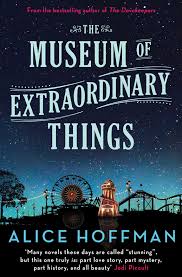
The Museum of Extraordinary Things by Alice Hoffman (Simon & Schuster)

museumofxtraordinarythings

“You would think it would be impossible to find anything new in the world, creatures no man has seen before, one-of-a-kind oddities in which nature has taken a backseat to the coursing pulse of the fantastical and the marvelous.”

STORY tellers, obviously enough, get better with each new work as they evolve their skills, but publishing being publishing there always seems a bias towards the new. I picked this up thinking Alice Hoffman was one such newbie but no it transpires this is her 23rd novel plus there are eight other titles for young adults and another non fiction. It shows. This is a writer at one with her craft. Notwithstanding, the very long list of thank yous at the back of the book also illustrate the kind of leverage needed these days to lift a novel up to mainstream attention.

Brooklyn or rather Coney Island is the real star here brought back to its noisiest, dirtiest, rowdiest clamour of 1911, an escape from New York to a seaside of fixers, crooks, conmen, liverymen- deliverymen, circus performers and the freak show of the title. The descriptions are thick and taut to the point that the history wraps itself like a big rug around a plot that snaps to a lion tamer’s whip. Which is it? Fact or fiction? (I had to check with Wikipedia to see if Professor Sardie was actually mentioned or no). The story moves through this grand garrulous setting like our heroine swimming through the waves of the Hudson river.

Hoffman reveals in her notes that her grandfathers both lived here at the time and she also drew on recorded texts. She weaves layers of fiction through the backdrop, of love, of desperation, of curiosity, of detective mystery, of murder, of that old waterfront gangster politic of rich and poor.

The narrative has dual first persons, one for each of her central characters as their worlds collide. She is the daughter of the mad museum collector, curator of the exotic, creator of the woman-sawn-in-half act, Mr Freak’s freaks. He is the handsome Jewish immigrant who disowns his past, his father, his honesty. The Jewishness is cleverly played out in placard imagery that duck the usual cliches or at least throw them back in unexpected relief. She seeks salvation in swimming, he in photography (although I might quibble at how many plate images a 1911 news photographer would have been able to shoot at a time, but I cripe).

It is a clockwork menagerie of the kind that Coney Island might, surely would, have had that swirls to its monstrous, incendiary conclusions. Each bit part player is drawn so precisely you can imagine seeing them painted on the side of the medicine show wagon. More than a few are novellas in their own right.

The mix is as extravagant as some of the characters which might just say that we are all sideshow freaks in our own ways.

Curiously for all the thank yous, I doubt the veracity of the original covers. My edition is the one at the top of the page which seems very much in keeping where this was the version in greater circulation…

xtraordinarythingswhile this one appears on Hoffman’s  web site…MuseumofExtraordinaryThings-TP-cvr-thumb and feels remarkably similar to her well reviewed 2012 DovekeepersDovekeepers-paperback-thumbYes, it is the story of a girl with long hair, but it is a lot more than that. At first I did not think this could be a movie, but on reflection it would make fabulous filming.

Posted in 101greatreads, fiction | Tagged , , , , , | Leave a comment

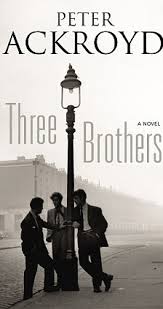
Three Brothers by Peter Ackroyd (Vintage)

3 brothers

“In the London borough of Camden, in the middle of the last century, there lived three brothers…” 

HISTORIANS should always write at least one novel set in their own era. They have the training for detail to record the now.

And this being Peter Ackryod, biographer of London, of the Tudors, of Dan Leno and Limehouse, of Chaucer and Blake, you might want his fiction to be based on a true story but it quickly becomes apparent that is pretty unlikely. Brothers is a crimo. You can feel the similarities with the London racketeer Peter Rachman – which would be a good plot, but here is just so much London pea soup.

Ackroyd shuffles around Camden Town like it is his own backyard, which it probably is. The 1950s and 1960s are also his time – he was born in 1949. He traces the fates of three young brothers for whom the usual clichés of the 1960s have not materialised. One character even asks what does it matter if he is living in the 1960s?

The detail as you might expect is excellent. This is a repressed, post war, bombed out, rent, in both senses, London. Notting Hill is in a state of “decay and dilapidation”. Even the writing style is of the period, a style since taken over by TV and soap operas. Without being an overt application for a TV series, it is at heart desperate to be TV and very good it might be too with its sinister, dark edges of crime, of poverty, of pre-Murdoch newspapers, university dandies and the mad or evangelist brother.

You smell the era in: “Wilkin lived with his wife Phyllis, a middle aged philologist, in a semi detached house close to the railway station. They had two Persian cats, and the house smelled of damp and pet food…Mrs W served him small portions of unappetising food”. You yearn to see her grimacing as she proffers a meat pie.

Every now and then you get flashes like: “You look like a frowning soup plate” or this historical research inside a handbag: “It was a capricious handbag, wrought out of leather dyed purple and with an interior lining of green silk. It smelled of mints and nail varnish and it contained many half empty packets of nuts and sweets as well as bus tickets, paper handkerchiefs and assorted items of cosmetics.”

There is an interesting juxtaposition here of skills, the historian, the period piece, a backdrop, some 1960s satire. The historian Ackroyd decants his plot abruptly between events. Coincidence and random events shatter the brothers lives. Some of them quite unbelievable. Even if he had of laid the groundwork. The coincidences of living in the London villages in the period may well have been a feature of communities then but now seem very distant, even more impossible.

Novelists work with emotions and motivations, the depth of the subjective which is not an option for an academic trapped within a discipline of facts and proof.

In even the most elemental of the detectos-with-a-gun sagas you know the narrator’s response. A waitress comes over and you know he will he jump her, or shoot her, or order eggs and coffee and say thanks and go home to his disabled wife. It must be one or the other, otherwise there would be no waitress. With Ackroyd’s large cast you are not so sure, which is a mistake. The more so, when he avoids the kinds of confrontations that perhaps a woman dramatist might relish.

Eventually all this catches up with him and he has to hack and swipe his way out of his own battlefields until he reaches a finale that he probably would not have wanted to arrive at from where he started.

Posted in Biography, fiction | Tagged , , , | Leave a comment

Curious Incident of the Dog in the Night-Time by Mark Haddon (Vintage)


curious-incident-of-dog2“It was 7 minutes after midnight. The dog was lying on the grass in the middle of the lawn in front of Mrs Shear’s house.”

On first reading of Mark Haddon’s Curious Incident of the Dog in the Night-Time you might not expect this teenage monologue to transfer to stage or even screen. But the National Theatre’s clever production has been playing to packed houses. The trick is that the stage becomes the Condition, the box that contains. Haddon has disowned the notion that Curious is specifically about asperger’s (itself now also downgraded to part of the wider autism family) even though the original jacket copy said as much. He  says it is about being an outsider, or in the theatre version an insider.

Equally I am not convinced about its classification as either children’s literature or even young adult. The angst is outside and grown-up. The style is false naive, a bit tamagochi even, but the issues are not the stuff of children’s literature anymore than if Snow White had been schizophrenic.

In the book the adults are shadows, but on stage the actors change the dynamic so the drama and tragedy is as much about them, implications become reality. Christopher, as he says, does not really care about other people anyway, his predicament is a separate dimension, as is his redeeming enthusiasm for mathematics.

It is a tribute to the original that the script so closely follows the narration. A person telling their own story on the page is allowed a certain narcissistic subjectivity. It is Christopher’s story. He has no problems apart from adults and people. All things are permissible. On stage subjectivity becomes objectified. He becomes the problem. The audience engages with everyone else’s issues. The stage teases out adult sensibilities, the dilemmas of the parents and teachers. Christopher’s modern odyssey from Swindon to London and back again ceases to be his exciting adventure and becomes everyone else’s nightmare, a child is lost, an image sweetly reflected when his pet rat makes a run for it in the tube, a good joke in the book but a bit over-excised on stage.

The plot reads like a children’s story. Troubled teenager discovers neighbour’s toy poodle killed by garden fork on the lawn. Whodunnit? “This is a murder mystery novel,” Christopher tells us, with some determination and relish.

The sharp writing, the intelligence, the unsentimental commentary, the vision set it apart where other imitators in the genre have been more blurred. The dialogue between author and reader is a clean shared crystal. Precise, curt, sharp not dissimilar to other fine first person approaches, J. D. Salinger’s Catcher in the Rye –  “all that Copperfield stuff “ –  or Kurt Vonnegut’s Slaughter House 5 – “All this happened, more or less”.

Christopher in the book has his chance to share his enthusiasm for maths including his little gimmick of not numbering the chapters sequentially but as prime numbers. There is a good maths joke on stage too. But it is not quite as intimate. The book befriends you, in a way the stage cannot.


Posted in 101greatreads, Biography, fiction | Tagged , , , , , | Leave a comment

Sapiens, a brief history of humankind by Yuval Noah Harari (Harvill Secker)

sapiens

“About 13.3 billion years ago, matter, energy, time and space came into being in what is known as the Big Bang.”

YOU will like this one. It is about you. Us. The master species. The wise ones.  Dr Harari’s middle name is Noah which is sort of appropriate. Albeit, his idea of brief is 70,000 years. And you might not appreciate his characterisation of us as mass killers…

Harari writes cleanly without adjectives. He draws comfortably on a large reading across different academic disciplines from physics to biology to anthropology and more.  His history is not history as in what date did king Alfred burn the cakes. It is the line between history and biology or what is it that made us such a force on the planet. Our intellect? Luck? Religion? Instinct? Our hormones? He works his way through the usual suspects shuffling them between references and scrubbing around the scrolls for data or even evidence. But history as he points out is “something that very few people have been doing while everyone else was ploughing fields and carrying water buckets”. Harari is one of the very few, a learned agnostic set apart from the struggles of the world.

Early on, he makes a couple of fascinating assertions that underpin a vision. The first is that it was homo sapiens ability to imagine fictions that helped us assert ourselves. Where other species think literally – a tree is a tree – sapiens imagined chopping it down and floating it down river. Imagined a god living nearby. And later we could imagine whole civilisations, as we have. And as he points out some of the familiar modern edifices are really not that tangible after all, just imagineering. “Myths, it transpired,  are stronger than anyone could have imagined“.

He also points out, interestingly,  that the optimum social grouping for sapiens is probably around 150, anymore than that and we struggle to maintain a sense of cohesive society. In a group that big we can gossip and bicker and politicise with our family,  friends and neighbours but any larger and we lose touch. It is an interesting number when you think about, say, school class sizes. One group of 150 people can relate to another group of 150 but each of us alone perhaps cannot do more. You can share beliefs but you don’t interact or not so well.

One of the key points in our early cognitive history is the ability to categorise and catalogue – without it we could not organise any form of structured progress. As you read, you may find that where you thought you were a liberal humanist, perhaps in fact you align closer to a Buddhist or even an evolutionary. History as he points out is not determinist, but capricious, swift, random. His not to argue why, just how.

He ends on a surprisingly positive, optimistic note (provided we don’t blow ourselves up) and then postulates: “The next stage of history will include…fundamental transformations in human consciousness and identity”. And  it is very nearly here already.


Posted in 101greatreads, Non fiction | Tagged , , , , | Leave a comment

The Buried Giant by Kazuo Ishiguro (Faber)

Buried Giant

“You would have searched a long time for the sort of winding lane or tranquil meadow for which England later became celebrated.”

We are in Shrek country. Frodo-land. There are ogres, sprites, curses. It is middle England, post Arthurian, pre millennium. Ishiguro laces his tale with ‘the mist of forgetfulness’ and the modern themes of Alzheimer’s, collective amnesias post despotic regimes, racism and even ageism. We know from his other writing, that he is playing with us…

His elderly couple set off on a journey to find their son not being completely sure they will even recognise him. But they have a quest in this strange unconstructed world of burrowed tunnels, of a handsome boatman, of mad, old and sometimes wise women…There is talk of dragons. And of love. Axl invariably talks to his wife as “princess”. Their dialogue is formally polite, from a time when talking or even just verbalising was more important. Ishiguro is Japanese (although he came to the UK when he was five but did not get a passport until he nearly 30) and this old England smells a bit oriental too. A bit Basho.

Their discourses fill in the pieces around a puzzle but soon other characters find their own voices too. These varying elements are  colourful jousting lances rammed through a plot of…well a dark ages road trip, not without a bit of Indiana Jones adventure somewhat heightened by the strange cast whose actions are hard to predict even for themselves which helps draw us deeper into their world.

There is a certain relaxation in wallowing around in all this warm bath of olde worlde fantasy. We are looking safely down the binoculars of our narrator’s history. I keep being reminded, quite randomly, that this was a time when England was as much a murderous mess as the Middle East or Africa seems now. Is that the point? An allegory…I won’t spoil it for you.

Posted in 101greatreads, fiction | Tagged , , | Leave a comment